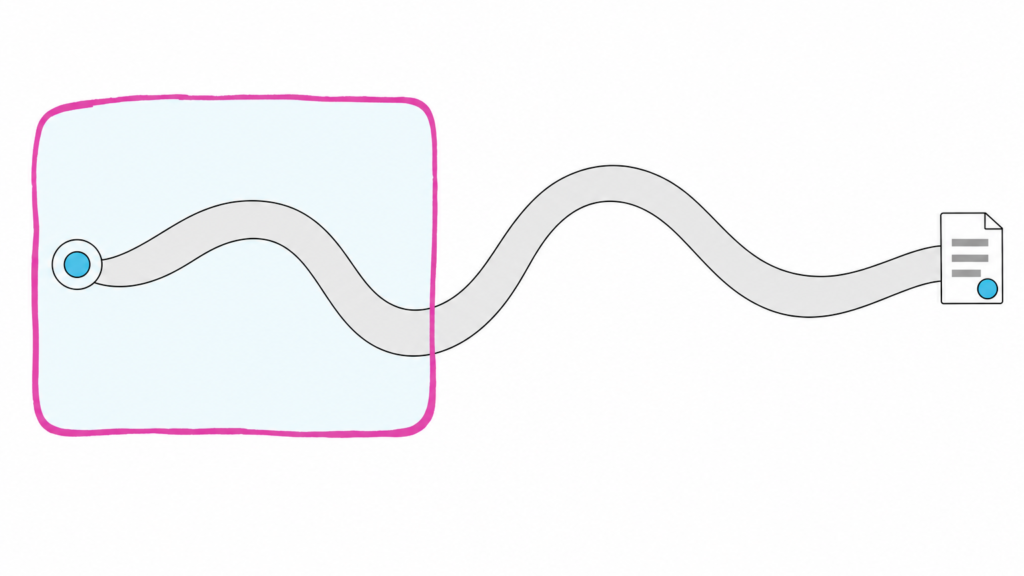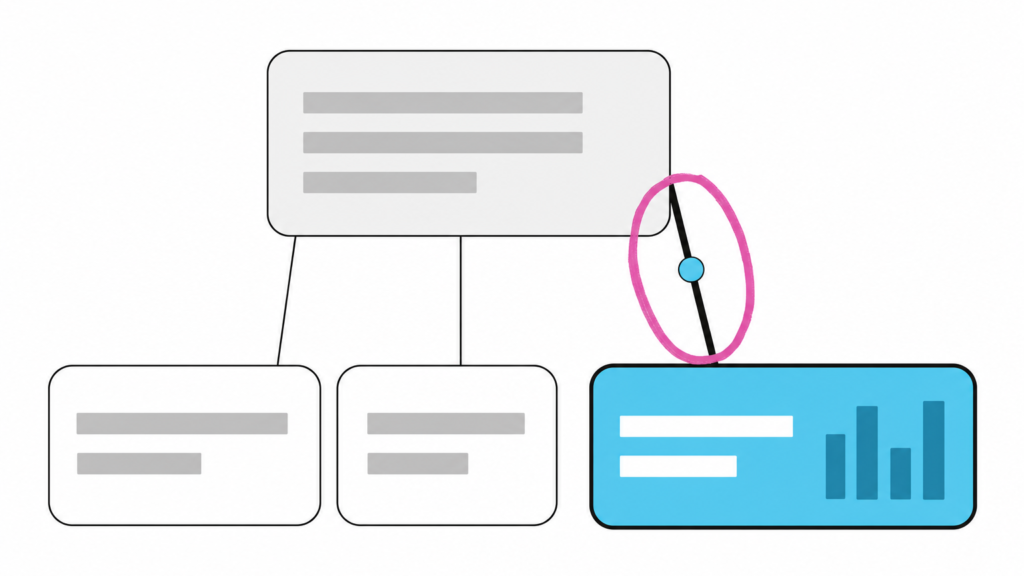
B2B PPC, or business-to-business pay per click, is paid search advertising aimed at small buying audiences with long sales cycles where a lead is closed by a sales team. B2B PPC lead generation works for companies whose gross margin and close rate can carry the cost of a click in their market, and it fails for those whose gross margin and close rate cannot, no matter how well the campaigns are built. The affordability test is the breakeven cost per lead, which multiplies average deal value by gross margin by lead-to-won rate, three numbers the ad platform never sees.
B2B PPC advice usually opens with campaign structure: keyword research, ad groups, bidding. Useful, eventually, but the wrong place to start, because none of it answers the question that decides whether the campaign is worth building in the first place: can this business afford what a lead actually costs on this channel.
That question gets settled before you turn the campaign on, with a bit of math that uses numbers the ad platform doesn’t have, long before three months of spend has produced any performance data to read.
Does PPC work for B2B?
People ask this as though it has an answer at the channel level, and it doesn’t. Paid search makes money for plenty of B2B companies and loses money for plenty of others, and what separates them usually comes down to whether the business can pay what a lead costs in its own auction and still clear a profit on the deal, which has very little to do with the quality of the campaign.
So the honest answer is yes, B2B PPC works, for businesses whose margin and close rate can carry the cost of a click in their category. Some fail that test. A company with thin margins selling a modest contract into a category where well funded competitors are bidding hard can run a technically excellent account and still lose money on every deal it wins, and optimization won’t rescue it, because the problem isn’t in the account.
The useful version of the question is narrower. Does pay per click work for us, at our margin, at our close rate, at the cost per click our terms actually go for. That one has an answer you can get most of the way to before spending anything.
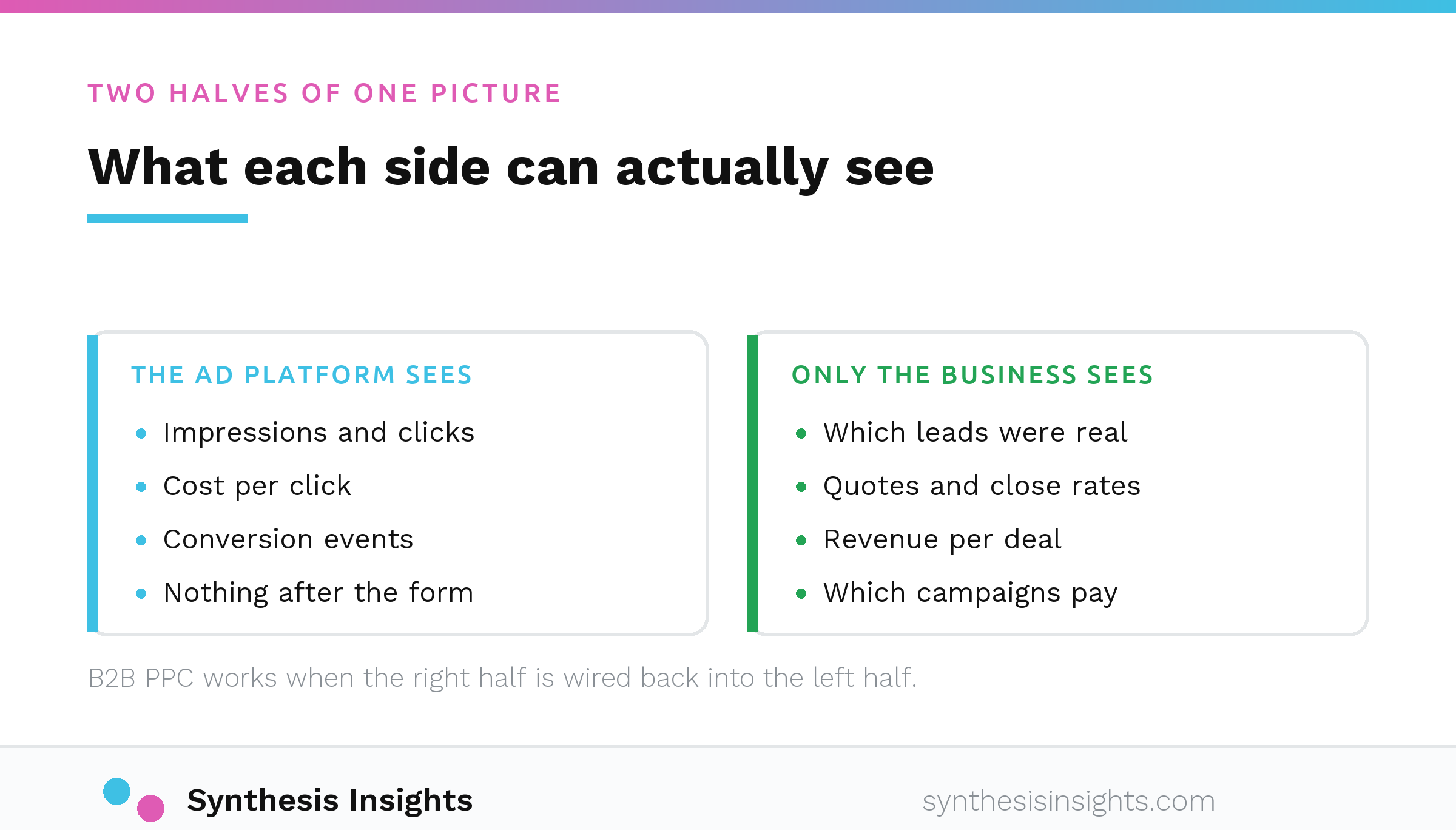
B2B PPC advertising platforms never know if a lead is worth the click
Google Ads and Microsoft Ads will hand you a cost per click, a cost per conversion, and a dashboard full of green arrows. None of that tells you whether the leads you’re buying are worth what you’re paying for them, for one structural reason: the platform doesn’t know your margin.
A “conversion” in Google Ads is an event, a form submitted, a call connected, sometimes just a page loaded. Google’s own definition is candid about what it is for: “A conversion is an action used to measure the performance of your ad campaigns and optimize your bidding strategy.” That is a bidding instrument, not a statement about your business. The platform can count the event accurately and still tell you nothing about whether it makes you money, because it has no idea what your product costs to deliver, what share of leads your sales team closes, or what a closed deal is worth after cost of goods. Those three numbers live in your business, so affordability math has to run there.
That’s separate from the more familiar problem of platform conversion counts drifting from what your CRM shows. Worth checking too, but even a perfectly accurate count can’t tell you what you can afford to pay for it.
The number you actually need: breakeven cost per lead
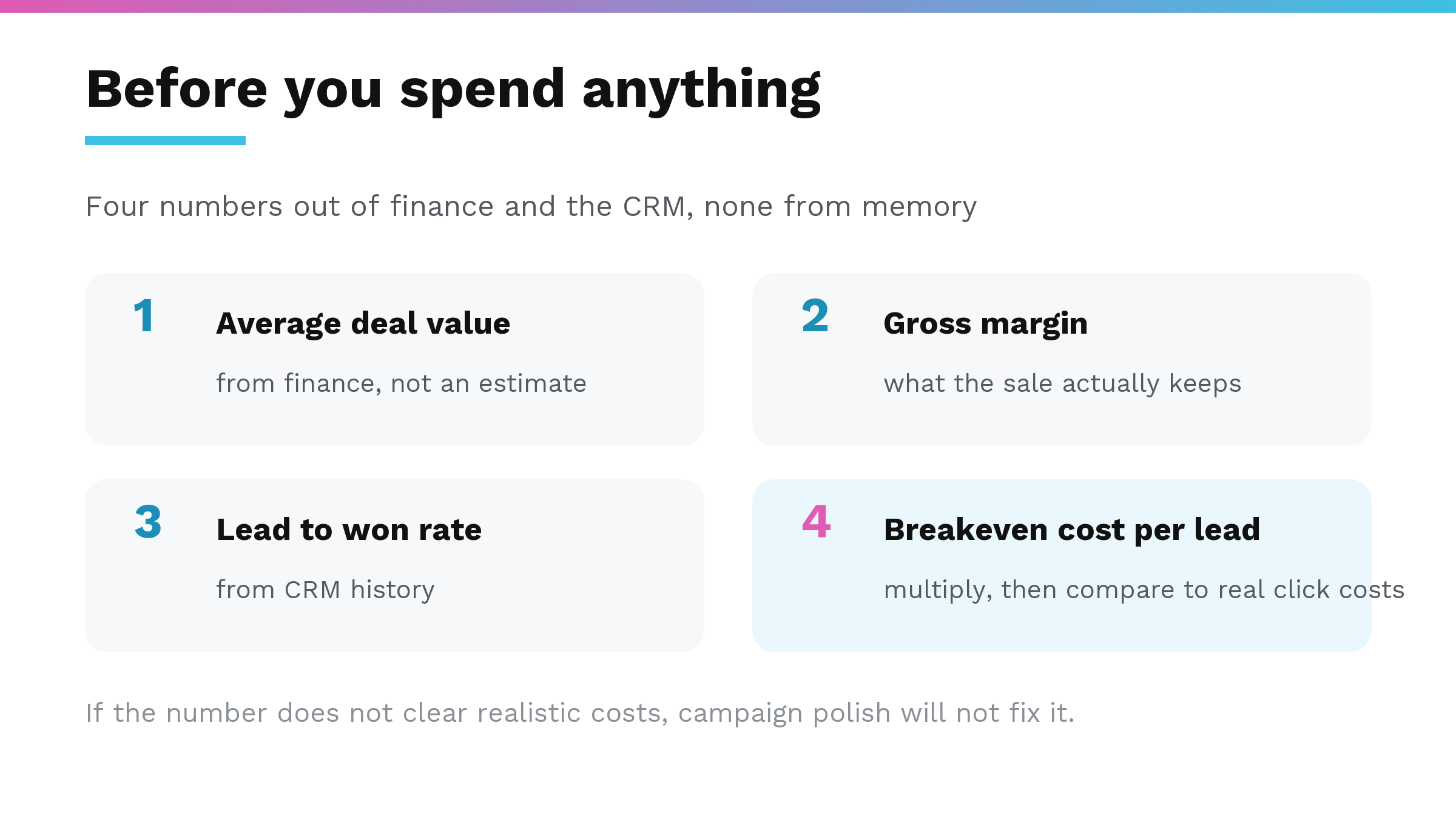
The number that matters is the most you can pay for a lead before the campaign stops making money, before overhead, before anything else. Call it breakeven CPL. It has three inputs, all of which should come from your own sales and finance data:
- Average deal value. What a typical won customer is worth, in revenue.
- Gross margin. What share of that revenue is actually profit before overhead, after the direct cost of delivering the product or service.
- Lead-to-won rate. Out of every lead your campaign generates, what share your sales process actually closes.
Multiply the three together and you get the gross profit a typical lead is worth, on average:
Breakeven CPL = average deal value x gross margin x lead-to-won rate
The logic: gross margin times deal value gives you the profit on one won deal, and the lead-to-won rate tells you how many leads it takes on average to produce one. Spread that profit across that many leads and you get the most a single lead can cost while the math still breaks even.
An illustrative example, with round numbers chosen to show the method rather than any real account’s figures: a manufacturer selling equipment through a direct sales team, average deal value $10,000, gross margin 35%, lead-to-won rate 8%.
Gross profit per deal: $10,000 x 35% = $3,500. Breakeven CPL: $3,500 x 8% = $280.
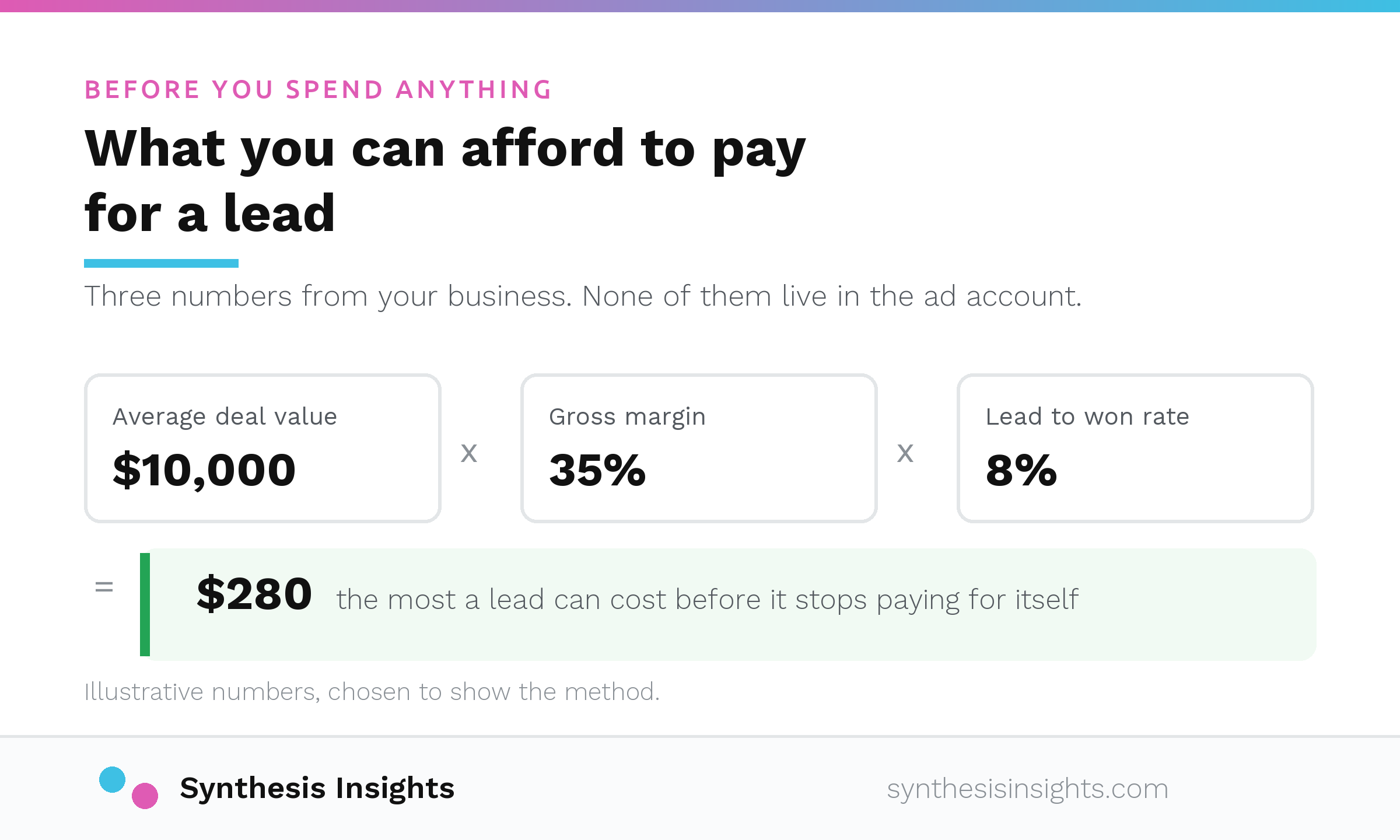
At $280 per lead, this business breaks even before counting overhead, sales salaries, or anything else the deal has to cover beyond direct cost of goods. That’s a ceiling, not a target. In practice I treat breakeven as the line you build a real safety margin under, because overhead has to come from somewhere and every one of those three inputs is an estimate with error built in. How far under the ceiling to set the target is a judgment call specific to the business, and there is no fixed formula for it.
You’ll also see a rule of thumb that says budget some percentage of revenue for advertising. That’s a planning convenience for a finance meeting, and it can’t answer this question, because it never touches margin or close rate.
Run this before the campaign launches and every other decision, keyword bids, budget, which channel earns the next dollar, gets judged against a real number, and nobody has to fall back on a feeling about whether the cost per click “seems high.”
Don’t borrow the SaaS ratio for a one-time sale
A common shortcut is the 3:1 LTV to CAC ratio: lifetime value should run at least three times customer acquisition cost. It’s a real, well-established guideline, and worth naming its source directly. David Skok’s SaaS Metrics 2.0, the piece most citations trace back to, puts it this way: “The best SaaS businesses have a LTV to CAC ratio that is higher than 3, sometimes as high as 7 or 8.”
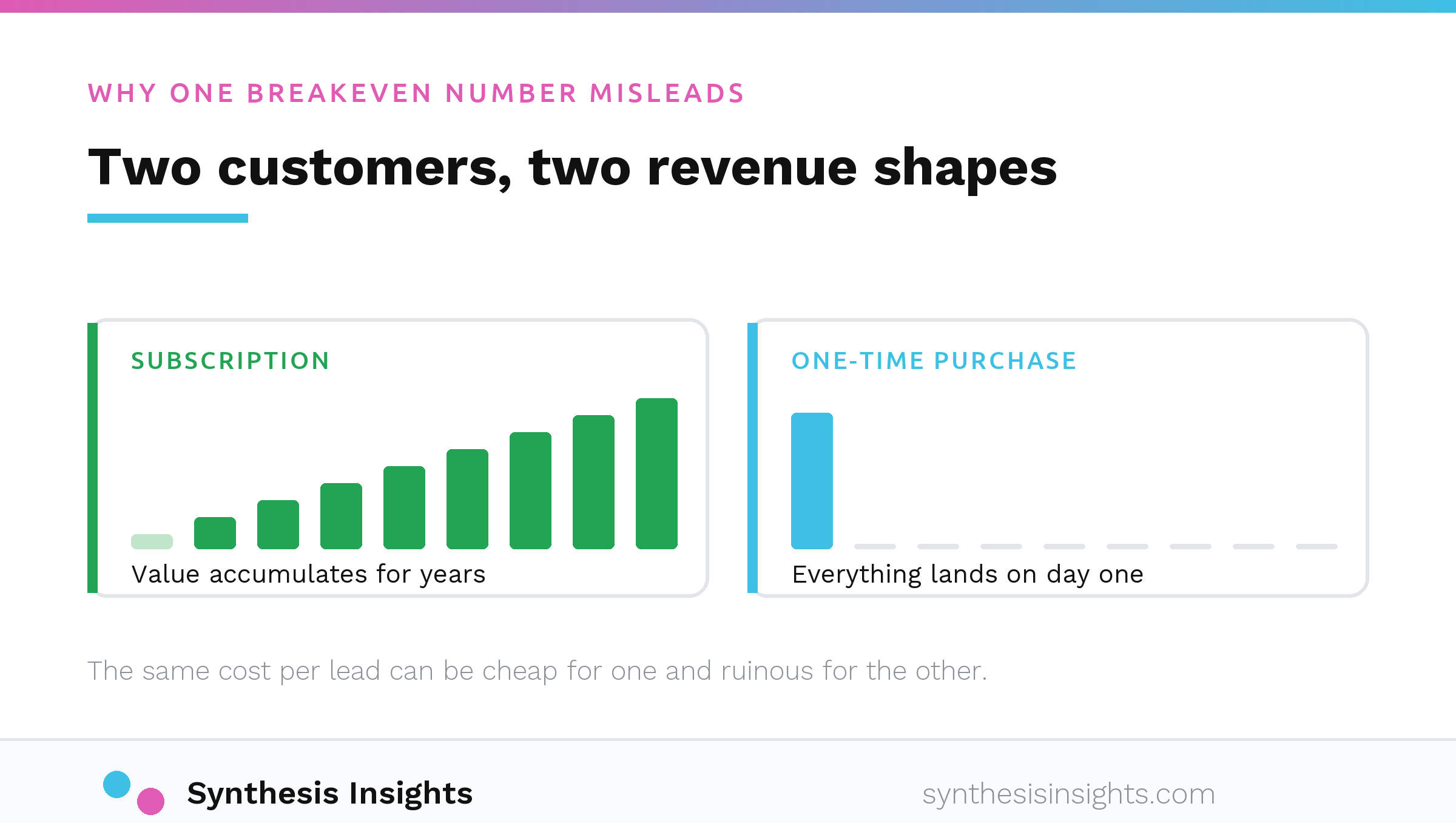
Read the source and the fit to most B2B lead generation gets shakier. Skok says so himself in the opening note, that although he focuses on SaaS the article applies to any subscription business. He is writing about recurring revenue, where a customer’s value compounds across years of renewals and the ratio measures whether that compounding clears the cost of acquiring it. A lot of B2B purchasing, industrial equipment, capital projects, anything sold as a one-time or infrequent purchase, has no such curve and no clean multi-year lifetime value to divide by three.
Importing a SaaS ratio into that kind of sale without adjustment is less an error than a mismatch, since it answers a question the business isn’t asking. The breakeven math above works for a one-time sale because all it needs is one deal’s margin, with no lifetime value curve involved. If real repeat business shows up later, treat it as upside worth measuring separately and keep it out of the original budget assumption.
What a B2B PPC strategy looks like once the math clears
Everything above is the gate. Past it, a B2B PPC strategy is three decisions made in order, and the order matters more than any individual choice inside it.
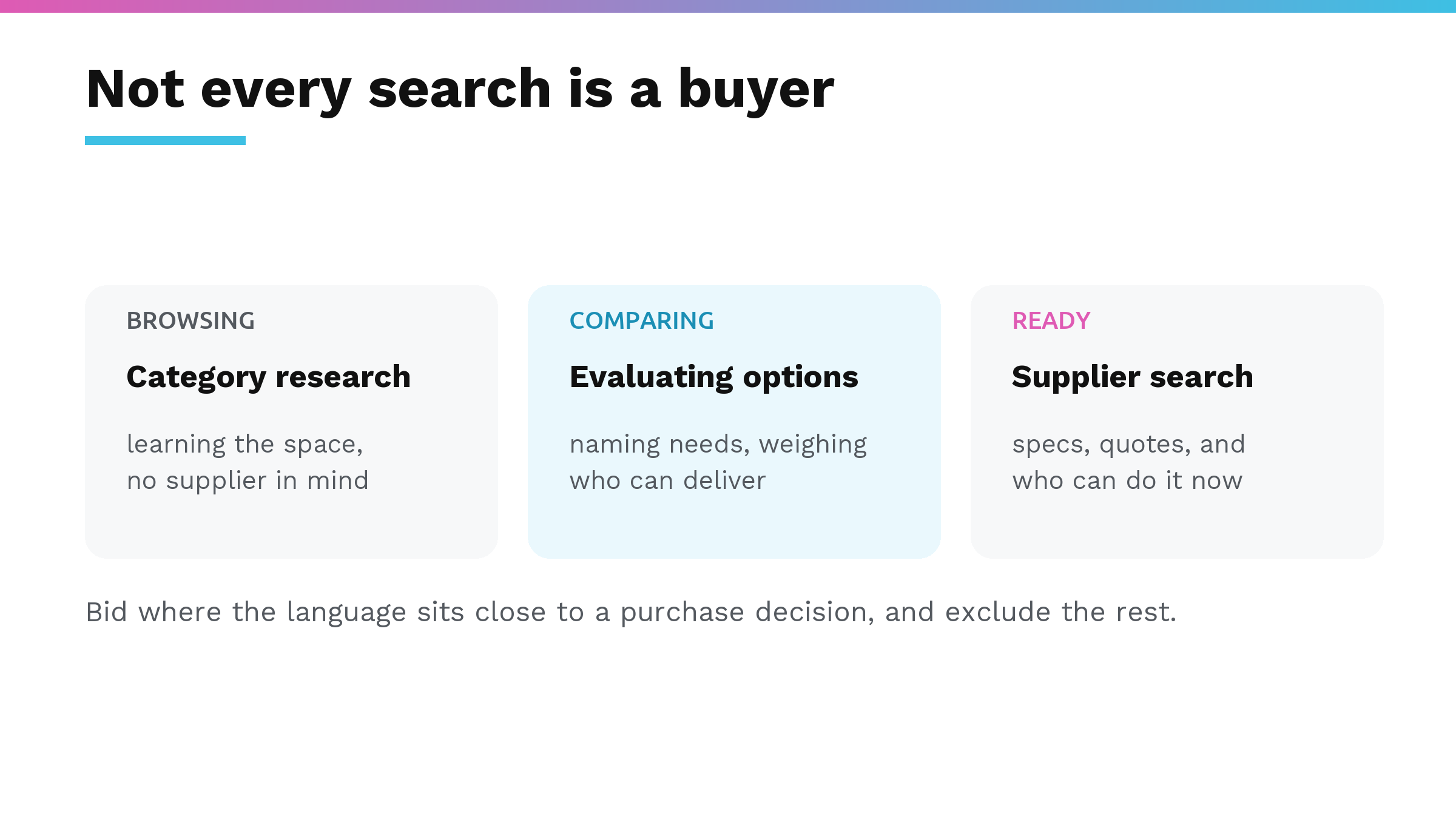
The first is which searches you’re willing to pay for. In B2B that’s a much shorter list than the keyword tool suggests, because a lot of the volume in any business category comes from other vendors, students, job hunters and people who read a term somewhere and wanted to know what it meant. The searches worth money are the ones where somebody is trying to buy or specify something, and they tend to be lower volume and more expensive per click than the broad category terms next to them.
The second is what those people land on. A search for a specific product shouldn’t arrive at a homepage. If the ad promises a spec sheet and the page opens with the company’s founding story, the click is already spent. Fixing what happens after the click is its own discipline; B2B conversion rate optimization is measured against what the CRM actually closes rather than raw form fills.
The third is what you count as a conversion, and this is where a lot of B2B accounts quietly go wrong. Whatever you count, the bidding system will get very good at producing more of it, including the versions that never turn into revenue. So it should be the thing closest to money you can measure reliably.
Bidding sits downstream of all three of those decisions, which is why an account with the wrong conversion definition can’t be fixed by changing its bid strategy.
What changes when you run PPC for manufacturers
Four facts about a manufacturing sale change the math, and most generic B2B advice sidesteps every one of them.
The lead often closes outside your system. When you sell through dealers and distributors, a click can become a sale that someone else’s paperwork records. A direct quote request you fulfill is worth a different amount than a qualified buyer handed to the nearest distributor, yet an agency optimizing to a single “lead” event bids the same on both. That means you can end up paying to compete with your own channel partners for the same search terms.
The buyer specifies rather than shops. The person on the other end of the click is often an engineer or purchasing agent pulling CAD files, spec sheets, and compliance data weeks or months before a purchase order exists. The searches are part numbers, dimensions, materials, and standards, not “best” anything. The click is early, the sales cycle runs a quarter or longer, and the payoff is a committee decision you won’t watch resolve inside a dashboard. To see how long your own conversions take to show up in Google Ads, and what the conversion window does to the slow ones, start with the Google Ads conversion window for long sales cycles.
Most conversions happen offline. The real conversion is a quote request, a spec sheet a rep follows up on, a phone call, or a trade-show contact that closes months later in the CRM. None of it is a tidy online form the ad platform can see. On one industrial account, we reclaimed 285 phone leads the platform had never tied to a source. That single change raised real paid-search lead volume by 14% without any extra spend. The leads were there the whole time; the tracking couldn’t see them.
The intent is a quote, not a demo. B2B SaaS PPC is built to book demos, and most agencies run it that way because most of their clients are SaaS. Manufacturing PPC is built to produce a quote request, a spec download, or a distributor match. That means a different call to action, a different landing page, and a different value per conversion.
If you sell a specified, considered product through a mix of direct and channel sales, this is the version of everything above that actually fits.
Which B2B PPC campaigns get the budget first
The largest share of a B2B paid search budget belongs to campaigns targeting buyer-intent search terms. These are queries where someone has already typed what they need, making them the only ad inventory where the query itself declares intent. A sound B2B keyword strategy starts by isolating those terms, because they are the closest thing to a hand raise you get in paid search.
Google defines Performance Max as “a goal-based campaign type that allows you to access all Google Ads inventory, including YouTube, Display, Search, Discover, Gmail, and Maps, from a single campaign.” For B2B lead generation, that breadth is a problem because it spreads budget across surfaces where industrial buying intent is sparse and optimizes toward whatever conversion action you set. If that conversion is a form fill sales later disqualifies, Performance Max amplifies the weak signal faster than a search campaign would. It can become useful once real qualified-lead outcomes feed back, but it is a poor first campaign for a small B2B budget that has not proven its breakeven cost per lead.
Remarketing lists for search ads let you “customize your Search campaign for people who have previously visited your site, and tailor your bids and ads to these visitors when they’re searching on Google and search partner sites.” Industrial buying cycles stretch over months, and the same engineer or procurement manager often runs the same search several times before making contact. A bid adjustment for past visitors makes you more visible when they return, costing less than acquiring that first click all over again.
Microsoft’s own documentation states that Microsoft Advertising “is the only advertising platform (other than LinkedIn) that allows you to target potential customers based on their LinkedIn profile information.” LinkedIn profile targeting in Microsoft Ads lets you target by company, industry, and job function. This maps directly to how B2B companies describe their own buyers, an unusual capability in paid search. The documentation also notes that “LinkedIn profile targeting will not narrow your ads’ audience.” In practice, that means it adjusts what you bid for someone who fits the profile, while everyone outside that profile still sees your ads.
Paid social and display reach people who haven’t searched for what you sell, so they’re held to the same breakeven cost per lead as search. Search has to be clean before a second channel is worth funding, and the cleaning work is negative keywords, the search terms you exclude so budget stops leaking onto queries that will never buy; learn how to find negative keywords. Once search runs against a known cost per qualified lead, another channel can be tested against the same ceiling.
The split of budget across B2B PPC campaigns follows from your breakeven cost per lead. A channel earns budget only by clearing that same cost-per-lead threshold that search must clear. If a campaign type cannot produce leads at or below that number, it gets no budget, regardless of how many impressions it promises.
How to structure B2B PPC campaigns
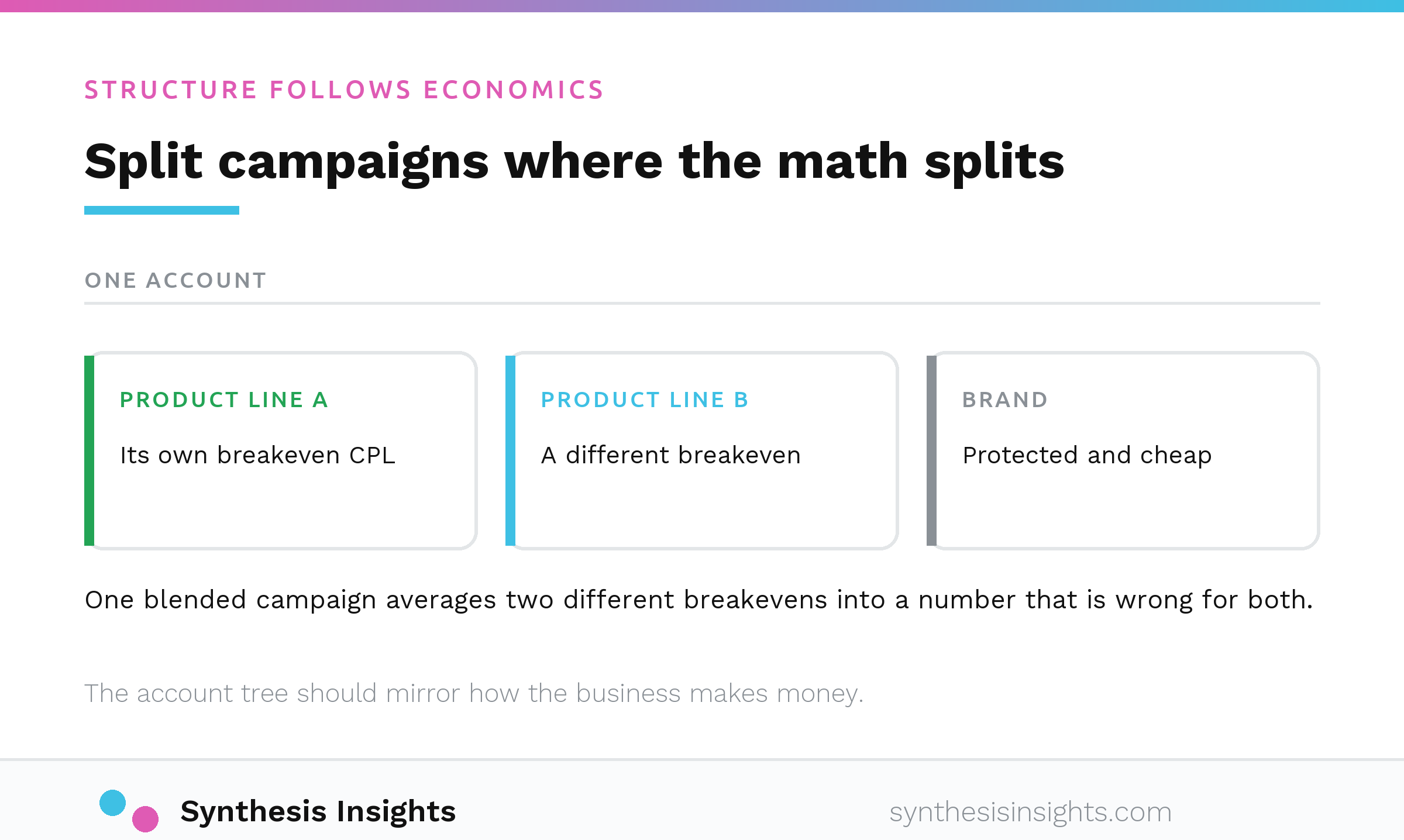
Campaign structure does one job that genuinely matters and several that mostly don’t. The one that matters is keeping different economics in separate containers.
If you sell two things with different deal values and close rates, they have different breakeven numbers, and putting them in one campaign under one budget means neither is judged against its own ceiling. The reporting averages them, the blended figure looks acceptable, and one half quietly subsidizes the other until somebody separates them. Split on economics first and worry about keyword tidiness second.
The same logic separates brand searches from everything else. People searching your company name close at a rate the rest of the account will never touch, because they decided before they typed. Leave them in with your product terms and the blended cost per lead looks good enough that nobody investigates the half that isn’t working.
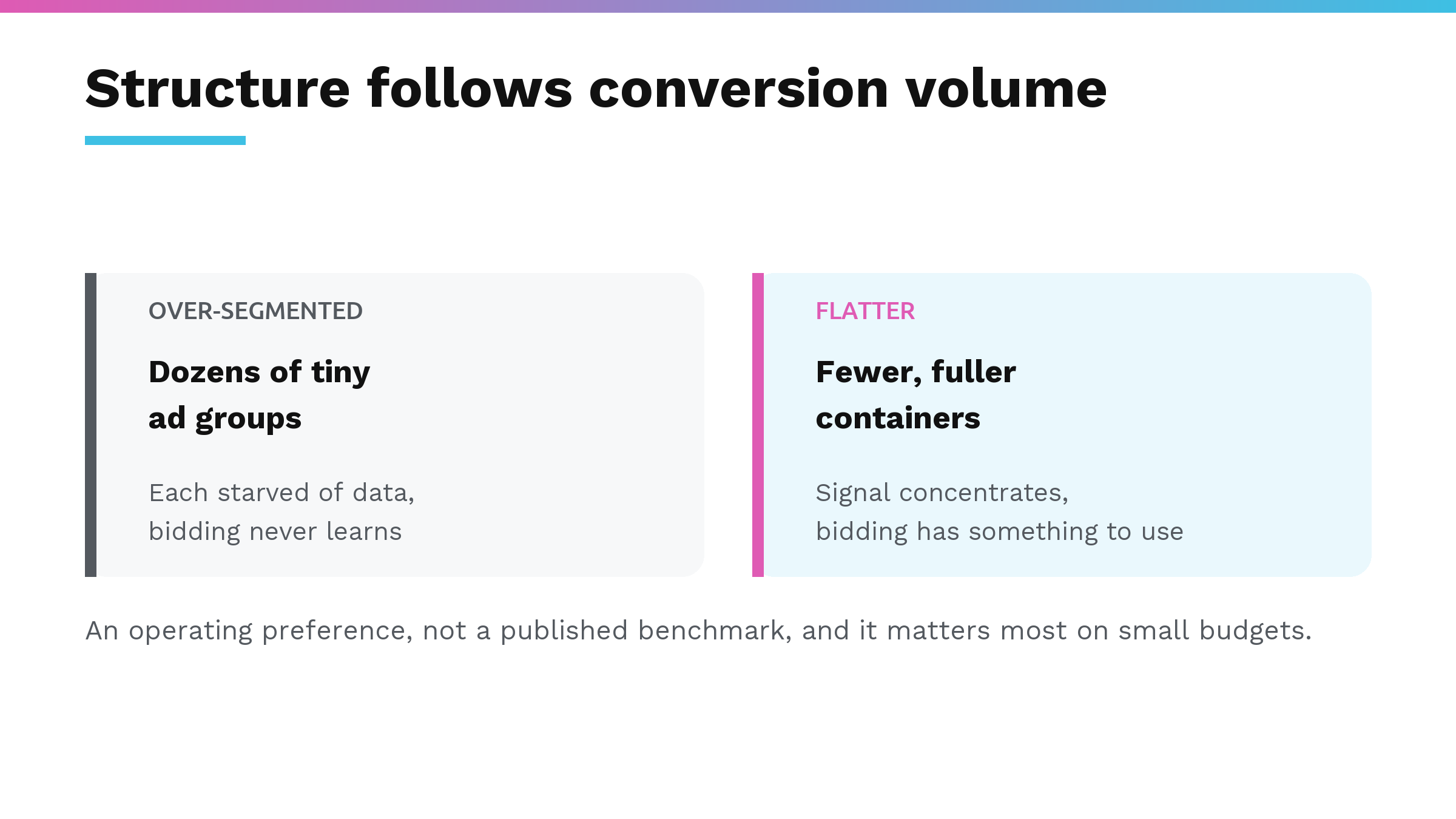
Beyond that I keep structures flatter than the older advice recommends. Automated bidding needs a reasonable volume of conversion data inside each bidding unit before it produces sensible bids, and slicing a modest budget across dozens of tiny ad groups starves all of them at once. I hold that as an operating preference with no published benchmark behind it, and it matters far more on small B2B budgets than on large consumer ones.
How do you actually generate B2B leads using PPC?
Generating leads means filtering for buyers, not chasing clicks. The mechanics are straightforward, but they only hold together when three pieces work as a single system: the keywords you target, the searches you exclude, and the feedback loop that tells the account what a real lead looks like.
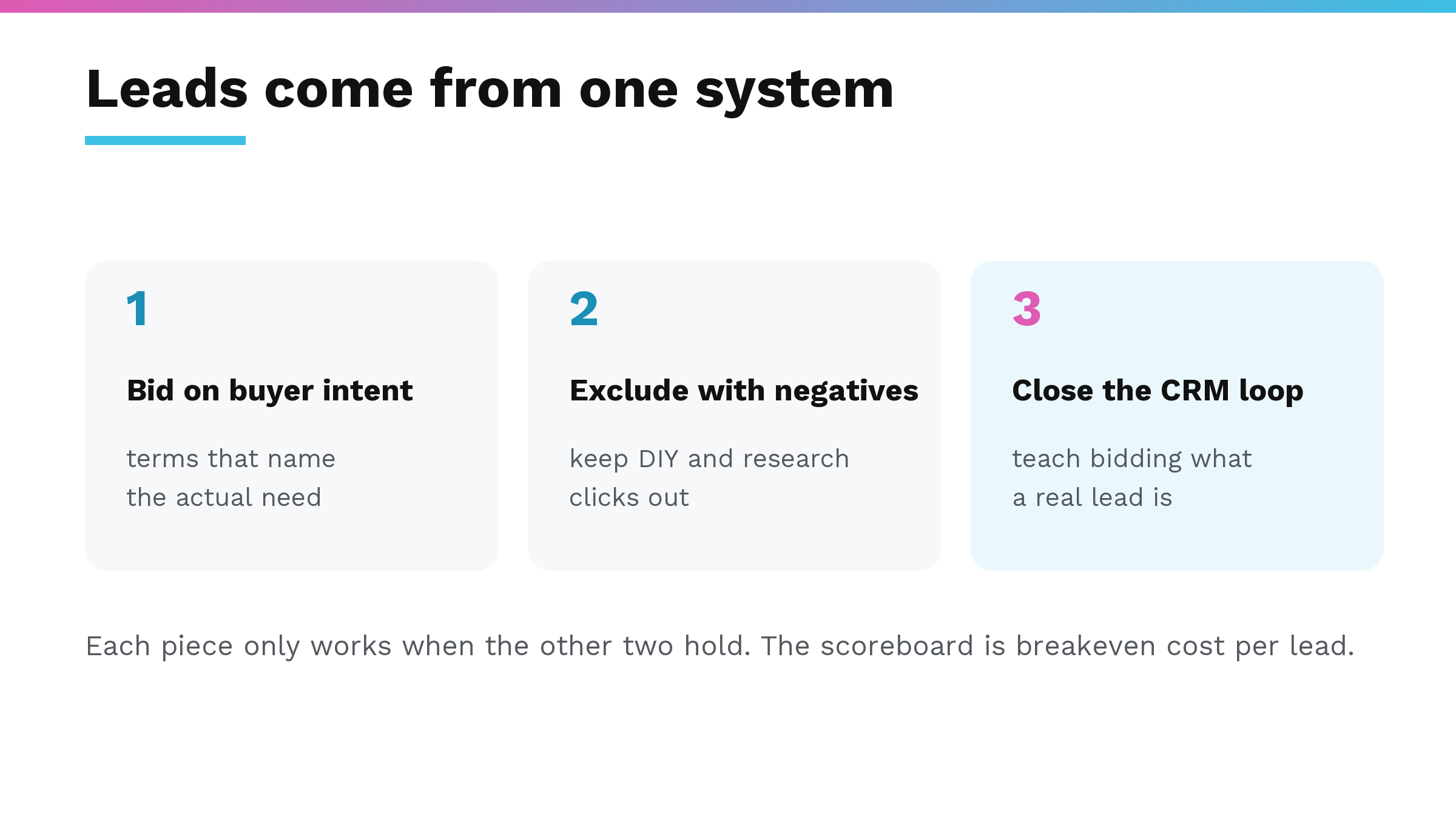
Start with intent. A buyer ready to evaluate suppliers searches differently than someone browsing category-level information. They name their actual need, compare options, and use language close to a purchase decision. Bid on those terms. In a PPC campaign, you want the person who already knows what problem they’re solving and is looking for a supplier who can solve it.
Then protect that intent with negative keywords, the search terms you explicitly exclude so your ads don’t show for them. Without negatives, a phrase like “custom metal fabrication” will match queries for DIY welding projects, salary surveys, or free CAD file downloads. Adding negatives steadily, and checking a term against real outcomes before you exclude it, keeps the account focused on the searches that actually convert. In B2B, where unqualified clicks are expensive, that focus is what gives automated bidding something worth optimizing toward.
The third piece is closing the loop to your CRM, the system where your sales team records actual outcomes. Platform-reported form submissions tell you someone downloaded a spec sheet, but they are silent on budget and buying intent. Offline conversion imports feed qualified lead data back into the account, teaching the algorithm to distinguish a form fill from a real sales opportunity. This is where flatter campaign structures become critical: when you concentrate conversion volume into fewer containers, each one gets enough signal for automated bidding to optimize for leads that actually enter your pipeline.
That brings everything back to your breakeven cost per lead. The number only means something when the thing you are counting as a lead matches what your pipeline can profitably close. If you’re importing qualified lead outcomes, you can measure cost per lead against the value of a real sales conversation. Until then, you’re optimizing for a proxy, and a proxy that costs more than it returns is just a fast way to burn through budget.
What B2B PPC management actually involves
Most descriptions of PPC management are a list of things to check weekly. The real job is narrower: keep the loop between the ad account and the sales outcome closed, because everything the account does automatically depends on what you feed it.
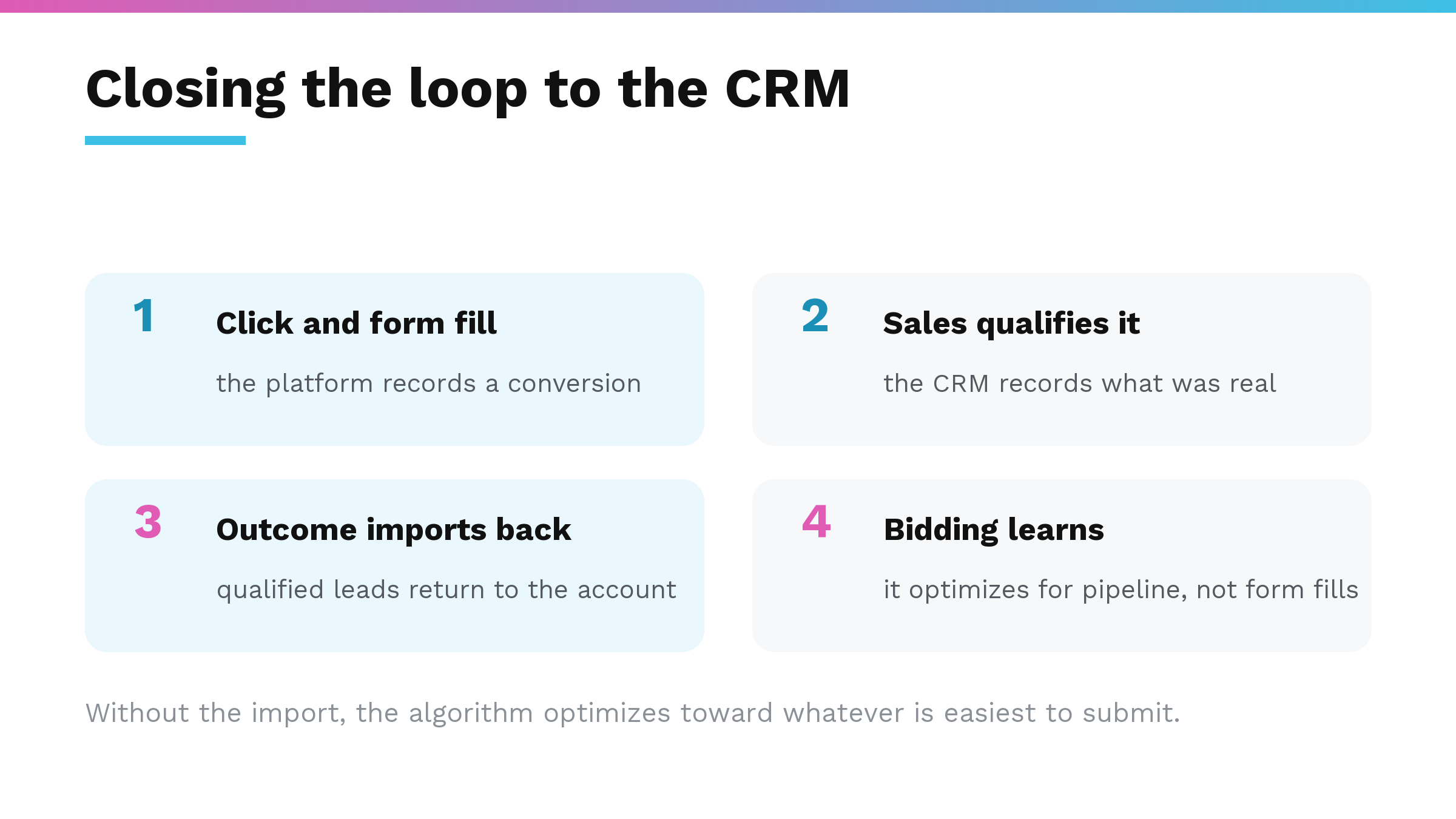
Google’s own documentation explains why. Its page on offline conversion imports puts it plainly: “Sometimes, an ad doesn’t lead directly to an online sale, but instead starts a customer down a path that ultimately leads to a sale in the offline world, such as at your office or over the phone.” Google also separates two outcomes worth sending back. A qualified lead is one “further qualified offline (outside of Google Ads) in your customer relations management (CRM) system,” and a converted lead is one that reached a chosen step further down the process. Sending both back gives the bidding system something to aim at that resembles your business.
Closing that loop is the largest single difference I see between accounts that work and accounts that only spend, and it’s most of what a B2B PPC agency should be doing after launch.
If an agency already manages your account, here is how to check who owns the Google Ads account and whether your company holds Admin access.
The rest of the job is keeping the three breakeven inputs current, because margin moves, deal values drift, and close rates change when the sales team does. Lead-to-won needs particular care in businesses with long cycles and infrequent, high-value purchases, the kind selling industrial equipment or water treatment systems. If a deal might not close for six months, measure the rate against a cohort of leads old enough to have had time to close, since last month’s leads are still working through the pipeline.
One tell worth knowing when you read anyone’s advice on this. Google’s help pages now call the extra pieces attached to an ad assets, “content pieces that make up your ad with useful business information.” Guidance still calling them ad extensions was written against an older interface, which usually means the rest of it is the same vintage.
The margin number I gave before I checked it
I’ve made the mistake this whole approach is meant to prevent. On a call with a platform account rep, asked for a client’s gross margin on the spot, I gave a round number off the top of my head. It sounded reasonable in the room. It wasn’t verified against anything, and later, when I checked it against what the client’s own finance data actually showed, it wasn’t the right number. Nothing broke because I caught it before it went into a budget recommendation, but the instinct that produced it in the first place, that a margin estimate is close enough to build on, is exactly the instinct this article argues against. A number that hasn’t been checked against the business’s own data is really just a placeholder wearing a number’s clothes.
Is B2B PPC affordable for your deal size and margins?
Pull your own average deal value, gross margin, and lead-to-won rate straight out of finance and CRM data, with nothing coming from memory. Multiply them into a breakeven CPL. Compare that to what leads actually cost in the platforms you’re considering, using typical cost per click for your terms as a starting estimate that nobody should treat as a promise. If the breakeven number comfortably clears realistic costs with room for overhead, B2B PPC is worth building properly: the search list, the landing pages, the campaign split, the conversion definition. If it doesn’t clear, no amount of campaign polish fixes an economics problem, and it’s worth knowing that before the spend rather than after.
If your breakeven cost per lead is lower than the click costs you see and you are unsure whether paid search can ever pay back, that is the exact conversation I start with, and it is the first thing we look at when B2B PPC management. Book an intro call and bring your average deal value, gross margin, and lead-to-won rate.
Related reading: How we work | Results
FAQ
Does PPC work for B2B?
PPC works for B2B companies whose margin and close rate can carry the cost of a click in their category. It fails for thin-margin businesses in auctions dominated by well-funded competitors, regardless of how well the campaign is run. The breakeven CPL math tells you which side your business lands on.
What is a good cost per lead for B2B PPC?
Breakeven CPL = average deal value × gross margin × lead-to-won rate. For example, a $10,000 deal, 35% margin, and 8% close rate produce a $280 ceiling, but that’s illustrative. A real campaign needs to pay well under that number to leave room for overhead and estimation error.
Is B2B PPC affordable for manufacturers with high-ticket sales?
High-ticket deals raise breakeven CPL because deal value is a multiplier. That can make a higher cost per click affordable if margin and close rate support it. Affordability is relative to your own numbers; there is no universal price that works for every manufacturer.
How do I know if PPC leads are actually worth what I’m paying?
Google Ads counts conversions as events (a form fill or phone call), not as profit. It doesn’t know your margin, close rate, or deal value. Compare your actual cost per lead to the gross profit your breakeven math says each lead generates.
Should B2B companies use the 3:1 LTV to CAC rule for PPC?
The 3:1 rule assumes recurring revenue that compounds over multiple years. Most industrial B2B purchases are one-time sales with no lifetime value curve, so the SaaS ratio answers the wrong question. Use breakeven CPL based on a single deal’s margin and close rate instead.