Google Ads call tracking counts five different things, and two of them count a click on a phone number instead of a phone call. If your account uses one of those methods, the Conversions column is telling you how many people reached for their phone, not how many people spoke to you, and every decision downstream inherits the error.
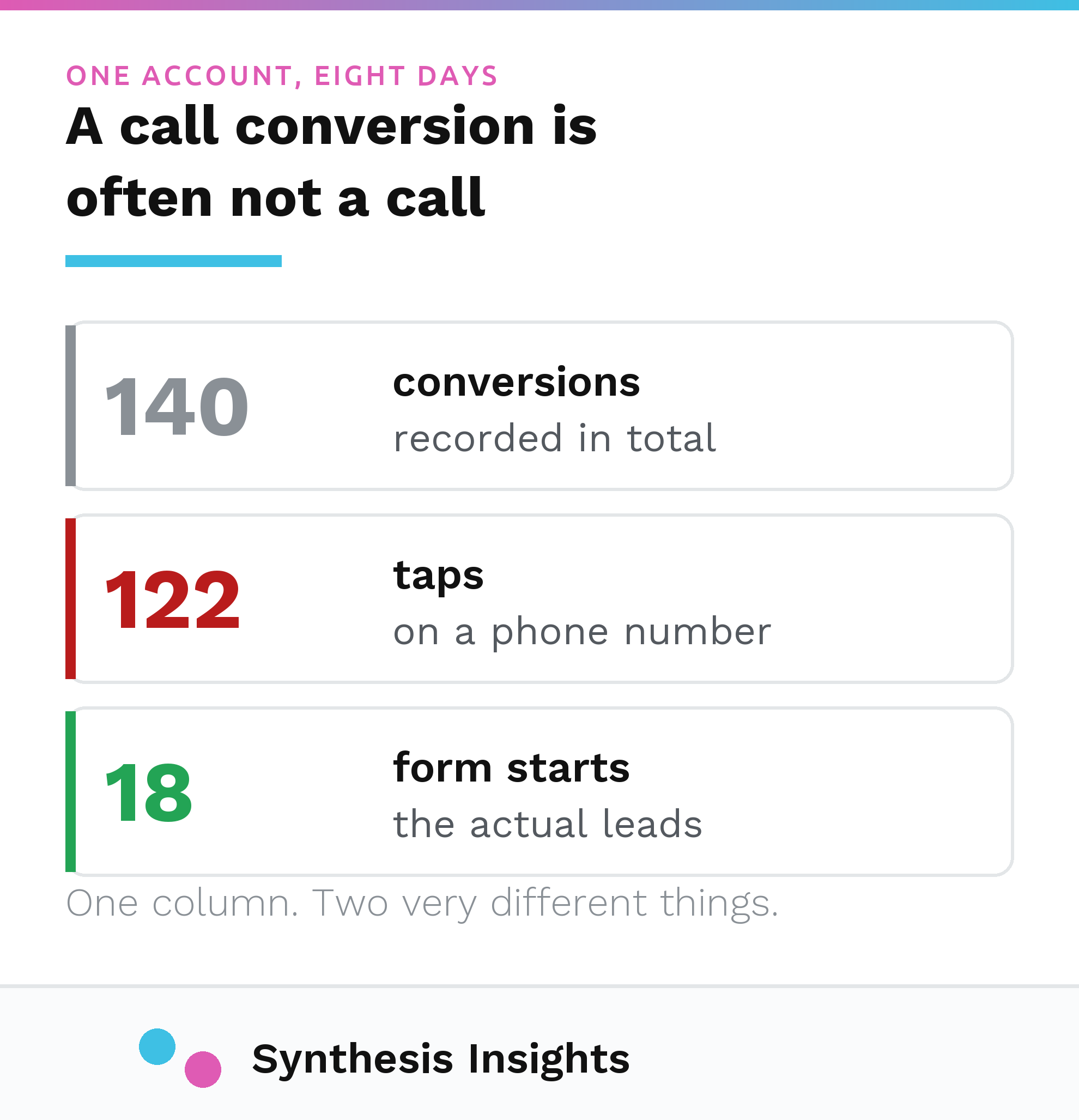
I found this on a live account last month. Over one eight-day window the account recorded 140 conversions. 122 of them came from an action that counts taps on a phone number. The remaining 18 were form submissions, and those were the only ones anybody in the business would have called a lead.
Nothing had been set up wrong. The action was created through Google's own workflow, it had been running for months, and it was quietly steering the bidding the entire time.
The five methods, and which ones measure a call
Google's help page on phone call conversion tracking lists five ways to count a call. They are not equivalent, and the page is direct about it.
| Method | What Google says it counts | Forwarding number |
|---|---|---|
| Calls from ads | "Track calls made directly from call-only ads, or call and location assets used in your ads. You set a minimum call length, and every call that lasts at least that long is counted as a conversion." | Required |
| Calls to a phone number on your website | "Track calls made when someone clicks on your ad, then calls the forwarding number we display on your website. You set a minimum call length, and every call that lasts at least that long is counted as a conversion." | Required |
| Clicks on a number on your mobile website | "In this case, we can only track these clicks, not the phone calls themselves." | Not used |
| Clicks on call ads and assets | "a click on call ad or asset counts as a conversion based on Google's estimation of whether a meaningful phone call occurred after a person clicked your ad." | Not used |
| Import call conversions | "Import call conversions that you track in another system into Google Ads. This method allows more control over which calls you count as conversions." | Required |
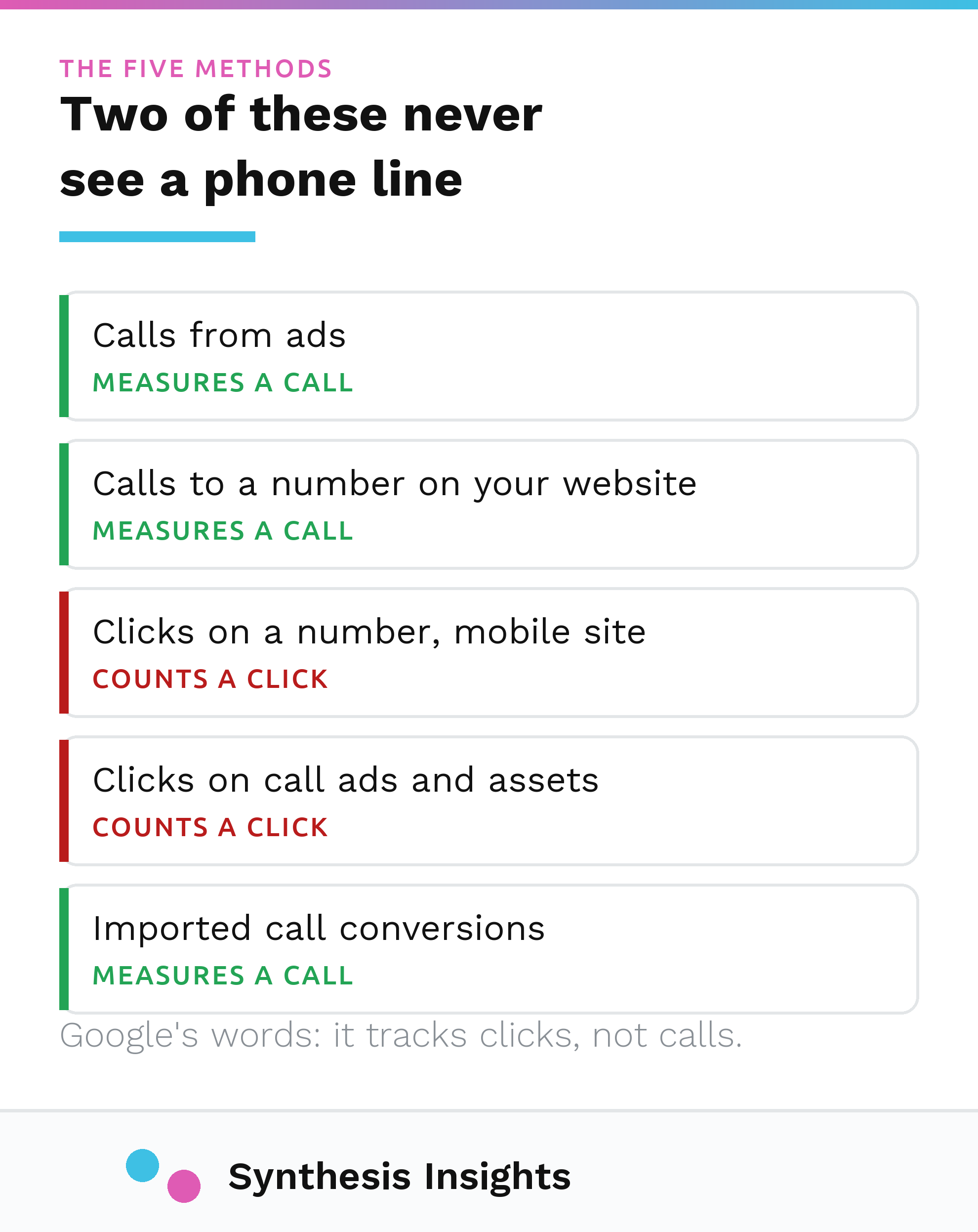
The first two and the last one measure something that happened on a phone line. The middle two do not. Google's setup page for phone number clicks puts it plainly: "Unlike other phone call conversion measurement, this feature only tracks clicks on your phone number, not actual phone calls."
That sentence is on Google's own help page and I have never met an advertiser who had read it.
What a tap actually is
A tap fires the moment somebody's finger lands on the number. It fires when they tap to read it and then close the dialer. It fires when the call rings out and nobody answers. It fires when they hang up two seconds in because they meant to tap the map. It fires twice when the first tap did not register.
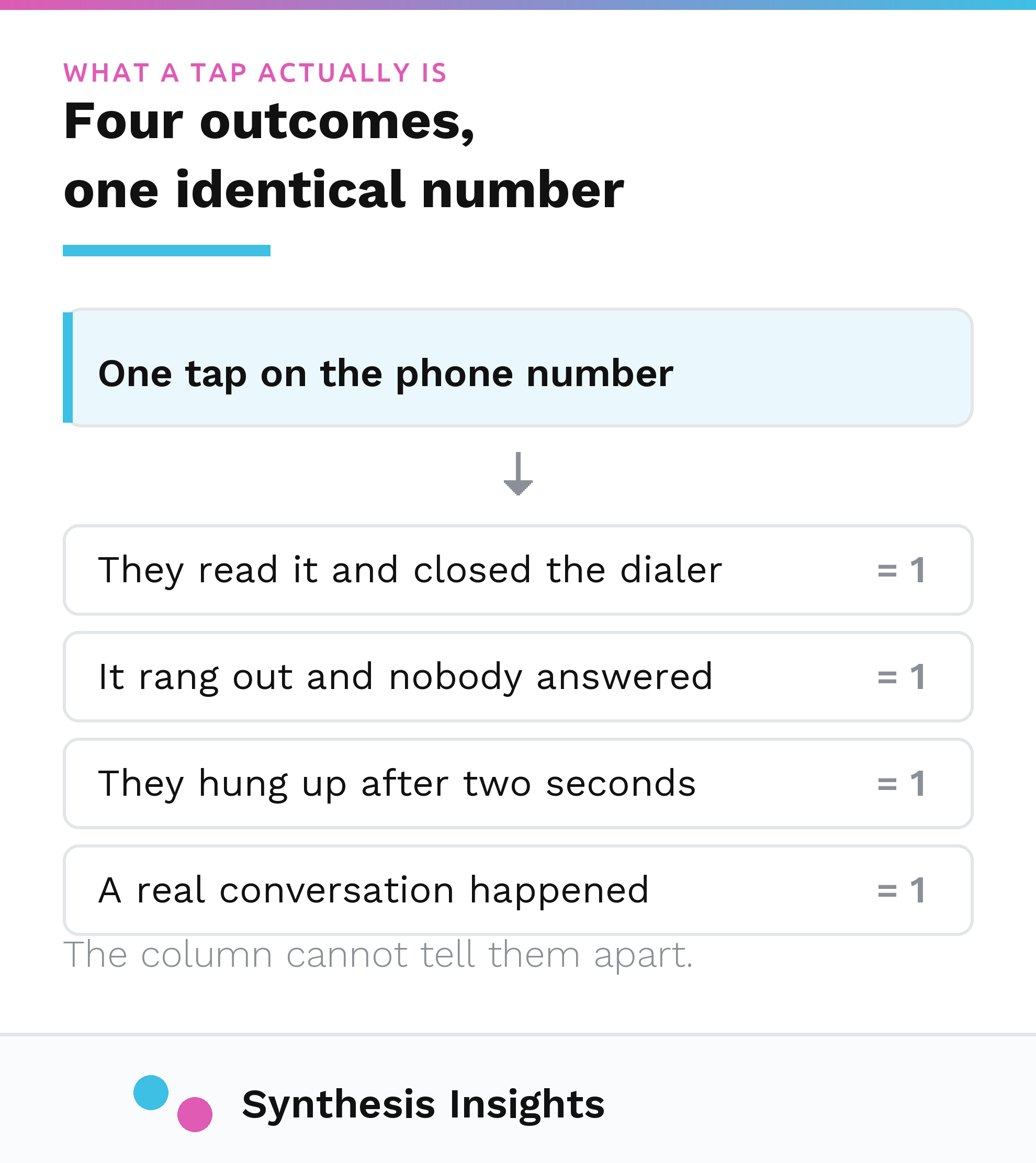
None of that is useless information. Somebody reaching for your phone number is a better signal than somebody bouncing off the page. It works reasonably well as a measure of interest and poorly as a measure of business, and the moment it sits in a column labelled Conversions it gets treated as business by everything downstream: your reporting, your search terms analysis, and your bidding.
What it did to one account
On the account I mentioned, the phone number sat on every page and the tap action counted every touch of it. 122 of 140 recorded conversions over eight days, or roughly 87%.
Two things were broken because of it, and neither was obvious from the surface numbers.
The search terms report was pointing the wrong way. Branded navigation queries, meaning people typing the organization's own name to find the phone number, looked like the strongest converting terms in the account. Of course they did. Somebody who already knows who you are goes straight for the number. Segment the tap action out and those same terms produced almost nothing. Every optimization decision built on that report was aimed at the wrong half of the account.
Smart Bidding was training on it. Automated bidding learns from whatever sits in the Conversions column, so the algorithm had spent months getting better at buying taps.
On that particular account the decision was to take the phone out of the funnel entirely, which is not the usual answer and I would not generalize it. Most businesses want the calls. What they need is a way of counting them that survives contact with reality.
Retiring the action is a bidding change, and nobody warns you
Here is the part that caught me out. When the tap action came off, the account's conversion volume dropped by roughly 87% overnight, because that is what the action had been contributing. The bid strategy kept behaving as though the old volume were still arriving.
That is the mechanic worth remembering. Adding or removing a conversion action changes the signal that automated bidding trains on, which makes it a good deal more consequential than housekeeping. Three rules I now follow:
- Do not retire a conversion action and change bid strategy, targets, or budget in the same window. You will not be able to tell which change did what.
- Let the new signal accumulate before you read performance again.
- Write down the date the clean window starts, because every window that straddles the change is contaminated and somebody six months from now will quote it.
What a Google forwarding number actually lets you monitor
This is the question people arrive at this page asking, usually word for word, and the answer is on Google's call reporting page. When call reporting is on, a Google forwarding number is assigned to your ad, and Google says it lets you "track details like call duration, call start time, caller phone number for calls over 15 seconds" and whether the call was connected.
Duration is the one that matters. It is the only item on that list that can separate a conversation from a wrong number, which is why the same page says: "You can count phone calls of a specified duration as conversions and use automated bidding strategies to increase the likelihood of conversions."
Google's own worked example on that page is a travel agent who reviews the data and finds that "calls lasting more than 2 minutes tend to lead to sales", then counts those as conversions. That is the whole method in one sentence, and the method is the part you should be taking away from it. Two minutes is right for a travel agent because a travel agent measured it.
One more line from that page that surprises people: "Google Ads doesn't charge advertisers for users who manually dial a Google forwarding number. Advertisers are only charged when the Google forwarding number shown in the ad is clicked on."
Getting a forwarding number onto your website
If your calls come from people who click an ad, land on your site, and then dial the number they see there, you need the number on the page to change for those visitors. Google calls this the phone snippet, and the plain description of what it does is on the setup page: "The phone snippet replaces a phone number on your website with a Google forwarding number."
Three things to get right:
The number has to match exactly. Google's instruction for the Tag Manager route is that "the phone number you enter needs to have the exact digits it has on your website." A script goes looking for that specific string. If your header writes it as (555) 123-4567 and your footer writes it as 555.123.4567, only one of them gets replaced.
Install it wherever the number appears. Google's guidance is to put the snippet on the site pages where your phone number shows up, not just the landing page.
Test it the way Google documents. Run a search that brings up your ad, click your own ad, and watch whether your number is replaced. You will be charged for that click. If you test repeatedly, delete the "gwcc" cookie from your browser between attempts, or the number you already fetched gets served back to you from cache. The #google-wcc-debug URL trick that the older version of this post recommended does not appear anywhere in Google's current documentation for this setup, so I would not rely on it as your only check.
Setting the duration threshold
Google now offers two ways to decide whether a call counted, and the calls-from-ads page spells out both: "by analyzing call recordings using Google's AI to identify high-quality leads, or by counting calls that last longer than a minimum duration you set."
There is a fallback chain behind that, and the last link is the one to pay attention to:
- If call recording is on, the recording is analyzed to determine lead quality.
- If recording is unavailable, Google falls back "to using your set call duration to measure the conversion."
- If duration is unavailable, meaning call reporting is off or no forwarding number could be assigned, "conversions will be classified based on ad interaction data."
In that third case nothing about the call itself has been measured, and Google is estimating from the ad interaction. It is a reasonable thing for Google to do and a bad thing for you to mistake for a call log.
Two limits worth knowing before you plan around any of this. Recording-based qualification "is currently limited to calls where both parties are in the U.S. or Canada", and forwarding numbers only work in the countries Google lists on the call reporting page, which is around thirty of them.
So for most accounts, the threshold is the lever. Do not take a number off a blog, including this one. Google names the report to use: "You can check actual call durations in the 'Call details' report in the Report Editor." Pull it over a period with real volume, mark which calls became a genuine conversation using your CRM or the person who answers the phone, and find the duration where those two groups separate. Set the threshold there and write down the reasoning, because a threshold you cannot defend ends up underneath every automated bid in the account.
And check what the threshold currently is before you assume. A minimum call length of zero or one second is a tap counter with better paperwork.
The default that installs itself
Worth knowing if you are about to go looking at your conversion actions and wondering where one of them came from. Google's calls-from-ads page states that "after you've enabled call reporting, new calls will be counted with the default conversion action 'Calls from ads'", and that this action "will be automatically included in your 'Conversions' column."
Turning on call reporting creates a biddable conversion action without asking you.
How to check your own account
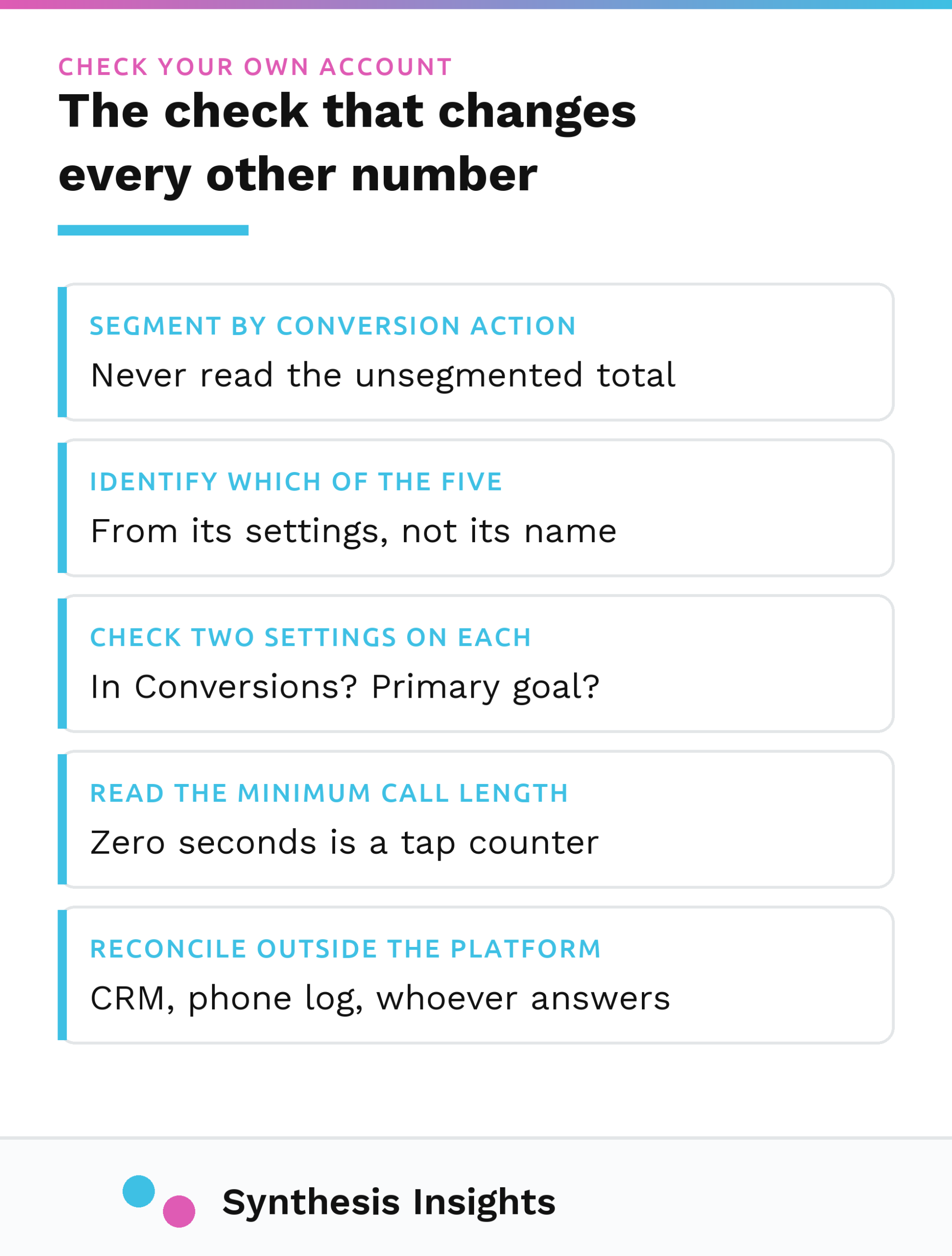
- Never read the unsegmented Conversions number. Segment by conversion action name and look at the actions individually. One contaminated action can carry the whole total, which is exactly what happened on the account above.
- Identify which of the five methods each phone action uses. Do this from the conversion action's own settings. The name was typed in by whoever set it up, so an action called "Phone Call" may well be counting taps and an action called "Click to Call" may well be a duration-gated call. The label tells you nothing.
- Read two settings on each action: whether it is included in the Conversions metric, and whether it is set as a primary goal. Both on means the action is steering your bids and any error in it is a money problem. Both off means it is reporting only, and a flawed action sitting there is untidy without being expensive. Knowing which of those you are looking at decides how urgent the fix is.
- For the duration-based actions, read the actual minimum call length. See above.
- Reconcile the count against something outside the platform. Your CRM, the phone system's own log, or the person who picks up. This is the step that gets skipped and it is the only one that can tell you whether a number is true, which is a different question from whether it looks significant.
On that last point: I once compared a full month of platform-reported conversions against the CRM for one account, campaign by campaign. The account total was within 5%, which is precisely why nobody had ever looked. Campaign by campaign, the platform was over by 57% on one and under by 43% on another. The errors ran in both directions, so there was no correction factor to apply. An account total that looks right is not evidence that any individual line in it is right.
A related habit that has saved me twice: pull the event data before you interpret the configuration. It is very easy to build a confident story about what a conversion "really is" from naming conventions, tag setups, and what you can see in the page source, and then be wrong. The direct data is usually queryable. Query it first, and then use the configuration to explain what the data already showed you.
What to do about it
Four options, in the order I would try them.
Measure the call rather than the tap. Switch to calls from ads or calls to a number on your website, both of which use a forwarding number and both of which let you set a minimum call length. This is the single change that turns the column into something you can defend.
Put a forwarding number on your site if a meaningful share of your calls come from people who visit before they dial. Without it, a website call is invisible to the platform no matter how good the rest of your setup is.
Import from your CRM if your CRM knows. Google's own framing for the import method is that it "allows more control over which calls you count as conversions. For example, you can choose to track calls as conversions only when they include sales." If you already know which calls become revenue, that is the highest-quality signal you can give the bidding, and duration thresholds drop back to being a fallback.
Keep the tap action, but demote it. Set it to secondary or observation-only so it keeps reporting and stops steering bids. That is the general principle I apply to every proxy action, whether it is a phone tap, a directions click, or a booking page view: bid on what you can verify happened, and report on the rest.
Honest limits
A few things this method cannot do, because pretending otherwise is how you end up defending a number you should not have quoted.
Duration is only ever a proxy. A three-minute call can be a supplier, a job applicant, or somebody who wanted to argue. A forty-second call can be a booked job from a repeat customer who knew exactly what they wanted. A duration threshold filters noise, and that is worth a lot, but it does not confirm an outcome. Only your CRM or the person who answered does that.
Geography constrains the whole approach. Forwarding numbers are country-limited and recording-based qualification is limited to the US and Canada, so an account running across regions will not measure calls the same way everywhere.
One account is one account. The 87% distortion above is something I observed on a single client account. The mechanism is documented by Google and applies everywhere; the size of the distortion on your account is yours to measure, and it may be nothing.
A tap is still real information. I am not arguing that phone number clicks should be deleted. Somebody reached for the phone, and that is a signal worth having in front of you. It just belongs in the reporting, well away from the column that trains your bidding.
About the name
A lot of people still search for AdWords call tracking, and that is the single biggest query bringing people to this page. Google renamed the product Google Ads on 27 June 2018, and the things that used to be called call extensions are now called call assets in Google's own documentation. The mechanics have not changed with the labels. If you arrived here looking for AdWords call tracking, you are in the right place.
Why this is worth twenty minutes
Most tracking problems announce themselves. A tag stops firing, the conversions go to zero, somebody notices. This one does the opposite. It produces a healthy-looking number that goes up when you spend more, which is exactly what a working account is supposed to look like, and it can run for years without anybody questioning it.
The real cost is everything built on top of that number: the search terms you optimized toward, the campaigns you funded, the bid strategy you trained, and the reports you sent to somebody who believed them.
If you have a phone number action in your Conversions column and you are not certain which of the five methods it uses, that is worth checking this week. And if you want a second pair of eyes on what is actually being counted in your account, book an intro call and we will go through the conversion actions together. Feeding those verified outcomes back into the platforms is the core of how we run PPC for B2B accounts.
Related reading: how to find negative keywords without cutting revenue, which covers the search terms report side of the same problem, and B2B PPC for how this fits into an account built for long sales cycles.