Most lists of bad SEO examples lead with keyword stuffing and paid backlinks. Skip those. Nobody running a real account does either anymore, because Google's spam systems caught up to both years ago. The bad SEO I actually find, auditing live client sites in 2026, is advice that used to be correct, delivered with total confidence, and still sitting in someone's strategy deck long after the platform underneath it changed. Here are four examples, pulled from real audits, of advice that was right once and isn't anymore.
1. "Keep keyword density under 2 to 3 percent"
The advice: an earlier version of this exact page told you to watch your keyword density and stay under 2 to 3% to "maintain readability and effectiveness." I wrote that. It's wrong, and it was wrong when I wrote it.
Why it's wrong: Google has never published a target keyword density, and it has said the opposite of what that advice implies. Its own spam policy documentation defines the problem as "keyword stuffing refers to the practice of filling a web page with keywords or numbers in an attempt to manipulate rankings," noting the keywords typically appear "unnaturally, or out of context." There's no percentage anywhere in that definition. Google's SEO Starter Guide reinforces the same point from the other direction: it warns that repeating words "even in variations" is tiring for readers and against spam policy, but the entire guide never states a target rate. A density number sounds like precision, when all it amounts to is a made-up threshold dressed up as a rule.
What to do instead: write the sentence the way you'd say it out loud to the person who needs the answer. If a phrase belongs in a sentence three times because that's genuinely how many times you're referring to the thing, leave it. If you're counting occurrences and doing math, you're optimizing for a number nobody at Google is checking.
2. "Add FAQ schema so you get the FAQ rich result"
The advice: mark up your FAQ content with FAQPage structured data and Google will show it as an expandable rich result under your listing, more real estate, higher click-through.
Why it's wrong: that stopped being true on May 7, 2026. Google's own structured data documentation states it plainly: "This feature will no longer appear in Google Search starting May 7, 2026." The Search Console report tracking FAQ rich results was pulled in June, and API support for it ends in August. This wasn't a surprise algorithm update. Google had already restricted FAQ rich results to a short list of authoritative government and health sites back in August 2023; May 2026 finished the job for everyone else.
I caught this on a live audit for a technical consultancy whose site carries valid FAQPage markup on a key page. Search Console's own URL inspection tool, run in July 2026, reports Breadcrumbs as the only rich result Google detects there. The FAQ markup is present, valid, and invisible to the SERP. A report generated three weeks after the deprecation had credited part of a CTR gain to that FAQ schema. It wasn't the schema. It was the meta description doing the work, the whole time, quietly, while the schema got the credit.
What to do instead: stop selling FAQ markup as a rich-snippet play. Google removed the feature documentation entirely without telling anyone to strip the markup out, and I have seen no guidance either way, so I would not bill a client for a cleanup project on the strength of it. But don't add more of it expecting search real estate that no longer exists. Write the FAQ content anyway; well-written question-and-answer copy is one of the more citable formats for ChatGPT, Perplexity, and AI Overviews, which is a different goal than a rich snippet and a better one to be chasing in 2026. If AI visibility is the actual target, that deserves its own audit question, asked directly, instead of arriving sideways through leftover schema advice.
3. "Your sitemap is broken, you need a developer to fix it"
The advice, or really the diagnostic reflex: Search Console shows a sitemap that's basically empty. Two pages indexed on a hundred-page site. Conclusion: the sitemap generator is broken or missing, file a dev ticket, wait for the sprint.
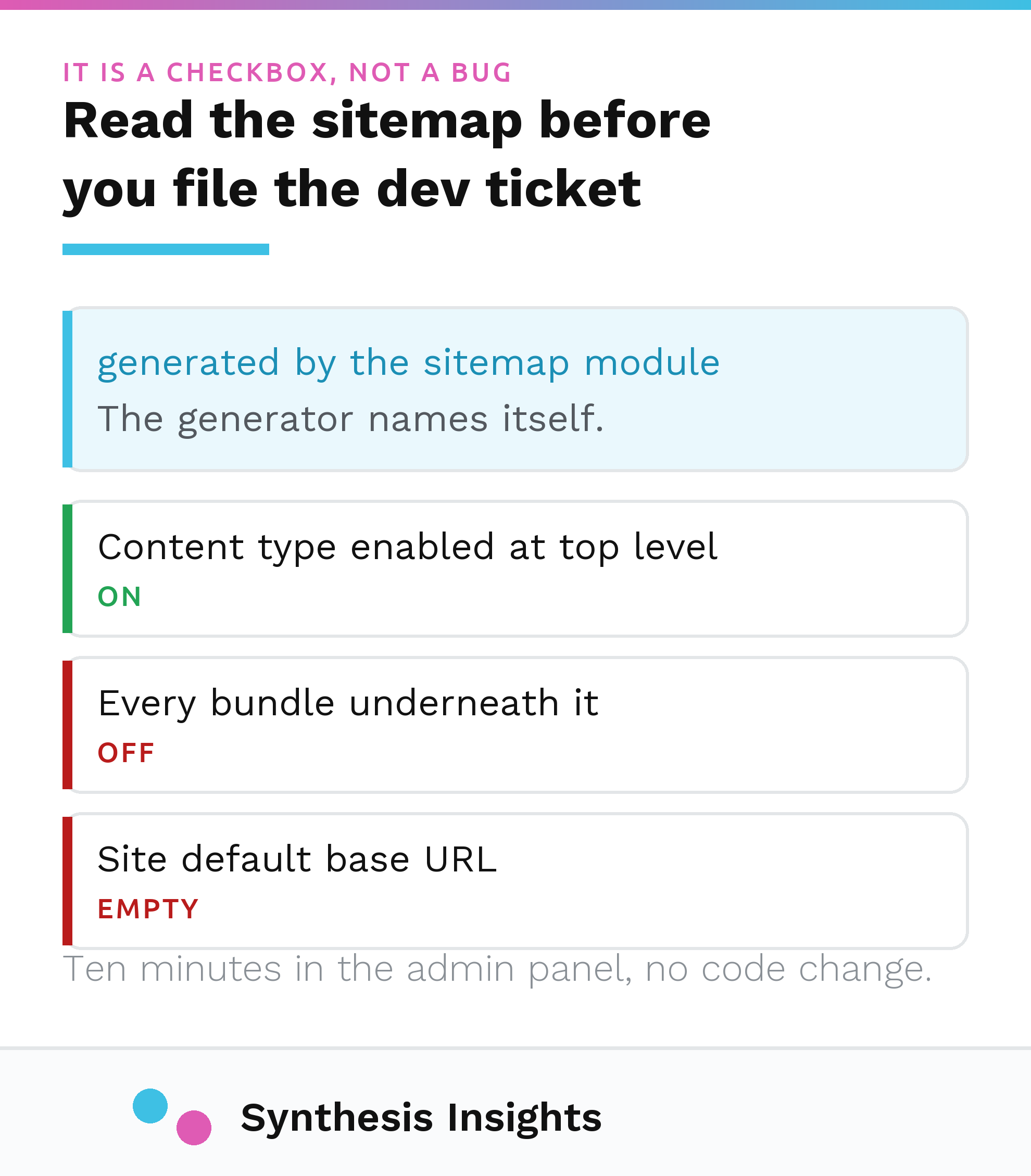
Why it's wrong: the sitemap almost never needs a developer. Someone just needs to open the file and read it. On a coatings manufacturer's site I audited in 2026, the live sitemap.xml carried a comment identifying exactly which module generated it, and that module was running fine. The actual problem was two settings sitting in the admin panel the whole time. First, the content type feeding the sitemap was enabled at the top level while every individual content bundle underneath it was set to "do not index," so the generator dutifully published a sitemap with almost nothing in it. Second, the site's default base URL field was blank, so the generator fell back to a non-canonical host, and most of the handful of URLs it did produce were 301 redirects to themselves under a different domain. Both of those are settings someone could have changed in the admin panel without writing any code.
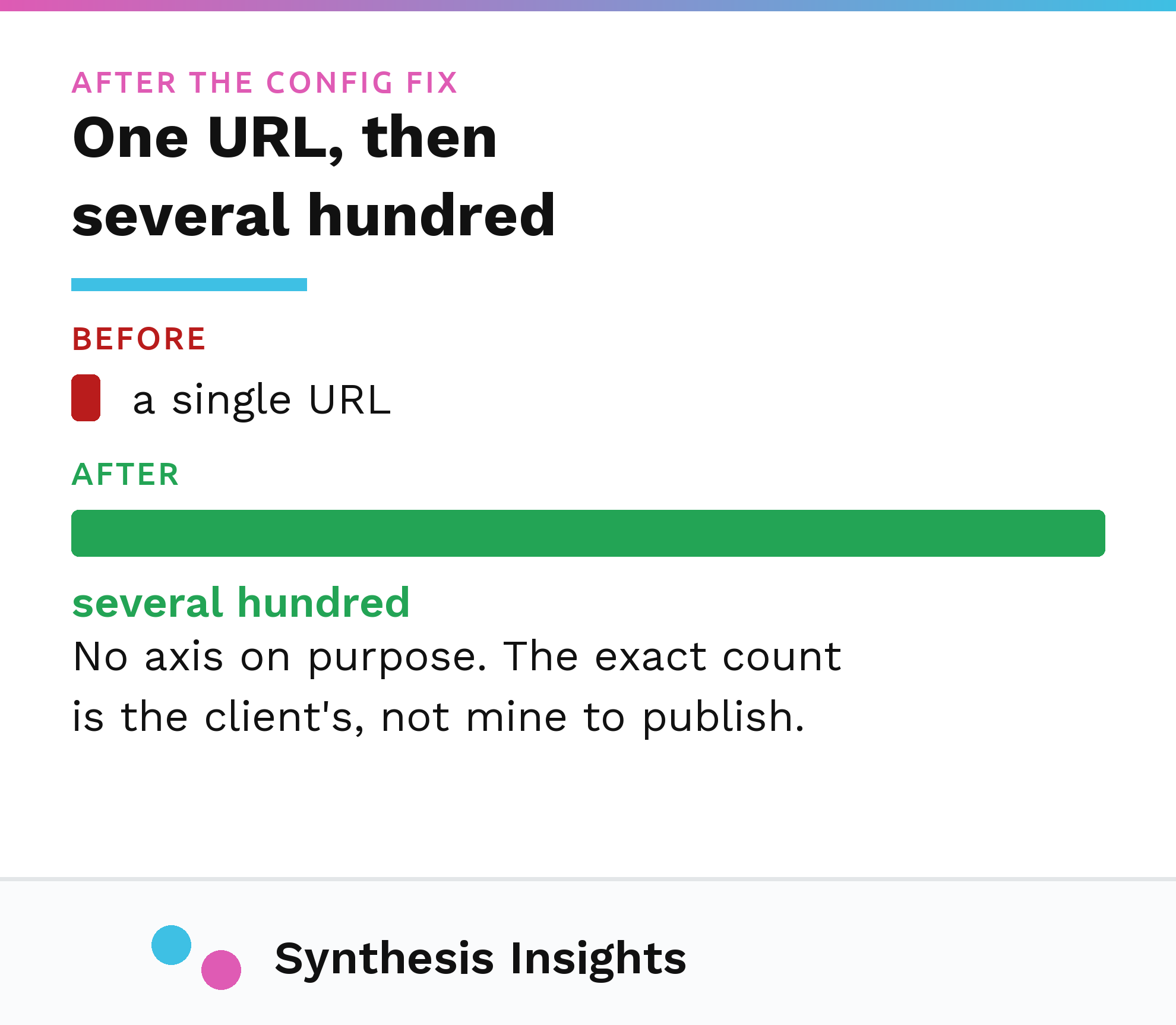
Fixing them took about ten minutes in the admin UI. The sitemap went from a single URL to several hundred.
What to do instead: before writing the ticket, fetch the live sitemap.xml and read the generator comment at the top. If a real module name is there, it's installed and running, and the fix is very likely a configuration setting. Check the per-content-type indexing flags and the site's default base URL before assuming the module itself is broken. Then spot-check a sample of the URLs the sitemap actually lists: you want 200 responses with no redirects, and a run of pages that immediately bounce somewhere else tells you the configuration still needs work.
4. "Just divide your Search Console total by the number of days"
The advice: you want a monthly run rate for organic clicks. Pull a date range in Search Console, take the total, divide by the days in the window, multiply by 30. Done.
Why it's wrong: that math assumes every day in the window has finished data, and Search Console tells you directly that it doesn't. Its own About Search Console data page states, "Normally, however, collected data should be available in 2-3 days," and adds that "there can be a lag between when the numbers are calculated and when they are visible to site owners," which means the most recent days in any range you pull are still filling in when you pull them, sometimes by more than that during heavier processing periods. On a technical consultancy's account, a finding I was carrying in project notes read "about 113 clicks per month" for a piece of gated content, computed by dividing a real click total by a 27-day nominal window. The property in question only had reliable data for about 11 of those days. Once I reran it over a window where every single day was fully populated, the real number came out to roughly 350 clicks a month, about three times higher, and it was about to become the headline number in a client report.
What to do instead: before turning any total into a rate, check how many of the days in your window actually have finished data, which is often fewer than the number of days the date picker says you selected. State the measured window in your output, something like "197 clicks between July 14 and July 30," and label anything extrapolated from it as an extrapolation. Build in the reporting lag on the trailing end of any range, and don't trust the most recent two or three days of any pull to be final.
The pattern across all four
None of these four are hacky bad SEO techniques a five-minute crawl would catch. Every one of them was advice that made sense, from someone paying attention, at the moment it was written. The failure mode isn't ignorance. It's confidence that didn't get an expiration date. If you're carrying advice from a course, a colleague, or an old audit (including one of mine), the question worth asking is whether anyone has checked it against what the platform is doing this month. A check from last year does not count.
If you want a sense of what your own site is confidently getting wrong right now, that's what an SEO strategy built for how B2B buyers actually search starts with, long before it gets anywhere near a checklist copied from 2023. And if the real question underneath your SEO work is whether AI assistants recommend you at all, that's a different measurement problem with its own audit, and no amount of leftover FAQ schema will answer it.