Off-page SEO strategy used to have one job: get other websites to mention or link to yours so Google trusts you more than the next result. It still does that job. What changed is that the same third-party mentions now do a second job nobody built them for. They are also the biggest single reason an AI assistant will name your company when a buyer asks it for a recommendation, ahead of anything you've written on your own site. I laid out why in Does ChatGPT Recommend Your Company?, where third-party citations came out as the number one driver. This post is the how: what off-page SEO (you'll see people write it off page, off-page, or offpage, and the same category also goes by off site or offsite SEO) actually looks like to build in 2026, and why the least glamorous part of it, chasing down mentions of your brand that never linked back, does most of the real work.
What Off-Page SEO Actually Covers
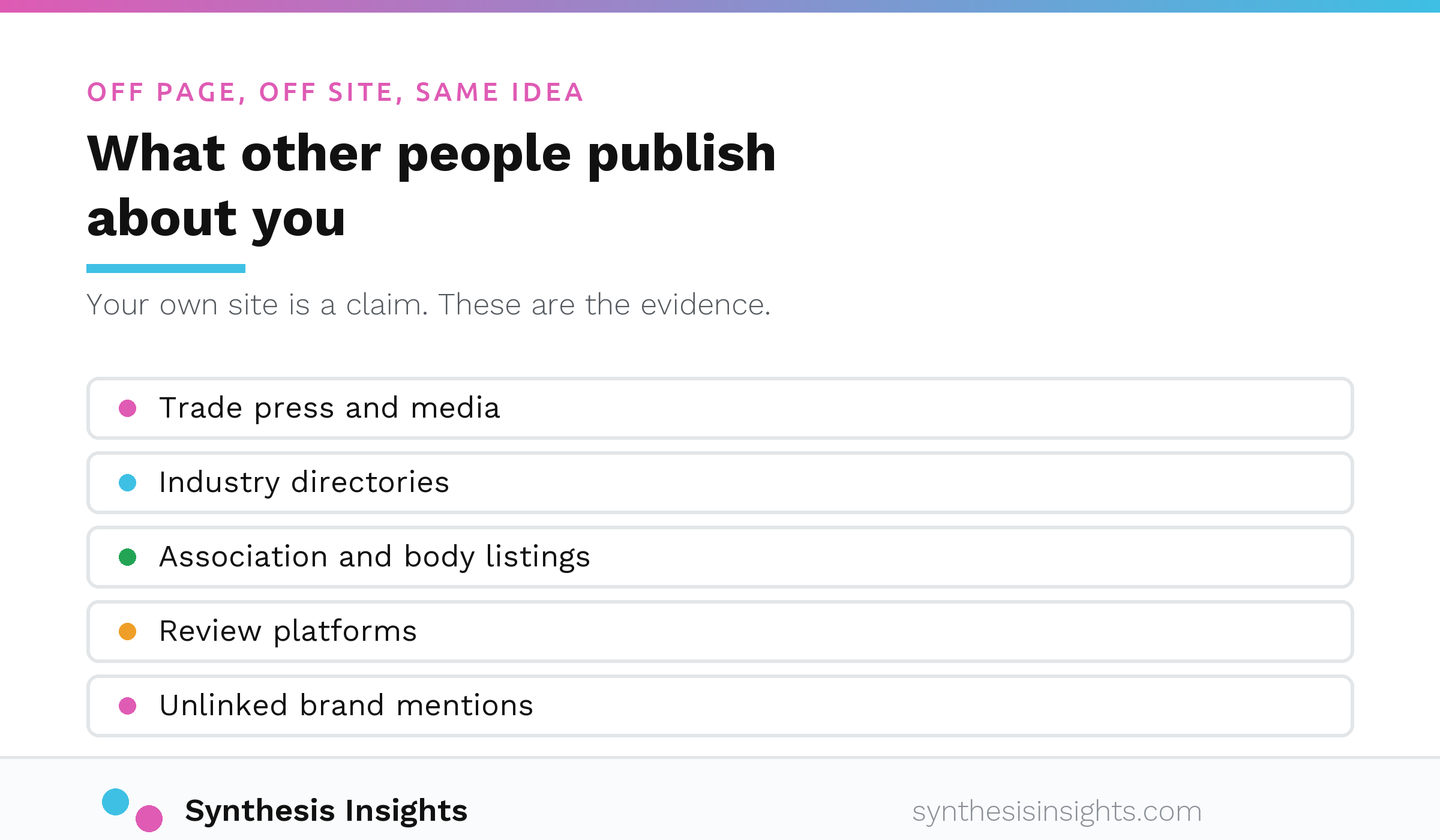
On-page SEO is what you control directly: your own pages, your own words. Off-page SEO is everything that happens somewhere else that still shapes whether Google, and now an AI assistant, trusts you. Backlinks are the most familiar piece. Reviews on third-party platforms are another. So is a trade publication naming you, an industry directory listing you, or another site's blog post mentioning your product without a link attached to it. All of it lives outside your domain, and all of it is evidence a machine can weigh that you can't fake by editing your own homepage.
Why It Now Does Double Duty
Google has never scored links directly off your own claims about yourself. Third-party sources are the check on that. An AI assistant works the same way, for the same reason: it has no way to verify "we're the industry leader" typed on your own about page, but it can weigh a trade publication that named you, an association that lists you, or a reviewer who wasn't paid to say so. That's the mechanism behind the double-duty claim above: the outreach and reputation work that used to exist purely to earn ranking signals is now also the raw material an AI model pulls from when it decides who to recommend. Build the third-party footprint and you're doing both jobs with the same effort. Skip it and you're invisible to both.
The Off-Page Work That Actually Moves Anything
Two pieces are worth doing well and mostly get skipped: reviews and unlinked mentions.
Reviews are the simplest to explain and the easiest to under-invest in. A page of specific, checkable customer stories on Google, industry-specific review sites, or a testimonials page reads as evidence. A wall of generic five-star quotes with no detail reads as decoration, to a human reader and, I'd argue, to a model summarizing what people say about you.
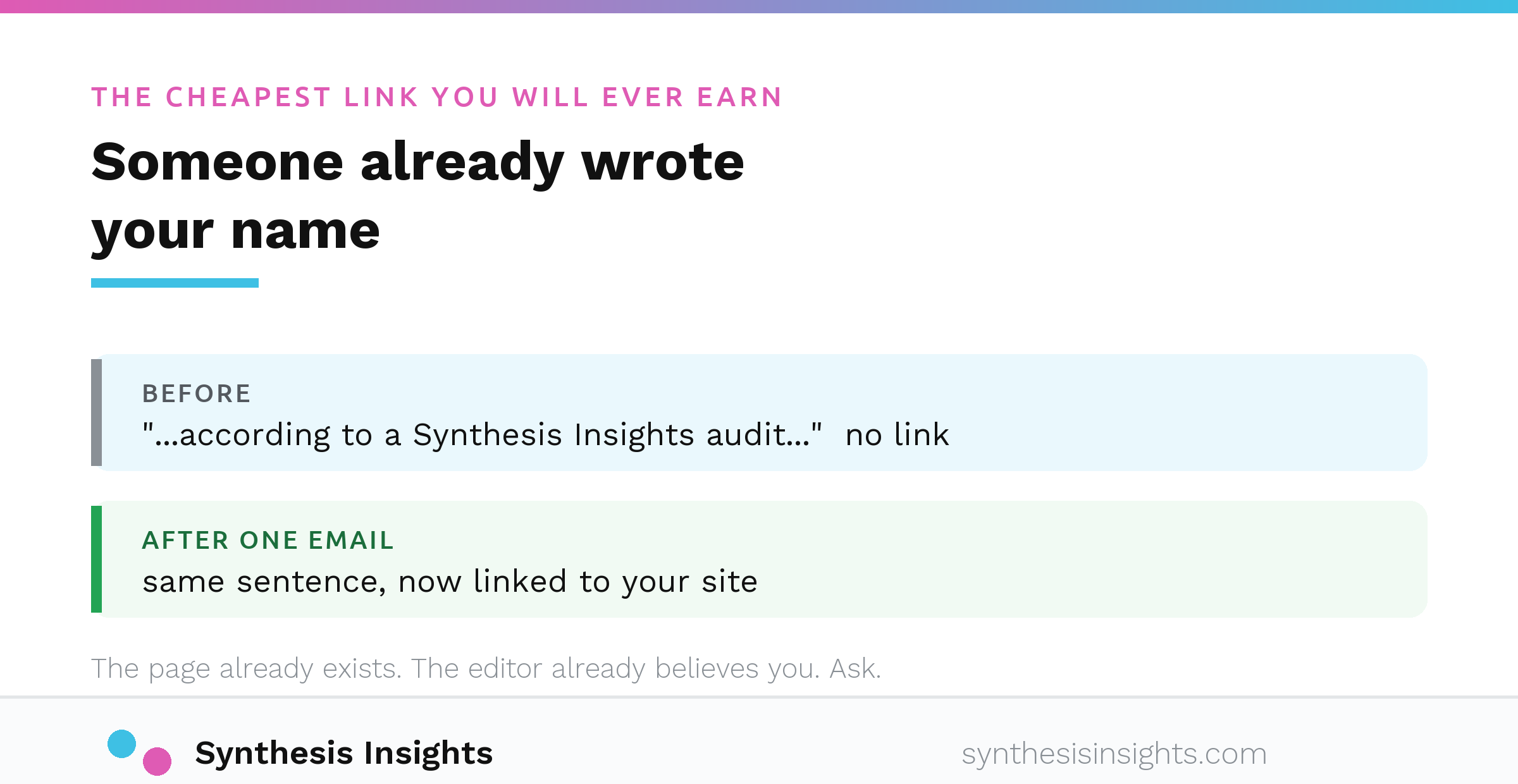
If the business trades from physical locations, a lot of this collapses into directory and listing work, which has its own rules and its own unit of measurement. Unlinked mentions are where I actually spend the hours, and where the real craft is. A publication, directory, or blog post names your brand or your client's brand without linking to the site. That's a citation sitting on the table, already earned, just not yet connected. Here's how I actually run that process.
Finding the candidates. I run a search sweep of the brand name excluding the brand's own domain, plus Google Alerts as they come in, and pull anything that looks like a real editorial mention: press coverage, an industry roundup, a directory listing, a guest byline that name-checks the client. I skip wire syndication (the same press release republished on twenty low-value sites), scraper sites, and mentions so thin they're a single incidental word. Everything else gets logged, even the ones I skip, because re-researching a URL I already ruled out the first time wastes a session I won't get back.
Finding a contact when there's no byline. The easy cases have a named author with a findable email. The hard cases don't, and giving up on those is the single biggest mistake I see in this kind of outreach. When the obvious routes come back empty, I keep going: the Wayback Machine when a personal site or contact page has gone dead; the page footer, which often has a real editorial address the byline doesn't; a masthead block buried in the article's own HTML; tracing a republished piece back to whichever site actually wrote it first, which usually has a better contact than the aggregator that copied it. A generic editorial inbox is a legitimate last resort, and I use it routinely. I also date every address I find, because a contact whose only evidence is a page from a few years back deserves a stale label until something more recent confirms it, however good it looks.
Why every qualifying candidate gets sent, not just the best ones. It would feel more rigorous to rank candidates by publication authority and send to the strongest ones first. I don't do that, on purpose. Which mention turns into a reply is not something I can predict from how big or reputable the publication looks going in, and sorting candidates into tiers just delays sends that would have worked. The only legitimate reason to hold a candidate back is a factual one: there's no working way to reach anyone there yet. That's a blocker. A hunch that a smaller trade blog probably won't respond is just a hunch, and it doesn't get to make the call.
Why a quiet inbox isn't a sign the campaign is broken. Most of these emails get no reply. That's just the normal shape of this channel. It's tempting to read a run of silence as a deliverability problem worth diagnosing. It usually isn't. I ran a sweep recently for an industrial manufacturer, and the pattern held: most inboxes said nothing back, and the campaign was still worth running exactly as sent, because the mentions that do convert don't announce themselves in advance either.
Writing to whoever actually opens it. The one place this breaks down is the email itself. If you've got a named person's address, write to them directly and ask them directly. If you've only got a shared desk like editorial@ or contactus@, don't open with a stranger's first name and then close by asking that stranger a question they can't answer. Greet the publication, describe the piece as theirs, name the actual writer in the third person so it routes internally, and aim the closing ask at the desk that can actually act on it. A mismatched greeting and closing question is the fastest way to read as a mail merge to whoever opens it.
Two Off-Page Habits Still Worth Dropping
Off-page SEO has its own version of the advice that outlives its expiration date. Two habits from that pile are still worth naming here.
Paying for links is still against the rules, not just risky. Google's own policy is explicit: "Buying or selling links for ranking purposes. This includes: Exchanging money for links, or posts that contain links" is a violation, and sites that do it "may rank lower in results or not appear in results at all," per Google's Search Central spam policies. Sponsored or paid links are fine when they're marked rel="nofollow" or rel="sponsored", because Google explicitly treats disclosed paid placement as a normal part of how the web's advertising economy works. What it doesn't tolerate is a paid link dressed up as an organic recommendation.
The other habit worth correcting: treating E-E-A-T as something Google directly scores you on, which it does not. Google's own documentation on creating helpful, people-first content says plainly that "while E-E-A-T itself isn't a specific ranking factor, using a mix of factors that can identify content with good E-E-A-T is useful," and that of experience, expertise, authoritativeness, and trustworthiness, "trust is most important. The others contribute to trust, but content doesn't necessarily have to demonstrate all of them." Off-page work is one of the ways you build that trust, though it was never a checkbox you tick to satisfy an algorithm grading you on it directly, because that algorithm doesn't exist. If your off-page strategy is built around chasing a score that doesn't exist, it's aimed at the wrong target even when the tactics look right.
Measuring Whether Any of This Is Working
Off-page work is slow to show up and easy to under-credit, which is exactly why it gets cut first when a budget tightens. If you're not already tracking the metrics that would tell you it's paying off, what actually counts as an SEO KPI is the place to start before you decide off-page isn't worth the hours. And if what you're chasing is AI citations specifically, the AI visibility audit is built to tell you which third-party sources are actually moving that needle for your category, instead of guessing.
Off-page SEO was never the part of the job you could fake from your desk. That was always the point of it, and it's why it still works when the rest of the field is busy optimizing pages a model barely reads before it decides who to trust.