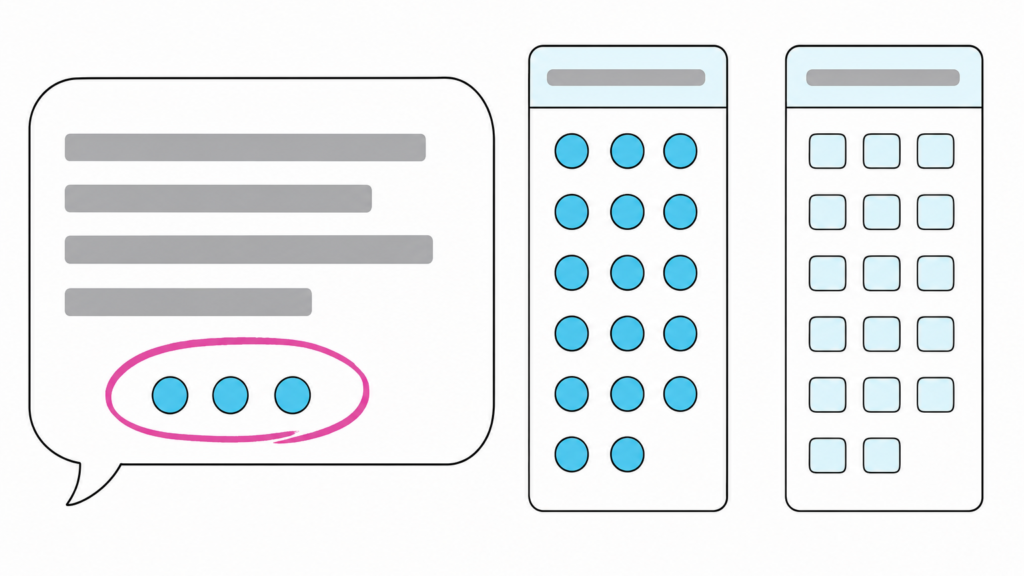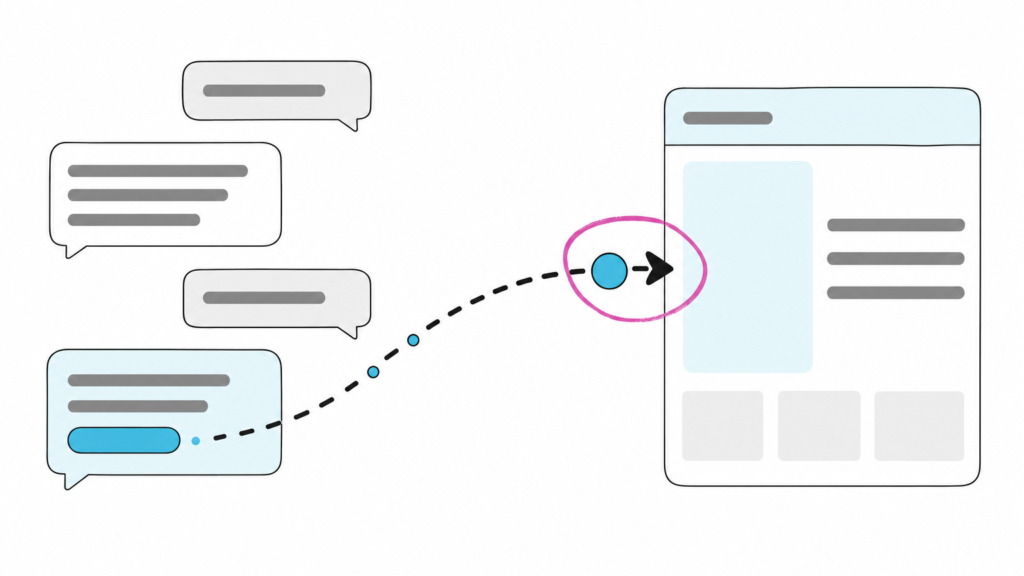
ChatGPT, like any AI assistant, generates different answers each time you ask. To learn whether it recommends your company, you need to run the same five buying questions a prospect would ask across ChatGPT, Perplexity, Gemini, and Google’s AI Overviews in fresh sessions. No free scanning tool can capture the full range of questions a buyer might use, and a single set of results is only that day’s snapshot. The real signal is the pattern you see when you repeat the check over time.
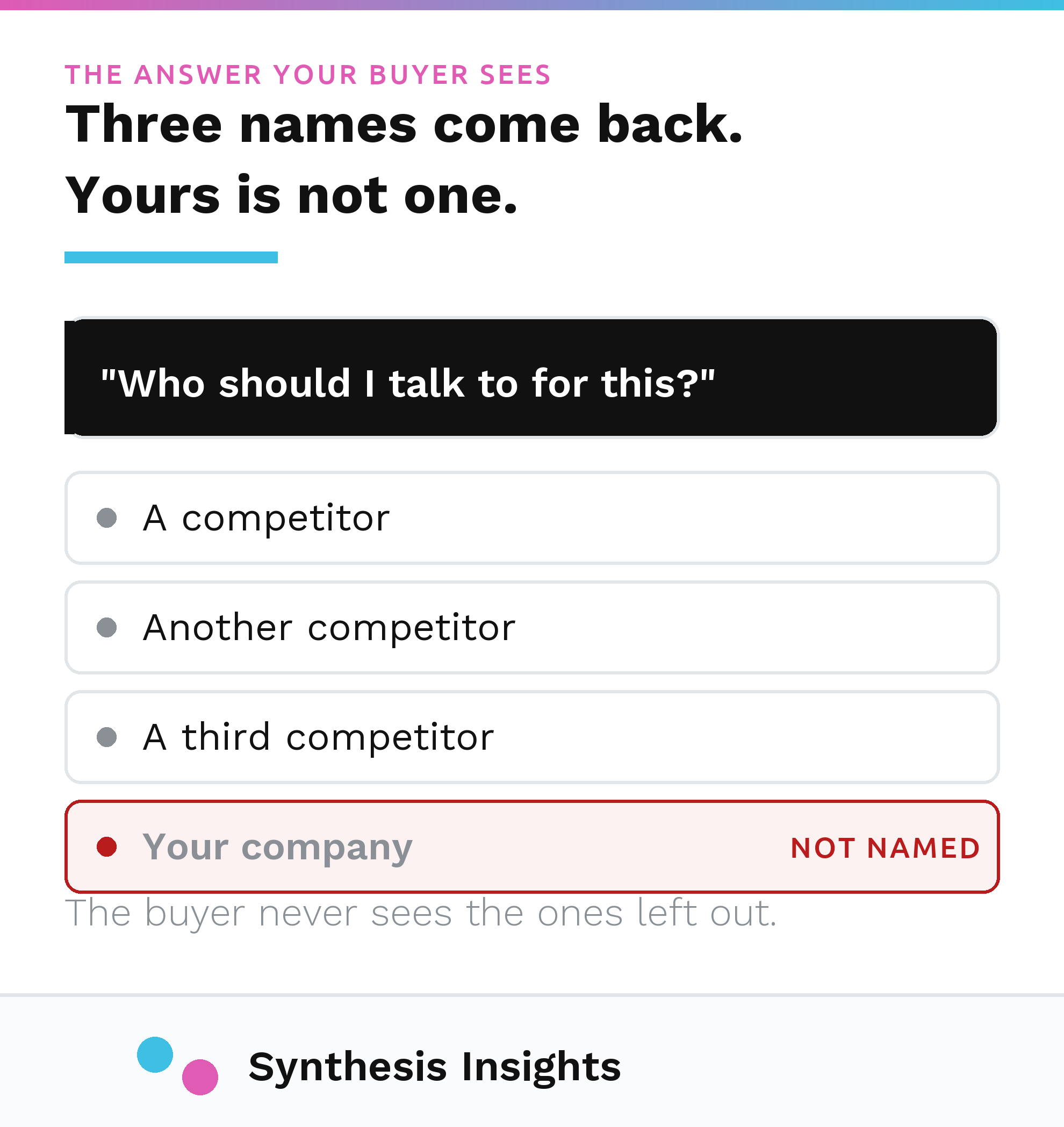
Your buyers have started asking AI assistants which company to use before they ever type a search into Google. The assistant answers with a shortlist of names. If your company is not on that shortlist, you are out of the deal before you knew it existed.
Most industrial and B2B companies have no idea where they stand in those answers. This guide shows you how to find out in about ten minutes, what your results mean, and what actually drives the answer.
Why this matters now
A client asked me a question last year that almost nobody was asking the year before: "When someone asks ChatGPT to recommend a company like ours, do we show up?"
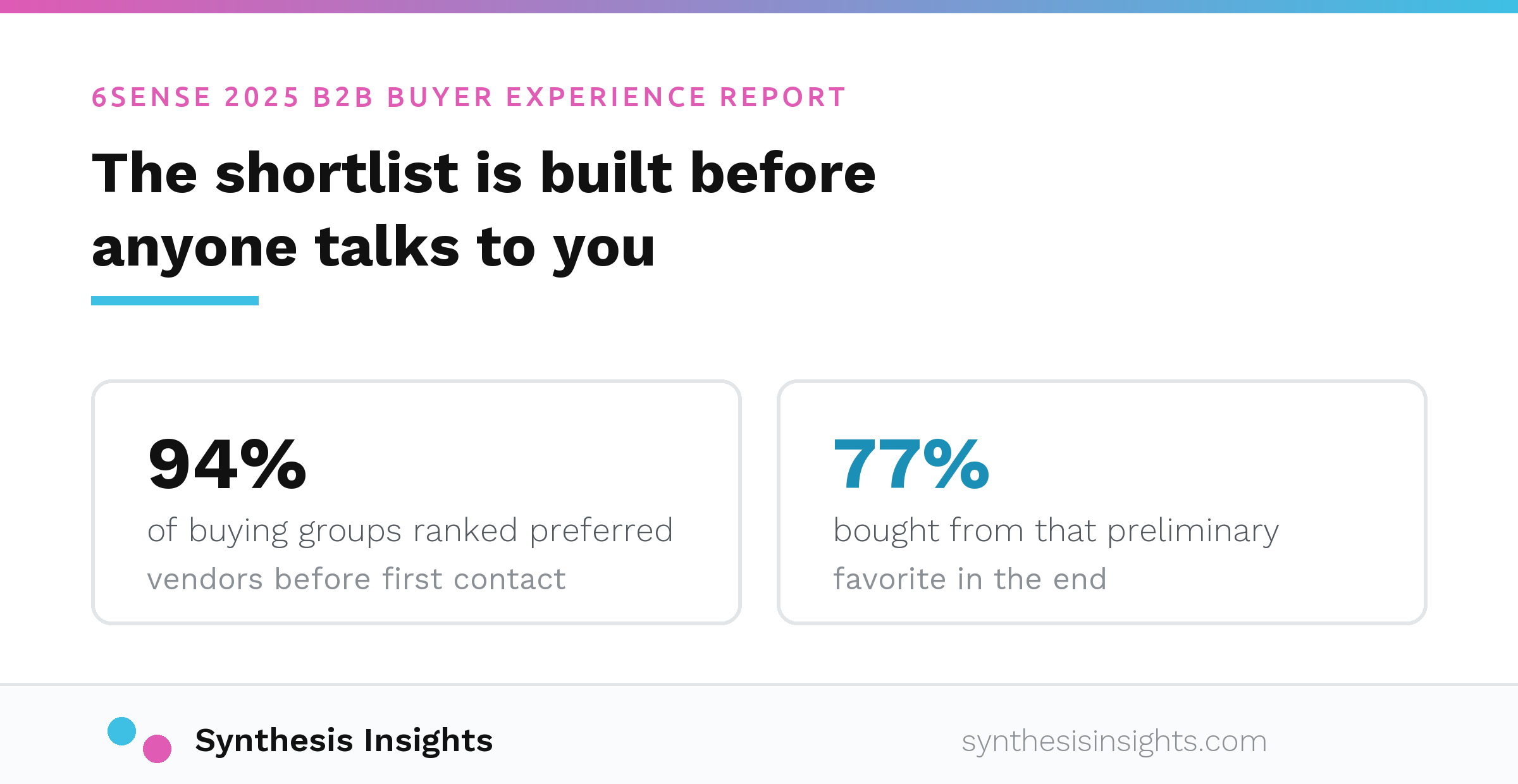
It is the right question, and the reason has less to do with AI than you would expect. 6sense's 2025 B2B Buyer Experience Report found that "94% of buying groups ranked preferred vendors before first contact," and that "they ultimately purchased from that preliminary favorite 77% of the time." The shortlist is built before anyone talks to you, and the name at the top of it usually wins.
I want to be careful with the AI part of this, because the same report cuts against the easy version of the story. Yes, 94% of buyers used large language models during the process. But 6sense found they used them mainly "to summarize reviews or analyze data," and that buyers still averaged 16 interactions with the winning vendor, unchanged from the year before. Their own write-up of that number is titled "Why ChatGPT Isn't Killing Your B2B Demand Gen, Yet." So this is not a claim that AI has replaced how buying happens.
The narrower claim is the one that matters. A shortlist forms early, it decides most deals, and one of the places buyers now assemble it is a chat window that returns three or four company names. If you are not one of them, you were never in the running, and nothing in your analytics will record that you lost.
Traditional marketing measurement does not see any of this. Companies track keyword rankings and ad spend. Nobody is checking the answer the model actually gives. Which means a competitor can quietly own the AI shortlist in your category for months before it shows up as lost revenue.
How to check if ChatGPT recommends your business in 10 minutes
You can run this yourself today. No tools, no budget.
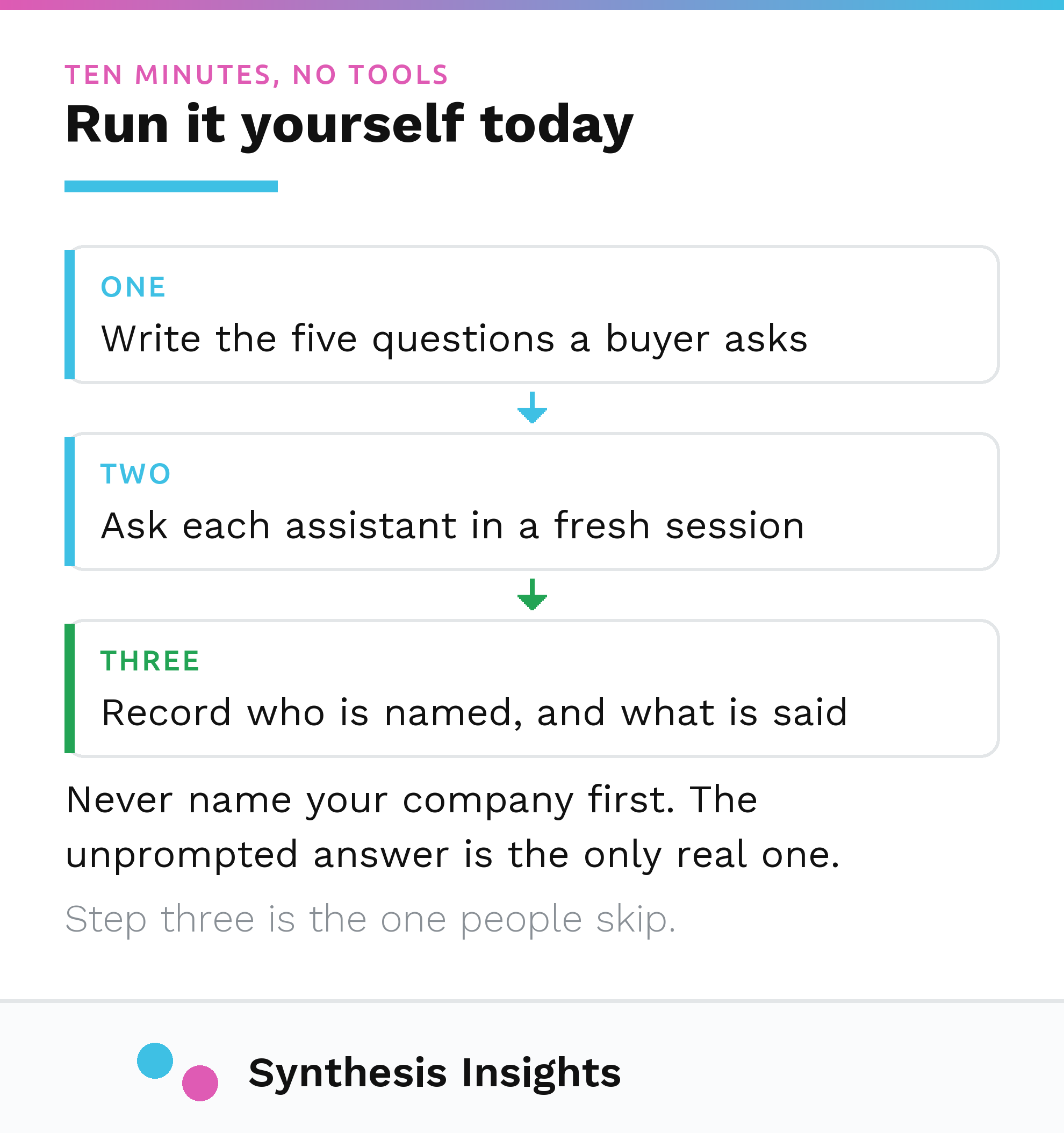
Step 1. Write down the five questions a buyer asks right before they would contact you.
Skip your product name and your brand entirely. Write down the problem the way a real buyer phrases it: "who does X for Y." If you build industrial conveyor systems, the question is something like "what company makes heavy-duty conveyors for food processing plants." If you sell industrial water treatment, it is "water treatment systems for manufacturing facilities." Ask your sales team what prospects actually say on first calls. Use those words.
Step 2. Ask those exact questions in ChatGPT, Perplexity, Gemini, and Google's AI Overviews.
Fresh session each time. No leading. Do not mention your company name first, because the model will happily talk about any company you name. You want the unprompted answer, the one your buyer sees.
Step 3. For each answer, record three things.
- Are you named at all?
- Who gets named instead?
- What does the model say about them that it does not say about you?
That third question is the whole game, and it is the one most people skip.
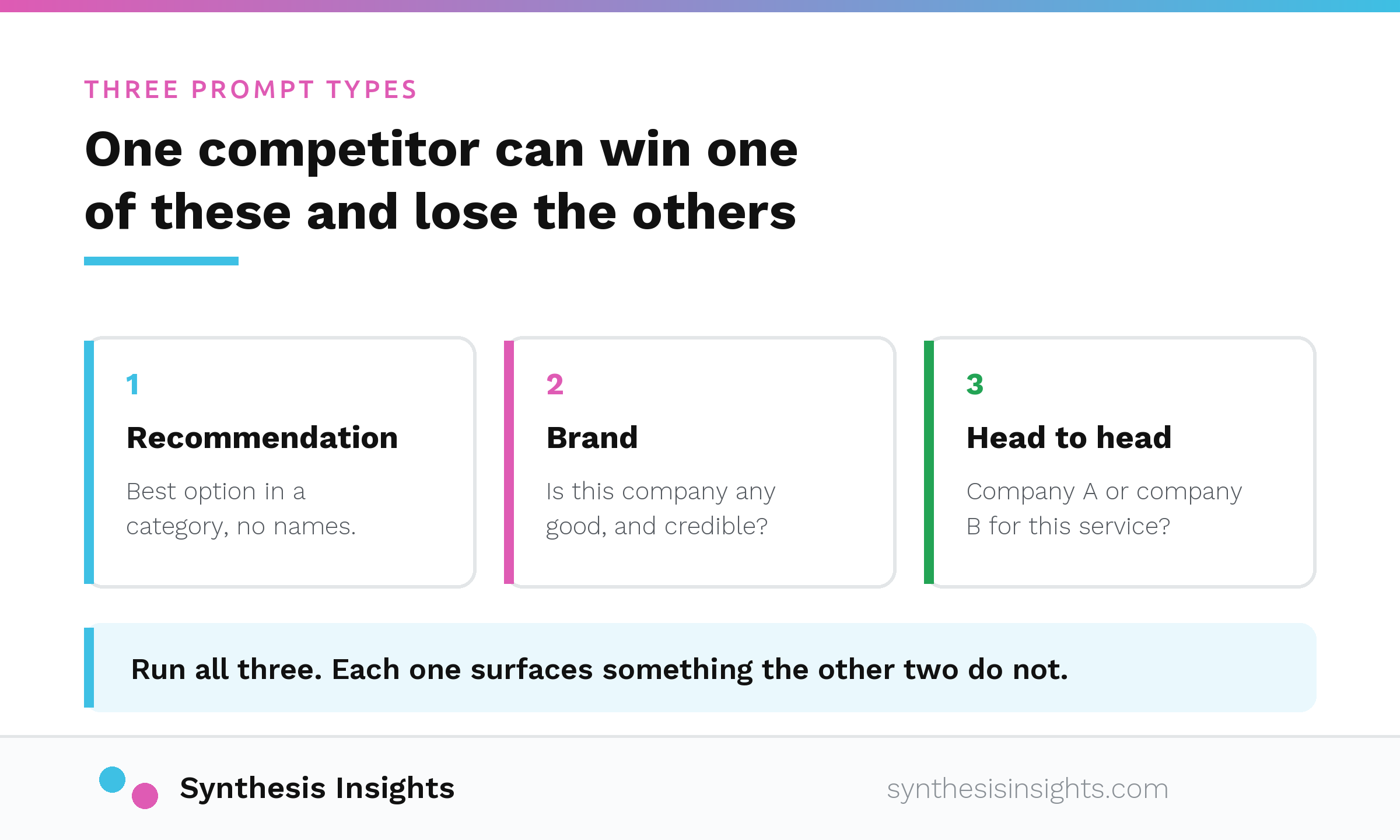
The five buyer questions are one of three prompt types worth running to see how AI assistants describe your company relative to competitors.
Three prompt types that show how AI assistants rank your company
Three prompt types are worth testing. A recommendation prompt asks for the best option in a category, like “best [service] in [city/category].” A brand prompt asks directly whether your company is good, credible, or worth using. A head-to-head decision prompt pits your company against a named competitor: “Is [Company A] or [Company B] better for [service]?” Each prompt type surfaces different information, and a competitor might appear in one but not the others.
Run these prompts across at least ChatGPT, Perplexity, Gemini, and Google AI Overviews. Use fresh sessions every time, not existing chat threads, so prior context doesn’t skew the answer. Because answers vary from one run to the next, test each prompt more than once. That variation is part of the picture: an assistant might recommend you today and a competitor tomorrow, and you need to see the pattern.
Logging each run to build a baseline
Log the results in a simple spreadsheet. Record the platform, the exact prompt, whether your company appeared, what the assistant said, and which sources it cited. This log becomes your baseline for tracking changes over time.
What does ChatGPT say about my company?
A good result on the recommendation question does not tell you whether the description is right. If the model recommends your company and then describes it as something you are not, the buyer who follows that recommendation arrives expecting a different company.
Run two separate prompts in two separate fresh sessions, with no other context in either thread.
- "What is [your company]?"
- "Who are the best [your category] providers?"
The first surfaces the description: what the model believes you do, who you serve, whether that is accurate and current. The second is the recommendation question the rest of this post already covers. Running both in one thread contaminates the second answer with the first, which is why they go in separate sessions.
Hold the description answer next to your own homepage and product pages. Compare it against what your site actually says today. Look for two things. Does the description match the services you offer and the industries you serve as your site currently states them? And does the description reflect the business you run today?
Software that runs a set of prompts across the assistants and reports where you were mentioned and how you were described is a legitimate time-saver over running everything by hand. It doesn't close the gap. These tools report the problem. Closing it is still work on your own site and on your third-party citations, and a later section covers what determines the answers assistants give.
![Two prompt cards side by side. The left card, labelled Describe, carries the prompt "What is [your company]?" and shows what the model believes you do and whether that is accurate and current. The right card, labelled Recommend, carries the prompt "Who are the best [your category] providers?" and is the recommendation question the rest of this post already covers. A line across the foot reads: Running both in one thread contaminates the second answer with the first.](https://synthesisinsights.com/wp-content/uploads/2026/09/aivc-11-describe-vs-recommend-p.png)
If what ChatGPT describes doesn't match your business anymore, that is its own problem with its own fix, which ChatGPT has wrong information about your company covers in full.
Reading your results
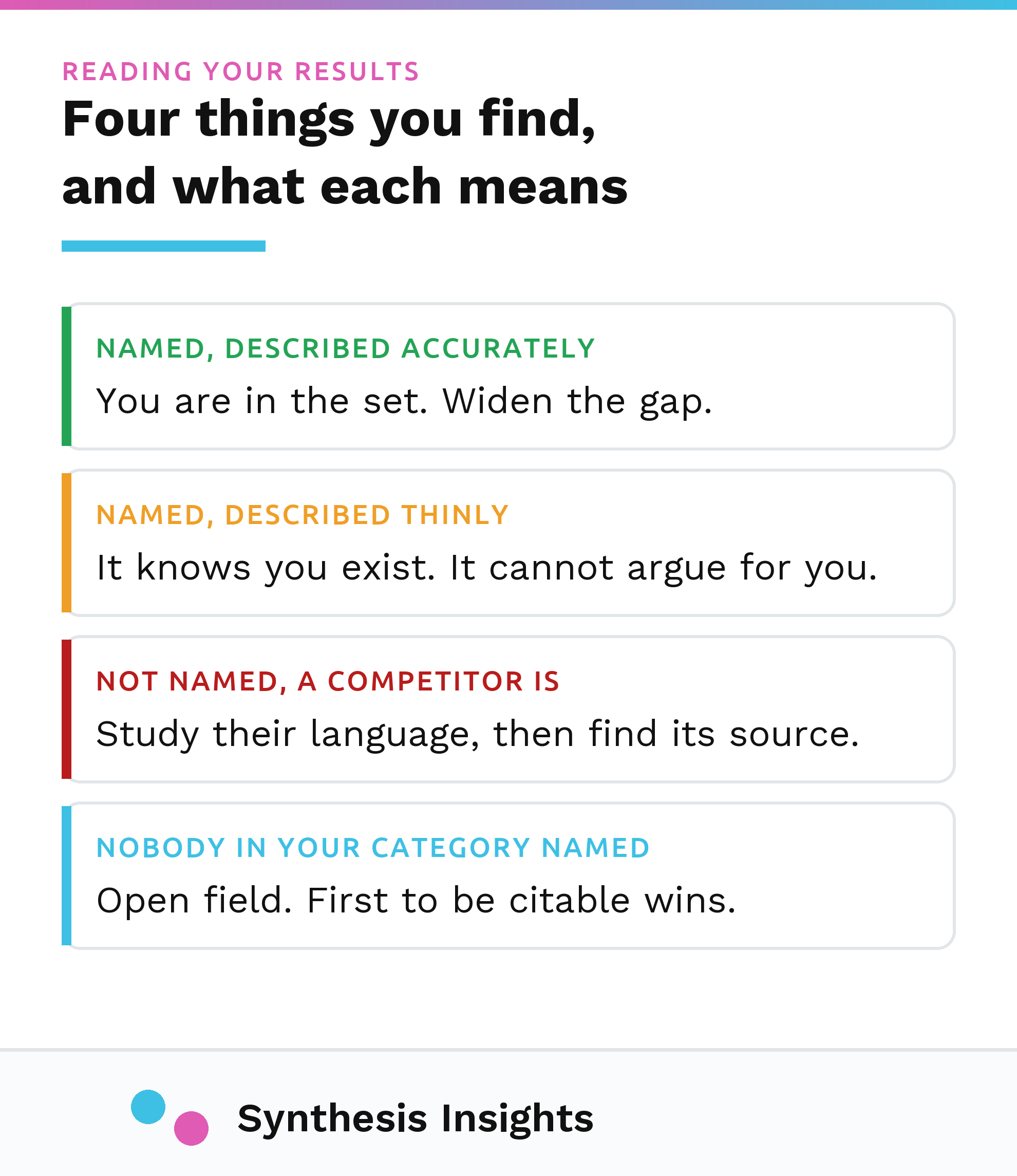
You are named, described accurately. You are in the consideration set. Now the work is widening the gap: more third-party citations, clearer proof, so a competitor cannot displace you.
You are named, described wrong or thinly. The model knows you exist but cannot make your case. This usually means your expertise lives in places a model cannot lift: PDFs, image-heavy pages, vague homepage copy.
You are not named, a competitor is. Study what the model says about them. It is usually specific: what they do, who they serve, why they are credible. Then trace where that language comes from. In a recent audit I ran, the consistent winner turned out to be the firm whose expertise was stated clearly across the sources the model reads. The biggest company in the category showed up as well, but on sheer scale, which is a different mechanism entirely.
One finding from that audit is worth sitting with. In several answers I could see the engine's own research trail: it searched the client by name, checked their reputation and history, weighed them against the competitor, and still left them out of the answer. The client was hardly unknown. The AI investigated them and could not find enough usable proof to recommend them, which means a problem that looks like awareness may really be one of legibility.
Nobody in your category is named. The model answers generically. This is the open-field scenario, and it is an opportunity: the first company in the category to become clearly citable tends to own the answer.
What actually drives the answer
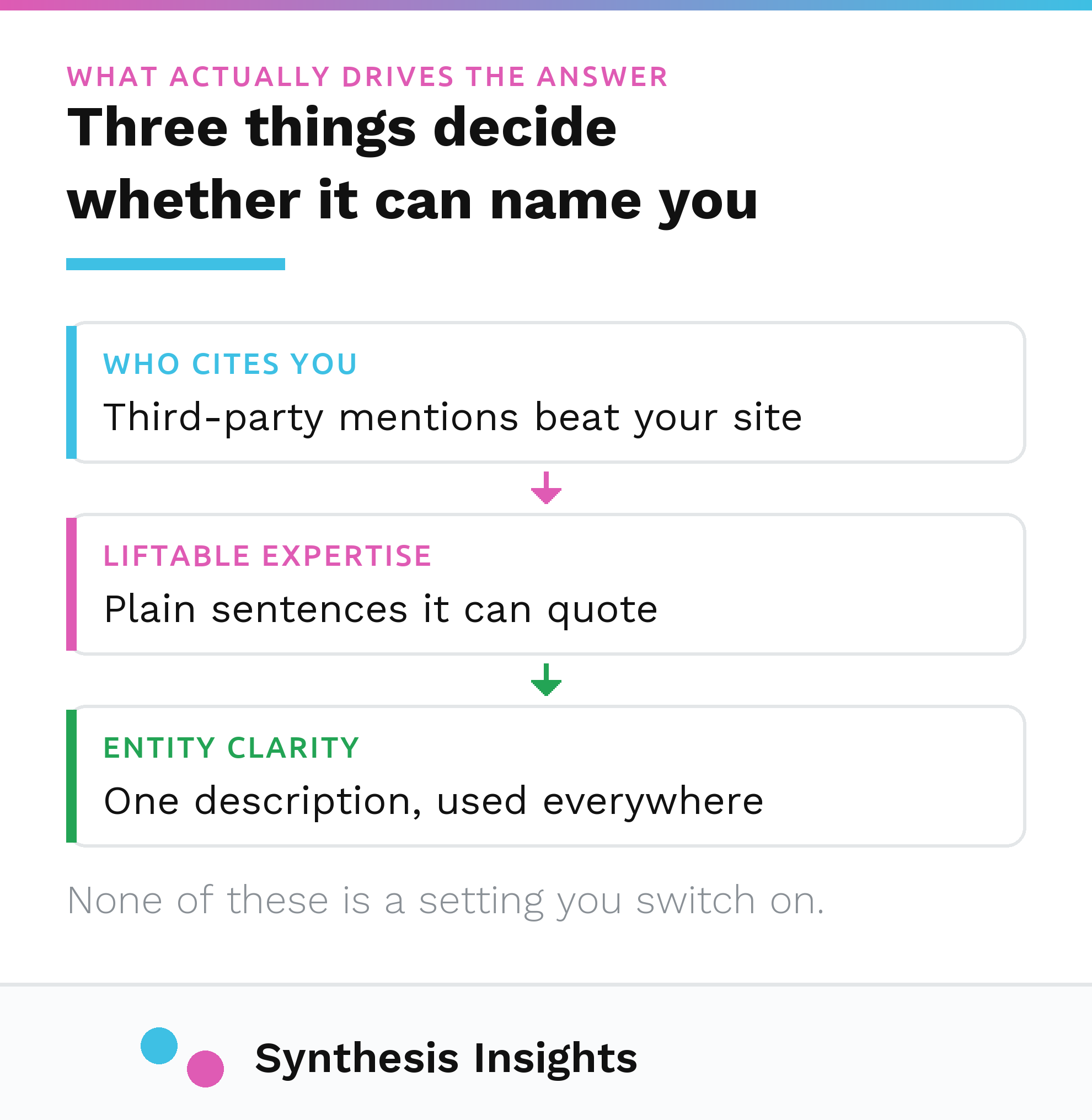
The model is not ranking pages the way Google ranks pages. It is reasoning over what the web says about you, and three things dominate:
1. Who cites you. Third-party mentions carry more weight than anything on your own site. This is off-page SEO doing double duty, and off-page SEO strategy is the practical version of that work. Trade publications, industry directories, association pages, review platforms, press coverage. The model treats independent sources as evidence and your homepage as a claim.
2. Whether your expertise is stated in a form a machine can lift. Clear sentences that say what you do, for whom, with what proof. A page titled "Conveyor Systems for Food and Beverage Manufacturing" that plainly describes the service can be quoted. A homepage that says "engineering tomorrow's solutions today" cannot.
3. Whether the model can tell what you do at all. Entity clarity. Consistent naming, a specific category, unambiguous descriptions across your site, your LinkedIn, your directory listings. Companies that describe themselves five different ways in five places dilute their own identity in the model's reading.
Most industrial company websites fail on all three, and not by accident. They were built for a human skimming a homepage, back when the design brief was impressions and nobody had to think about whether a model could lift a usable sentence off the page.
One thing worth saying plainly, because a lot of people are being sold the opposite. There is no technical file or markup that gets you into an AI answer. Google's own guidance on AI features is explicit: "There are no additional requirements to appear in AI Overviews or AI Mode, nor other special optimizations necessary," and "you don't need to create new machine readable files, AI text files, or markup to appear in these features." It goes further and says "there's also no special schema.org structured data that you need to add."
So if someone quotes you for an llms.txt file or a schema package to fix your AI visibility, they are selling you a deliverable, not a result. The three drivers above are slower and less tidy, and they are what actually moves the answer.
An honest word on limits
Two disclosures, because overclaiming is how agencies get fired.
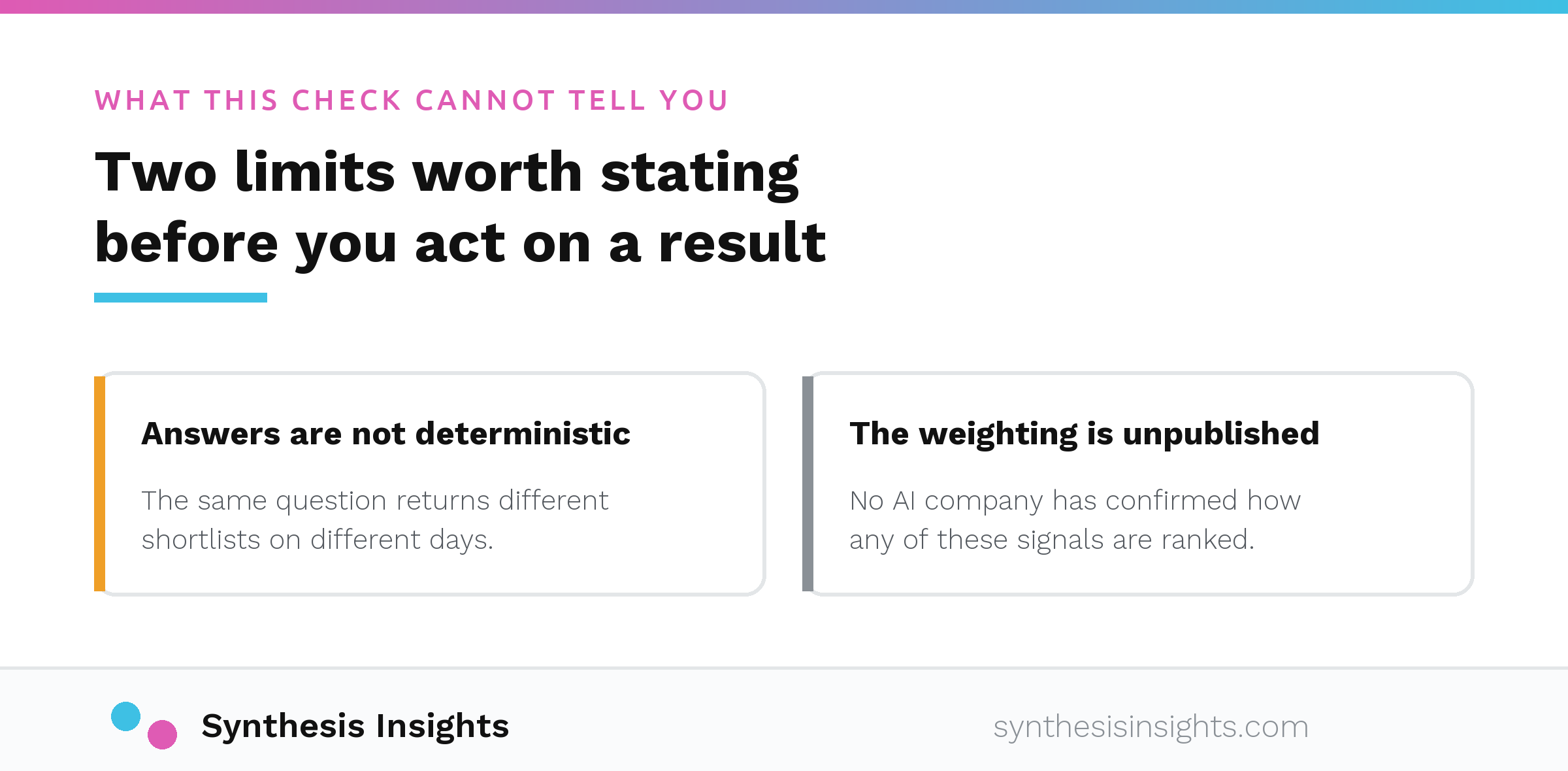
First, AI answers are not deterministic. The same question can produce different shortlists on different days, and the models update constantly. A single check gives you a snapshot of one day. Run your five questions monthly and read the trend across them, because any one answer on its own can mislead you.
Second, nobody outside these AI companies knows the exact weighting of any of this. What I describe above is what my audit work has shown so far: companies with strong third-party citations and liftable expertise get named, companies without them do not. Treat it as a well-supported operating model that no AI company has published or confirmed.
What to do with a bad result
The fix takes real work of the kind no plugin does for you, and it falls out of the three drivers: earn citations in the sources the model reads, restate your expertise in liftable form, and clean up your entity signals. Which lever matters most depends on what your check revealed, which is why the diagnosis comes first.
If you run your five questions and do not like the answer, that is the situation my AI Visibility Audit exists for. I benchmark whichever competitor keeps winning the answer, work out which of the three levers is actually doing it, and hand back a written plan in priority order. But run the ten-minute version first. It costs nothing, and it tells you whether you have a problem worth solving.
Why a free AI visibility checker isn’t the full picture
A free automated checker typically runs a one-time scan on a handful of prompts. That gives you a fast first pass, and it can flag a problem you didn’t know about. But it misses several things that matter for making decisions.
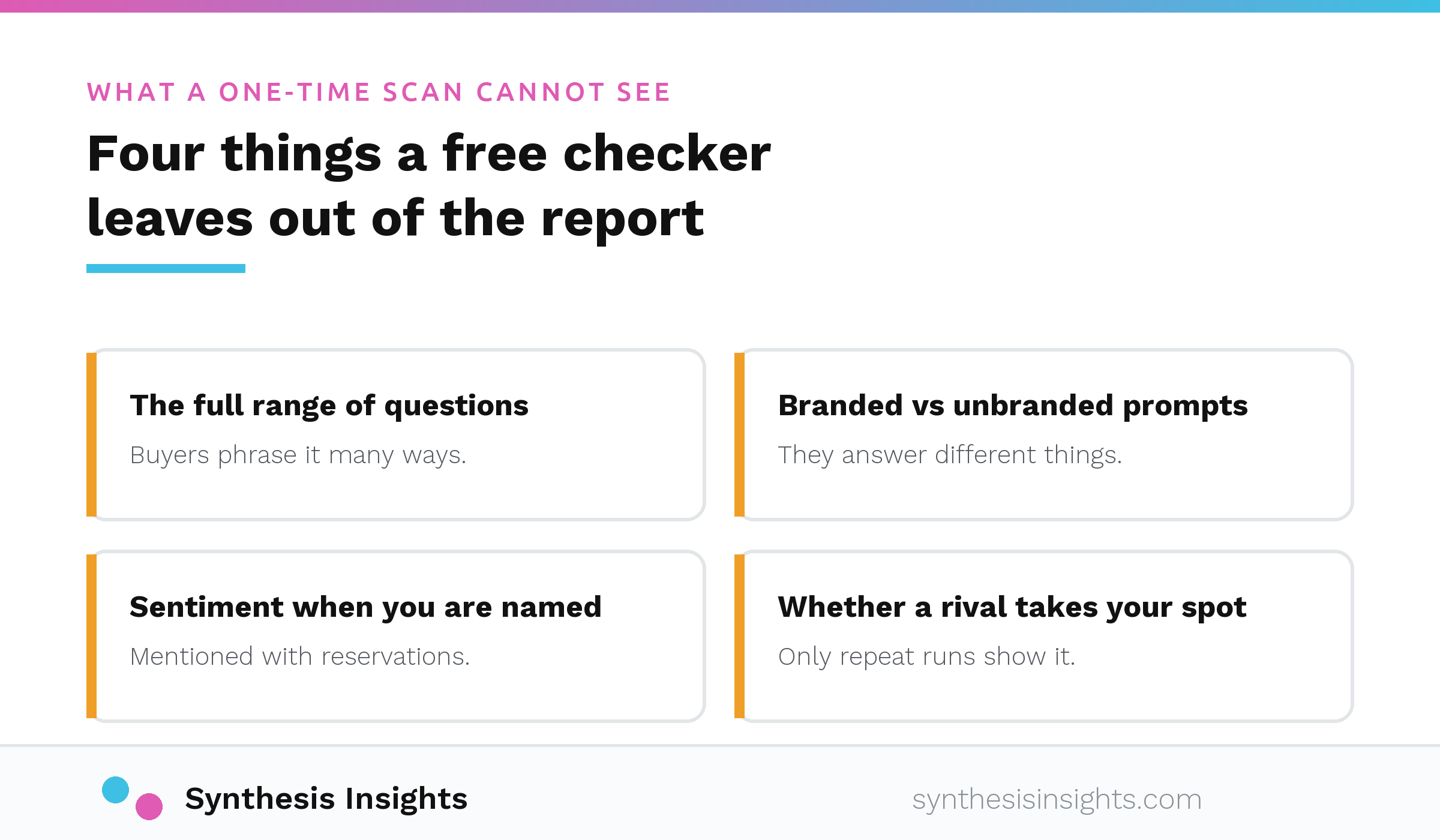
First, it rarely covers the full range of category-level questions a real buyer asks. Someone searching for a service rarely uses just one phrase; they try different variations, and your company might show up for some but not others. Second, a scan often treats branded and unbranded prompts the same way, even though they reveal different things. A brand prompt tells you whether the assistant knows you exist. An unbranded category prompt tells you whether it considers you a top recommendation without being prompted by your name. Third, a single scan doesn’t capture sentiment nuance. The assistant might mention your company but describe it with reservations, which a binary “appeared or didn’t” report misses. Finally, a one-time check can’t show you whether a competitor swaps into your spot over time. That pattern only becomes visible when you check repeatedly.
If you need the category-level and competitor-level picture instead of a one-time scan, our AI Visibility Audit is built for that. For the broader AI-search readiness picture, read our overview of AI search readiness and how the pieces fit together.
What changes if ChatGPT recommends a competitor instead of you
If your company gets recommended, you have a head start, but the work doesn’t stop there. AI assistants change their answers frequently. A competitor can appear in your place next week. Track your position over time, and use the positive mentions to understand which sources the assistant trusts. Strengthen those signals so you stay visible.
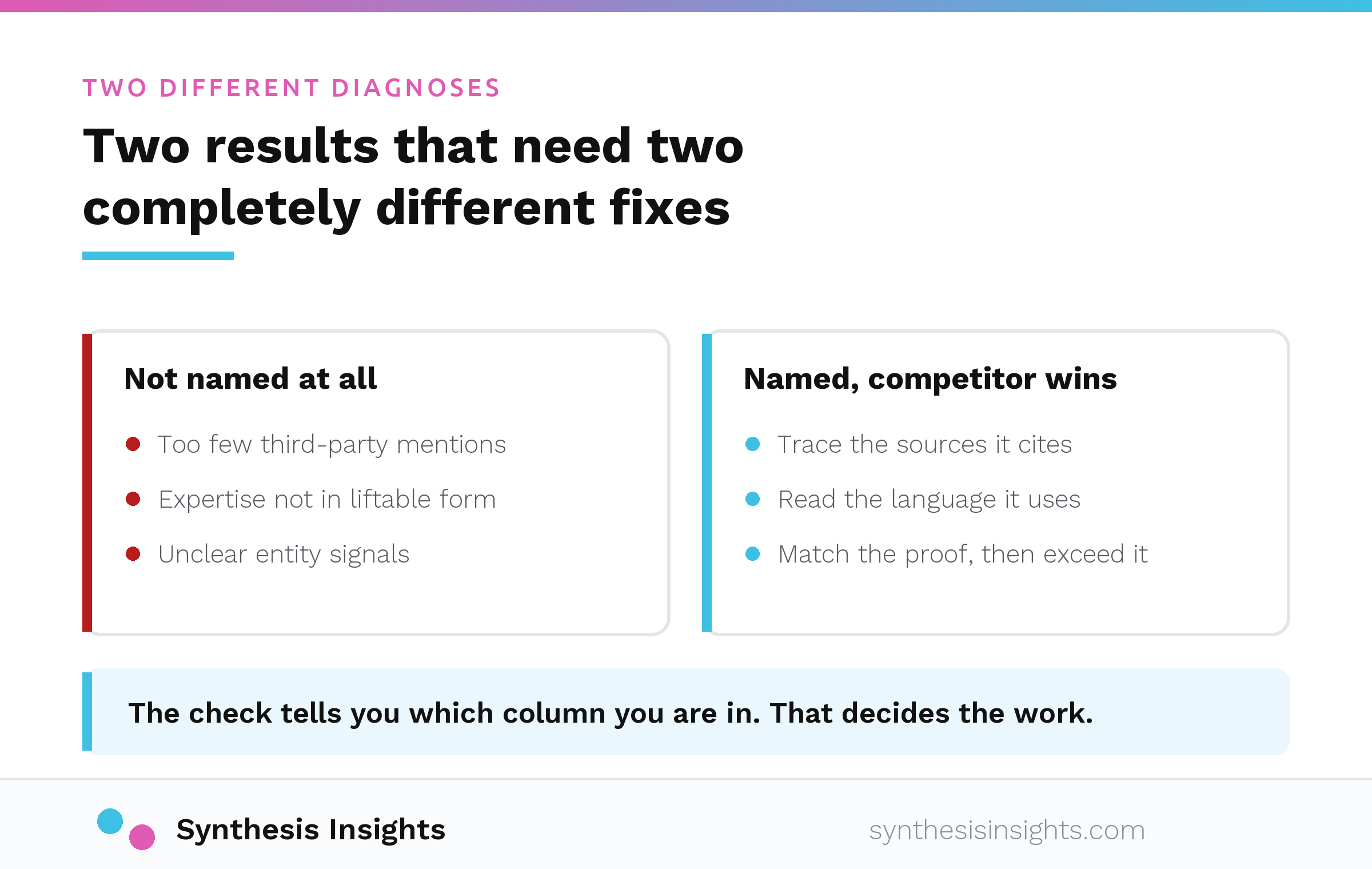
When a named competitor keeps winning the head-to-head prompt, the diagnostic path is different from simply not appearing at all. Not showing up often points to missing structured data, weak citations, or low overall authority. The earlier section on bad results covers that. A competitor winning a direct comparison tells you the assistant sees them as the better choice for that specific category. You need to analyze why. What sources does the assistant cite for them? What signals is the competitor sending that you aren’t? This is where the distinction between AI Engine Optimization (AEO), Generative Engine Optimization (GEO), and traditional SEO matters. AEO is the practice of shaping how AI assistants understand and describe your business. GEO focuses on getting your content into the generative outputs of AI-powered search. Traditional SEO builds the underlying authority and relevance that both AEO and GEO rely on. Understanding that difference helps you diagnose why a competitor keeps winning and what to adjust first.
I run paid media for companies whose ad spend has to prove itself in revenue. Increasingly that means making sure the AI layer sitting above the ads knows my clients exist. If you want a second pair of eyes on what the models say about you, book an intro call to talk through what the AI Visibility Audit would find in your category.
Related reading: AEO vs GEO vs SEO | AI citation volatility | share of AI answers | website redesign and AI visibility
FAQ
How do I find out what ChatGPT says about my company?
Go to ChatGPT in a fresh session and ask the exact question a buyer would ask, without mentioning your company name. Record whether it names you, who it names instead, and what it says about them that it doesn’t say about you. Repeat across Perplexity, Gemini, and Google’s AI Overviews, because each assistant draws on different sources and can give a different answer. The pattern across several runs is more informative than a single result. Running the procedure tells you whether ChatGPT recommends you, and finding out what it says about you takes a separate prompt in its own fresh session.
How can a company find out whether AI assistants recommend it to buyers?
Write down the five questions a buyer asks right before contacting a company like yours. Run each question in a fresh session on ChatGPT, Perplexity, Gemini, and Google’s AI Overviews, with no brand name in the prompt. Note whether your company appears, who appears instead, and the language the model uses to describe those competitors. Check monthly, because answers shift as models update and as competitors earn new mentions.
Why does ChatGPT describe my company with outdated information, including products we no longer sell?
ChatGPT is built on a snapshot of the web plus whatever it retrieves in real time, so outdated product pages, old press coverage, and stale directory listings from sites you don’t control can all keep the old description alive. Correcting your own site helps, but it won’t overwrite the third-party sources the model is pulling from. There is no support ticket to file, because no one at the AI company manually updates what the model says about your business.
How do you measure a brand’s visibility in AI assistants credibly, and where do those methods stop working?
A credible approach starts by asking the exact questions a buyer would use across multiple assistants in fresh sessions, then repeating the check over time to spot the pattern. That tells you whether you appear, who appears instead, and how the model describes them. The limit is that a single run is just a snapshot: answers are non-deterministic, the weighting of signals is unpublished, and the same prompt can return different shortlists on different days. No outside measurement can read the model’s internal ranking logic, so every result is an observation of outputs, not a direct score.
Is a free AI visibility checker enough?
A free one-time checker can tell you whether you appear for a handful of generic prompts on one day, but it cannot capture the full range of category questions a buyer might ask, the difference between branded and unbranded prompts, the nuance when you are mentioned with reservations, or whether a competitor swaps into your spot over time. Because AI answers vary from run to run, a single snapshot is not a reliable measure of your visibility. You need repeated checks across multiple assistants using the actual questions your buyers ask to get a useful reading.
How do I find an agency or consultancy that can analyze how AI assistants describe my company?
Find a provider who runs your buyers’ actual questions across ChatGPT, Perplexity, Gemini, and Google’s AI Overviews, then benchmarks whichever competitor keeps winning the answer. The analysis should pinpoint which of the three drivers (third-party mentions, machine-readable expertise statements, or entity clarity) is giving that competitor its advantage, and it should not stop at a list of technical files to install. That is the kind of work the AI Visibility Audit from Synthesis Insights performs.
Is asking ChatGPT what it says about my company different from checking whether it recommends me?
Yes, they are two separate checks. Run "What is [your company]?" and "Who are the best [your category] providers?" in separate fresh sessions. Compare the description answer to your own homepage and product pages to see if it matches your current services and industries.
Remember that any single set of answers reflects one moment in time, and the pattern you see across repeated runs is what tells you whether your visibility is improving or slipping.