Share of AI answers is the percentage of a defined set of buyer questions where your company appears in an AI-generated answer, measured against your competitors. It tracks whether answer engines name you when a buyer asks who to consider. Unlike traditional search visibility, it captures the shortlist that forms in conversational answers, where a mention is not the same as a recommendation.
What share of AI answers actually measures
Share of voice has been a marketing metric for decades: the portion of total category mentions a brand earns against its competitors, measured in things like advertising spend, press mentions, or search results.
Answer engines return a written answer instead of a list of links. ChatGPT, Claude, Gemini, Perplexity, and Google AI Overviews are answer engines. When a buyer asks one of them a question like “which industrial pump manufacturers should I consider for wastewater,” the engine generates a single, synthesized response in place of a page of ten blue links.
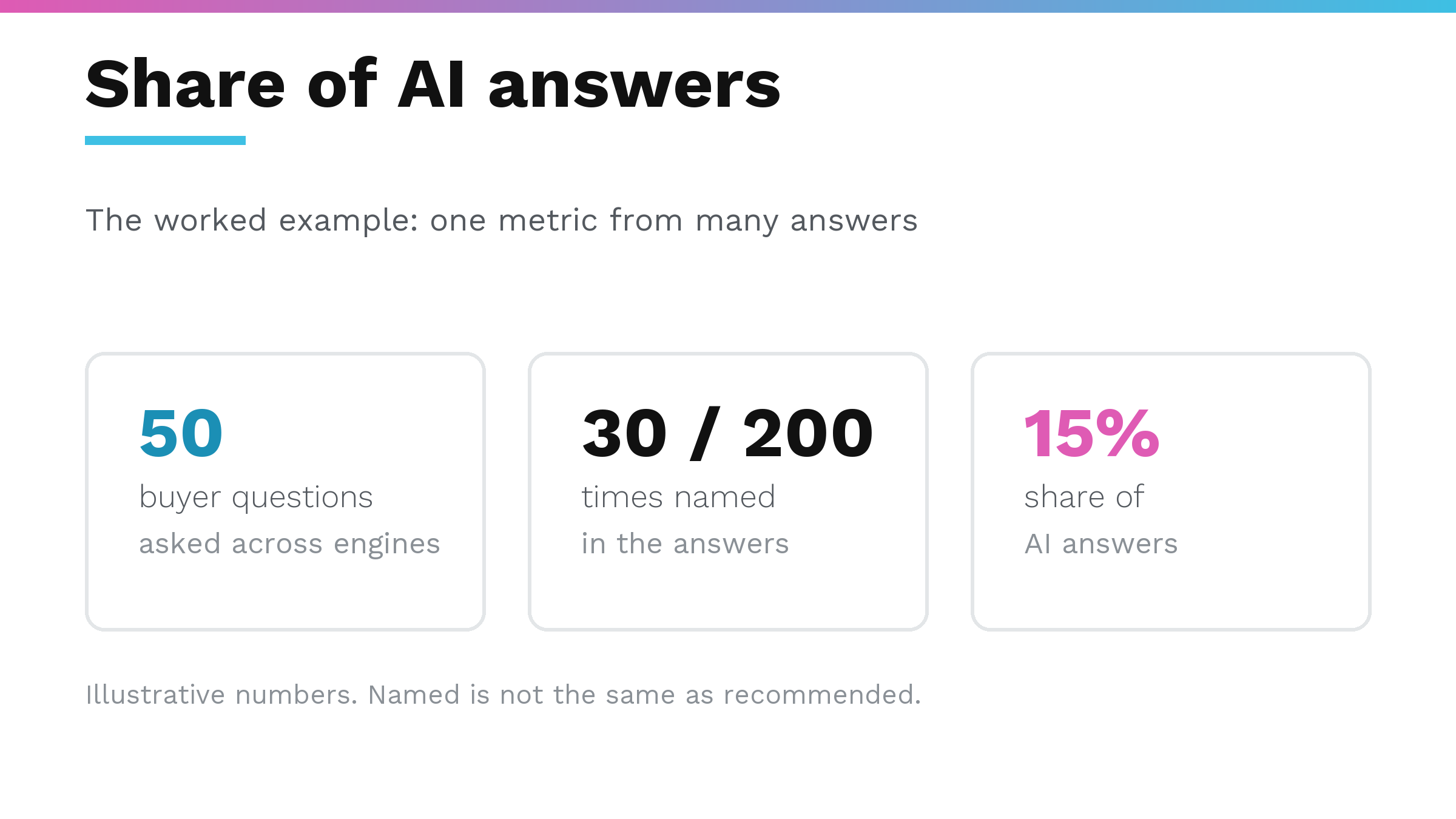
Share of AI answers applies the old share of voice logic to this new surface. It is the share of answers to a defined set of buyer questions where your company appears, measured against the competitors appearing in those same answers. Say a set of 50 buyer questions about your category produces answers that name companies 200 times across all answers (counting each company once per answer). If your company is named in 30 of those instances, your share of AI answers is 15 percent.
Why traditional SEO metrics miss the shortlist
A rank tracker shows where a page sits in a list of links. Forrester’s Buyers’ Journey Survey, 2025 found 94 percent of business buyers used AI in their buying process, up from 89 percent the year before. And 61 percent reported using private AI tools provided by their organization. The survey also found twice as many buyers named generative AI or conversational search a more meaningful information source than any other source. That means for a growing share of buyers the shortlist forms inside an answer engine rather than on a page of search results, which is the surface a rank tracker measures.
Analytics reports only the buyers who arrived at your site. It cannot report the shortlist you were left off. There is no line item in Google Analytics for “considered but dismissed.” And because answer engines generate a unique response per conversation, there is no shared results page you can inspect.
According to Semrush’s 2026 AI Visibility Index, 45 percent of marketing leaders cannot accurately measure their brand visibility in AI-generated answers, and only 9 percent have the tools to track all the relevant metrics across platforms. (Semrush sells AI-visibility tooling, so this is vendor-published research, not independent research.) The same report analyzed 126 million U.S. AI search prompts across ChatGPT, Gemini, Google AI Mode, and Google AI Overviews and found that only 36 brands maintained visibility across every platform for the whole window of January through April 2026. The examples Semrush names are consumer giants: YouTube, Google, Reddit, Amazon, Facebook, Apple, Walmart, Disney, Nintendo. An industrial manufacturer should not read that as the bar it has to clear.
Being named is not being recommended
The single most important distinction in measuring share of AI answers is the difference between being named and being recommended. An answer engine can mention a company in several ways. It can mention it in passing. It can mention it as a competitor to someone else. It can list it in a group of “other options” or “also considered.” Or it can put it forward as one the buyer should consider.
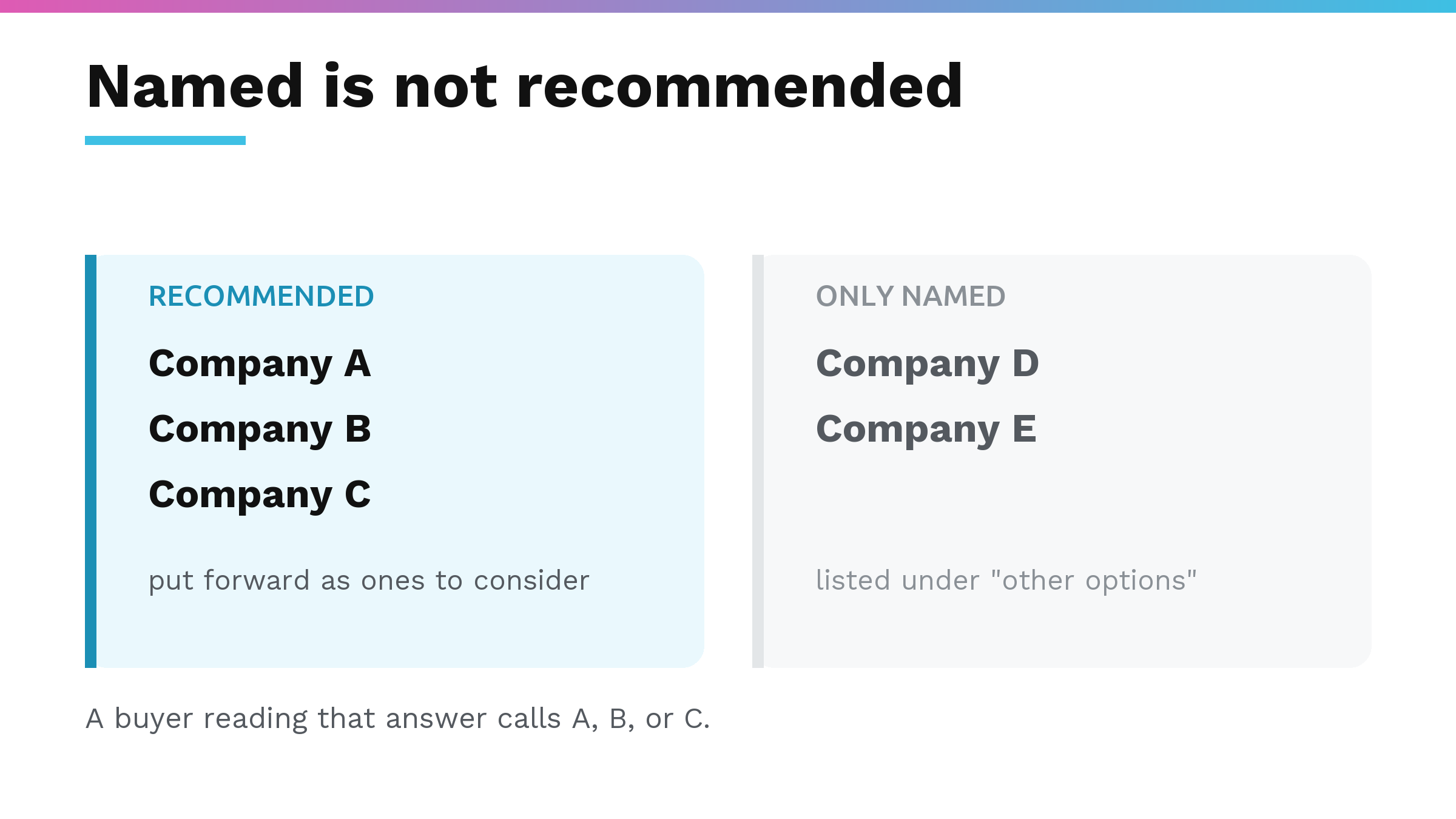
Imagine a buyer asks, “What are the best industrial pump manufacturers for wastewater treatment?” The answer engine says, “Three manufacturers stand out: Company A, Company B, and Company C. Other companies include Company D and Company E.” Companies A, B, and C are recommended. Company D and E are named. A buyer reading that paragraph will call Company A, B, or C. Any measurement worth using must classify every company in every answer as either named or recommended, using the same definitions each time. Without that classification, the number is a vanity metric.
The four parts of a real measurement
A measurement that produces a useful share of AI answers number has four moving parts. None of them is a script or a one-off query.
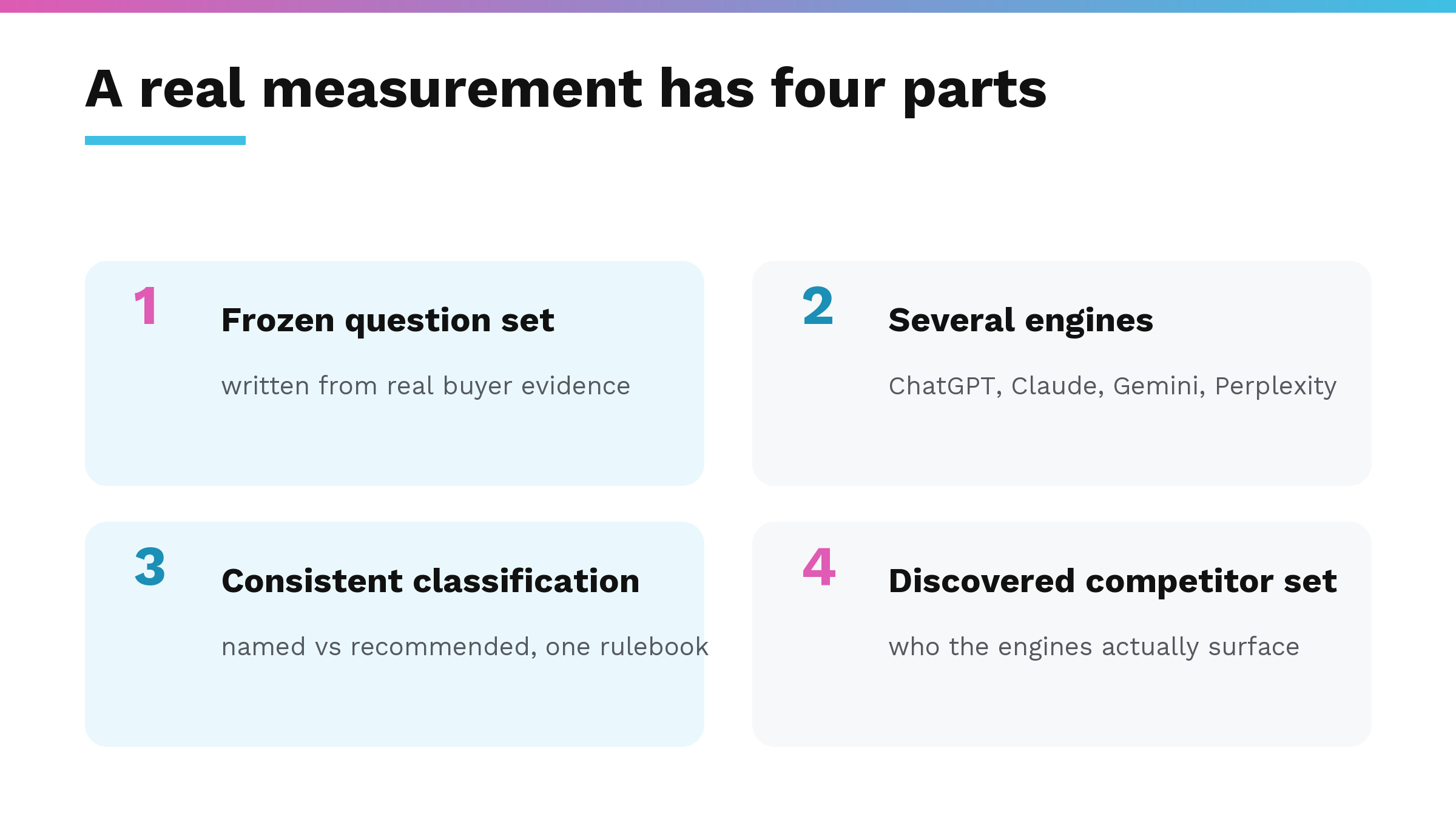
First, a fixed set of buyer-phrased questions. The questions must be written from real buyer evidence, not from asking an AI what buyers ask. Asking an AI produces questions that sound like buyer questions, but they are often hallucinated or pulled from content marketing. The question set is frozen so later runs are comparable. If the questions change, the share number changes for reasons that have nothing to do with your visibility.
Second, the same set of questions runs across several answer engines. ChatGPT, Claude, Gemini, and Perplexity do not agree. An answer that names your company in one engine may omit it in another, so a measurement taken from a single engine gives you a number specific to that engine rather than to the market.
Third, a human or a consistent classification system reads each answer and classifies every company in it as named or recommended. The classification rules must be applied identically across every run. Without that, the share number drifts from the definitions.
Fourth, your share is computed against the total mentions of all companies that appeared in the answers. The measurement discovers which companies the engines actually surface in your category, and a competitor list you wrote in advance will miss companies the engines put in front of your buyers.
If you want to know where you stand without assembling the measurement yourself, we run a flat-fee AI Visibility Audit. It measures whether answer engines name your company, benchmarks whoever is winning, and returns a written plan.
What moves your share
Four levers move your share of AI answers. The first is a gate, not a growth lever.
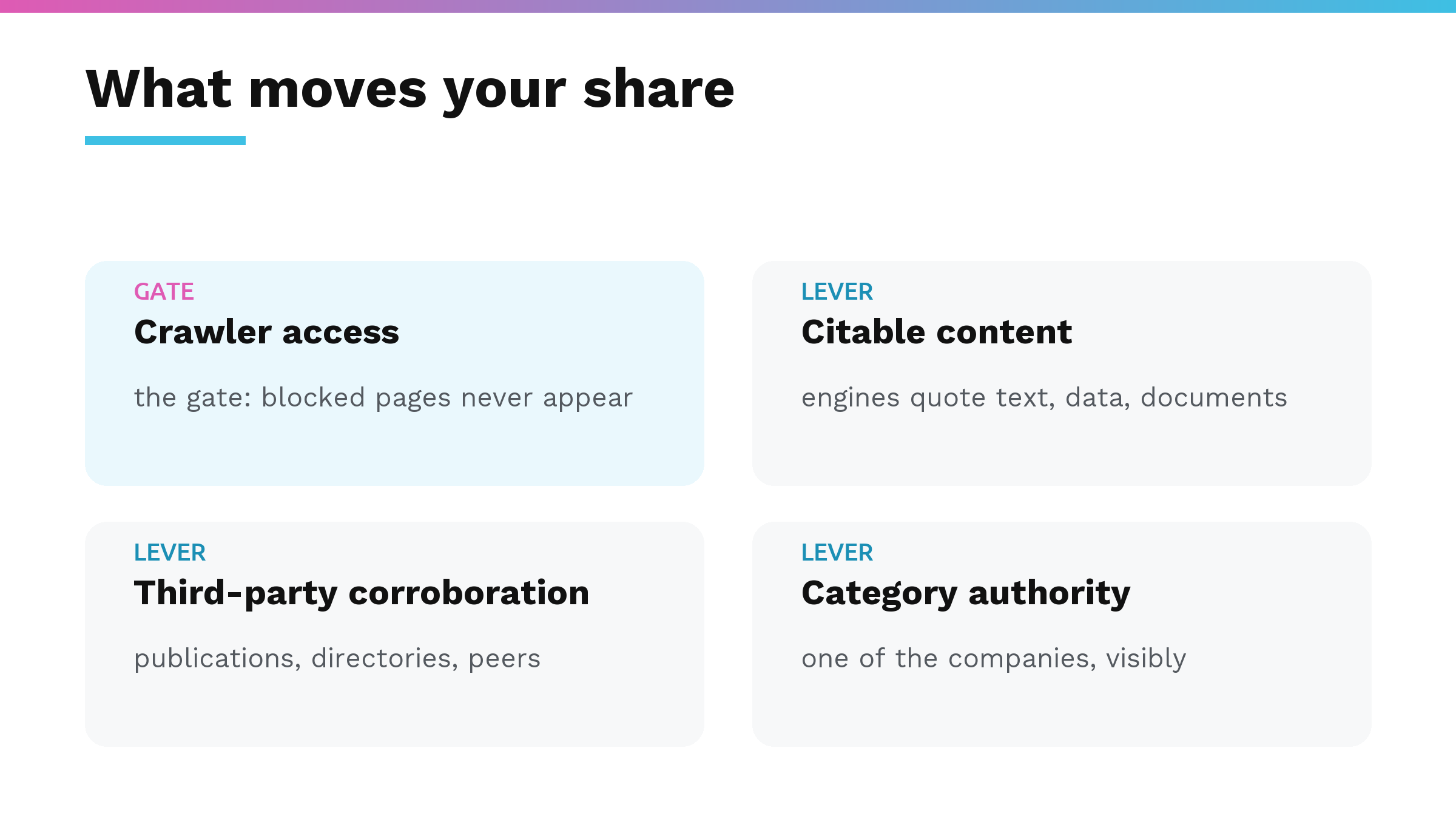
Whether answer engines can reach and read your pages at all. If your site blocks the crawlers that feed answer engines, or if your technical setup prevents parsing, you will not appear in answers regardless of everything else. This is the first gate of AI search readiness, which we covered in detail in the three gates of AI search readiness. The AI Agent Readiness Check reports whether a page passes that technical threshold.
Whether the things answer engines cite about you exist in a citable form. An answer engine cannot cite a reputation. It cannot cite a relationship. It cites text, structured data, and documents. If your company’s capabilities, use cases, and differentiators are not published in a form the engine can parse and quote, they will not appear in answers. This lever is partially under your control.
Whether third parties corroborate your claims. Answer engines lean heavily on sources other than your own site. Industry publications, engineering databases, trade association directories, and peer-reviewed articles all carry weight. This lever is slower, earned over time, and mostly lives on other people’s domains.
Category authority: whether you are visibly one of the companies in your category rather than a company with a website. Answer engines build a model of the category itself. This lever is the slowest and the least directly controllable.
Why a single check tells you nothing
A single measurement of share of AI answers is a single sample from a noisy distribution. Ask the same question twice and the list of companies can change. That is not a bug. Answer engines generate probabilistically, so the output varies from run to run.
A 2026 preprint (a paper posted publicly before peer review) titled Don’t Measure Once argues that a single query in a classical search engine often provides a representative snapshot, but the probabilistic nature of AI search makes one-off observations unreliable. The authors recommend characterizing a brand’s visibility as a distribution rather than a single-point outcome.
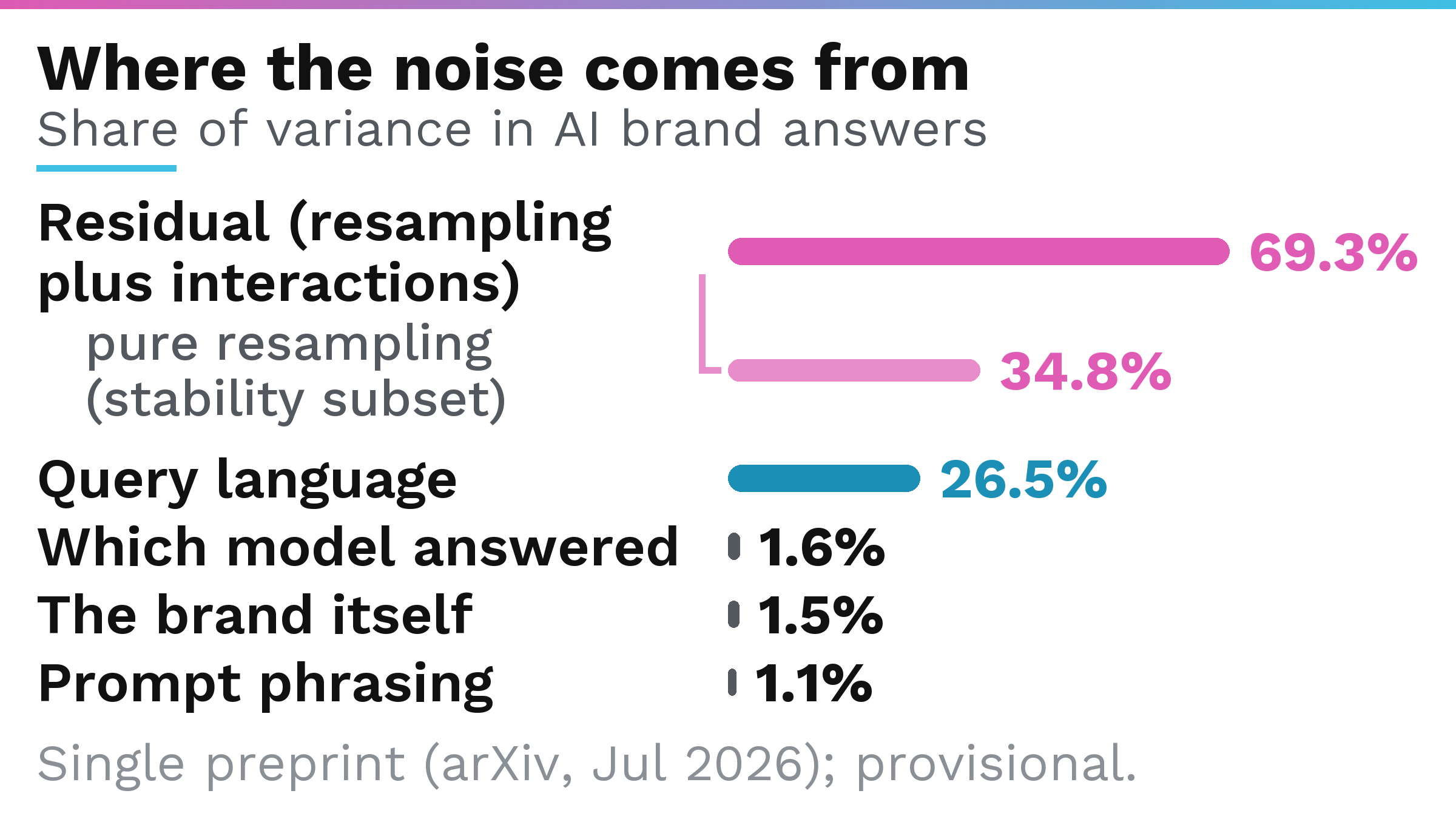
A variance decomposition study posted on arXiv in July 2026 quantified where the noise comes from. Across a large corpus of AI brand answers, 69.3 percent of the variance sat in a residual bucket that conflates run-to-run resampling with interaction effects, 26.5 percent came from the language the query was asked in, 1.6 percent from which model answered, 1.5 percent from the brand itself, and 1.1 percent from how the prompt was phrased. On a smaller stability subset the paper decomposed that residual further: pure run-to-run resampling, the model sampling a different continuation on an identical prompt, accounted for 34.8 percent, about a third of the movement in a replicated cell. This is a single preprint, not peer-reviewed and not replicated, so the exact numbers are provisional. The pattern matters: the largest source of variance is the fact that you asked the question again. That means any measurement that runs once and reports a number is reporting noise.
You can run a quick manual check yourself. We published a 10-minute AI visibility check that any marketer can follow. But a single sample is not a measurement.
The term “AI citation velocity” has started to appear in vendor marketing, defined as the rate at which a brand picks up new citations over a window. The underlying idea is reasonable: if your share is growing, you want to know that. But the term is not standardized. Different vendors define it with different windows: 7 days, 14 days, 30 days, or a rolling 30-day rate. No standards body or research paper has settled the definition.
If the underlying measurement is noisy, a growth rate computed on top of it is noisier still. A single spike in run-to-run variance can look like a surge in citation velocity. Citation velocity is one of many marketing labels that have emerged around AI search, much like AEO and GEO, which are largely SEO rebranded under new acronyms. Our post on AI citation volatility walks through a public example of Reddit’s citation share collapsing. When the distribution shifts, so does your number.
The first step is measuring where you are
A company either has a baseline number or it has a hunch. The two are not the same thing. Our AI Visibility Audit produces the baseline.
The AI Visibility Audit measures naming and recommendation across several AI assistants, using a fixed set of your buyers’ real questions. It returns a written plan. AI Visibility Audit
FAQ
What is share of AI answers?
Share of AI answers is the percentage of a defined set of buyer questions where your company appears in an AI-generated answer, measured against your competitors. It tracks whether answer engines name you when a buyer asks who to consider. Unlike traditional search visibility, it captures the shortlist that forms in conversational answers, where a mention is not the same as a recommendation.
What is the difference between being named and being recommended by AI?
The single most important distinction in measuring share of AI answers is the difference between being named and being recommended. An answer engine can mention a company in passing, as a competitor to someone else, or in a group of “other options” or “also considered.” Or it can put it forward as one the buyer should consider. Companies A, B, and C are recommended. Company D and E are named.
Why does my AI visibility change every time I check?
A single measurement of share of AI answers is a single sample from a noisy distribution. Ask the same question twice and the list of companies can change. That is not a bug. Answer engines generate probabilistically, so the output varies from run to run. A variance decomposition study quantified where the noise comes from. Across a large corpus of AI brand answers, 69.3 percent of the variance sat in a residual bucket that conflates run-to-run resampling with interaction effects. Decomposed further on a smaller subset, pure resampling, asking the same question again, accounted for 34.8 percent, about a third of the movement in a replicated cell.
What is AI citation velocity?
The term “AI citation velocity” has started to appear in vendor marketing, defined as the rate at which a brand picks up new citations over a window. The underlying idea is reasonable: if your share is growing, you want to know that. But the term is not standardized. Different vendors define it with different windows: 7 days, 14 days, 30 days, or a rolling 30-day rate. No standards body or research paper has settled the definition.
What are the four levers that move share of AI answers?
Four levers move your share of AI answers. The first is a gate, not a growth lever. Whether answer engines can reach and read your pages at all. Whether the things answer engines cite about you exist in a citable form. Whether third parties corroborate your claims. Category authority: whether you are visibly one of the companies in your category rather than a company with a website.