An AI assistant can recommend your company while sourcing the answer to a page you do not control and cannot update. The page that decides what a buyer believes about your company is one you cannot fix when it is out of date, leaves facts out, or puts you third behind two competitors. That is why ChatGPT will not cite your website even when it recommends you as a top option. You can measure your own version of that gap in one sitting. In its October 2025 report "The Influence of Offsite Signals in AI Search," AirOps found that only 13.2% of brand mentions came directly from the brand’s own domain.
Named, recommended, cited: three different events
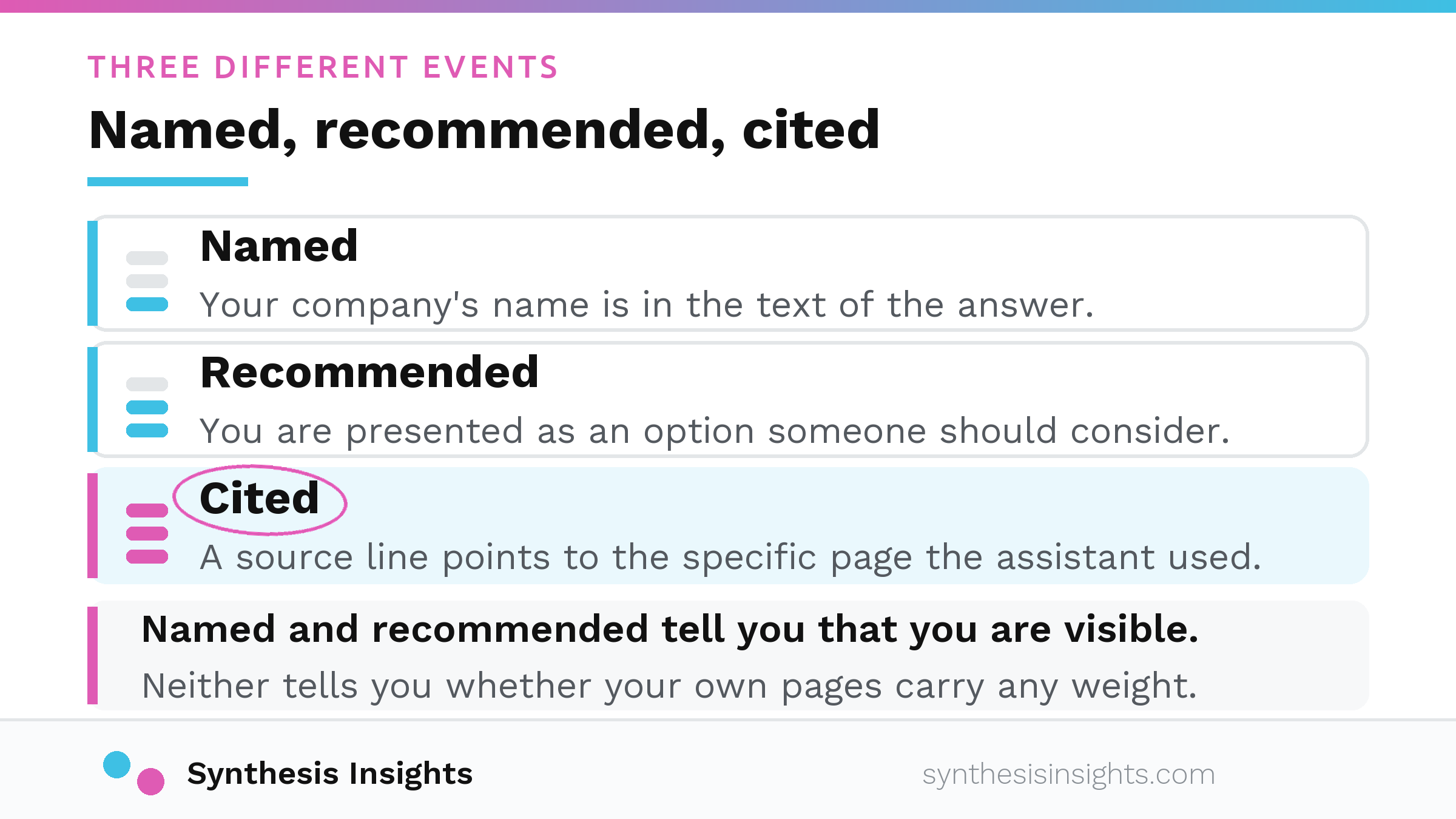
Being named and being recommended are separate events, covered in our earlier post on share of AI answers. Being named means the assistant uses your company’s name somewhere in the text of the answer. Being recommended means it presents you as an option someone should consider, often alongside competitors. Those two events tell you whether you are visible. They do not tell you whether your own pages carry any weight behind what the assistant says.
The third event is being cited. A citation is a source line: a reference that names or points to the specific page the assistant used to build that part of the answer. That source line is the only part of an AI answer you can trace, check, and act on. You can open it, read the page it points to, and understand exactly what the assistant relied on. You can see whether the assistant drew from your product page, a reviewer’s comparison table, or a trade publication’s analysis. When your company gets named but never cited on a page you own, the source line points to a third party that described you, and the reasoning that sent a buyer your way sits on a domain you cannot update or correct.
The gap between being recommended and being cited can be complete. In a recent probe, a brand that every engine named first for its category received zero of the 21 citations one engine produced for that category. The citations went to third-party pages that talk about the brand. The brand’s own site returned an HTTP 403 to a plain, non-browser fetch. This is one probe, not a rate. It shows the shape the problem can take.
Google and Bing now publish reports on how your site appears in AI answers, and can you see when ChatGPT cites your website covers what those reports count.
Whose pages do AI answers cite?
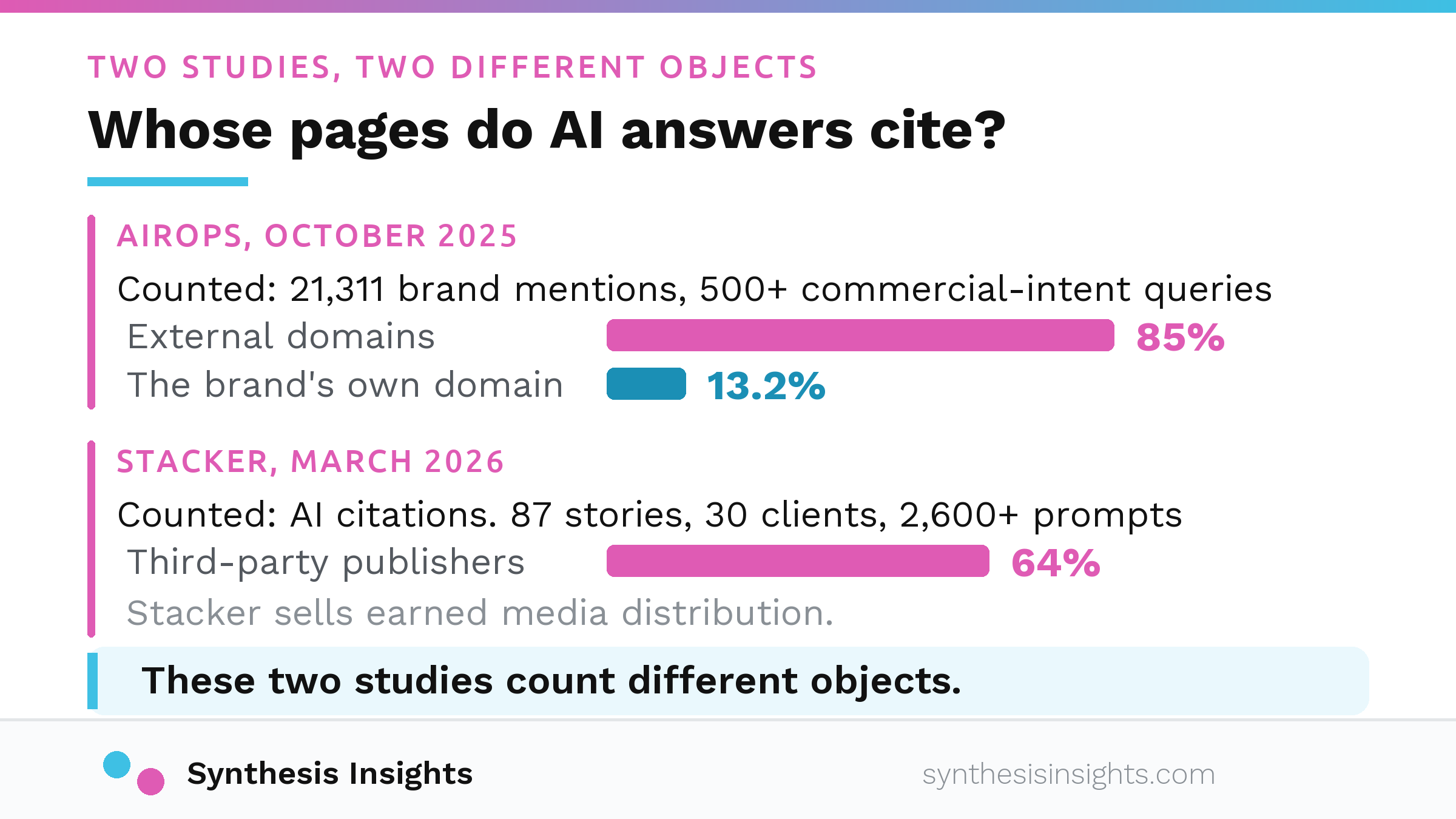
AirOps analyzed 21,311 brand mentions across more than 500 commercial-intent queries, tested on GPT-5, Claude Sonnet 4.5, and Perplexity Sonar. The study found that 85% of brand mentions came from external domains and only 13.2% came directly from the brand’s own domain.
A separate study, published by Stacker in March 2026, reported that 64% of AI citations came from third-party publisher sources, a finding from a company that sells earned media distribution and therefore has a commercial interest in third-party citation being the dominant pattern. That study was based on 87 stories across 30 clients, with more than 2,600 prompts queried across 8 AI platforms.
These two studies count different objects. AirOps counted brand mentions and where they originated. Stacker counted citations. Holding your own number up against both means you are holding it up against two different measurements.
Neither published figure was computed on the same basis as the share you are about to produce, so neither is a result to expect from your own tally; what matters is whether your number is near zero.
Run the 20-answer audit yourself
This worksheet measures where your citations come from. You can run it this afternoon with no tools beyond the assistants themselves.
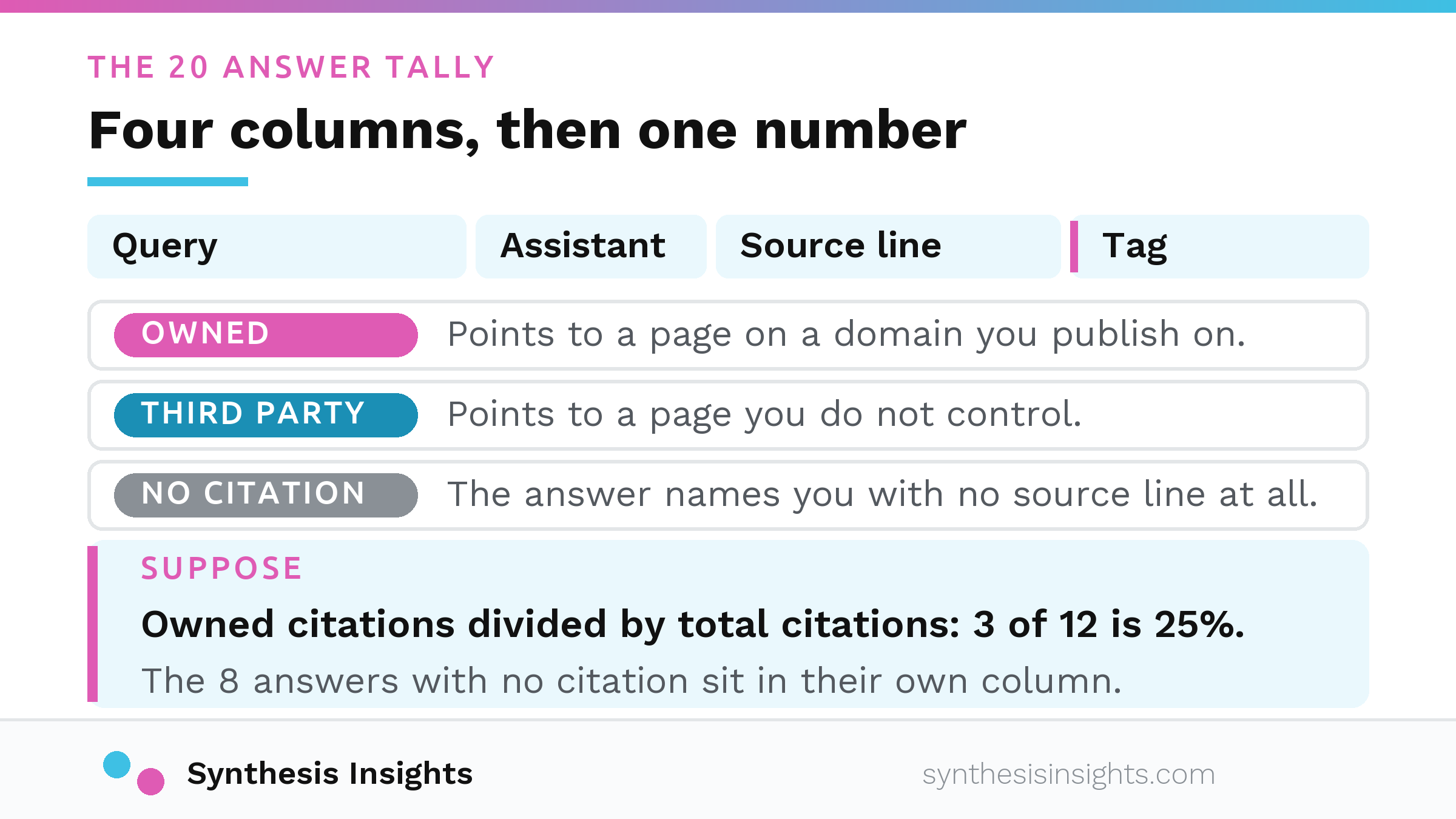
- Pull the last 20 AI answers that name your company. Answers forwarded by a colleague or prospect, and prompts you already log, can supplement the ones you run. The questions that produce such answers are the ones a buyer types before knowing your name: the category, the problem, and "best X for Y" variations. The source for those questions is your buyers’ language, covered in what buyers are asking ChatGPT about your industry. Discard any answer that comes back without your company in it, and keep going until you have twenty that do. A four-column spreadsheet is all you need: one for the query, one for the assistant that produced the answer, one for the source line you will tag in the next step, and one for that tag.
- For each answer, find the source line attached to the sentence that names you: the reference the answer attaches to that sentence. Not every mention carries one. When the assistant did not search, there is nothing to find, and that absence is itself a data point.
- Tag each answer as one of three things. An owned citation is a source line that points to a page on a domain you own (a profile or listing on a platform someone else owns counts as third party). A third-party citation is a source line that points to a page you do not control. The third bucket is named with no citation at all.
- Compute your owned share: owned citations divided by total citations, and compute that share for each assistant separately as well.
Count the no-citation bucket separately. A mention with no source line is not a citation at all. Folding it into the total changes what the percentage measures. Suppose you ran 20 answers and found 12 citations total, with 3 of them owned. Your owned share is 3 divided by 12, or 25%. The 8 answers that named you without citing anything sit in their own column. They tell you how often your name appears without any traceable source behind it, which is its own finding and has its own fix.
The three reasons your own page loses the citation
The assistant answered without searching
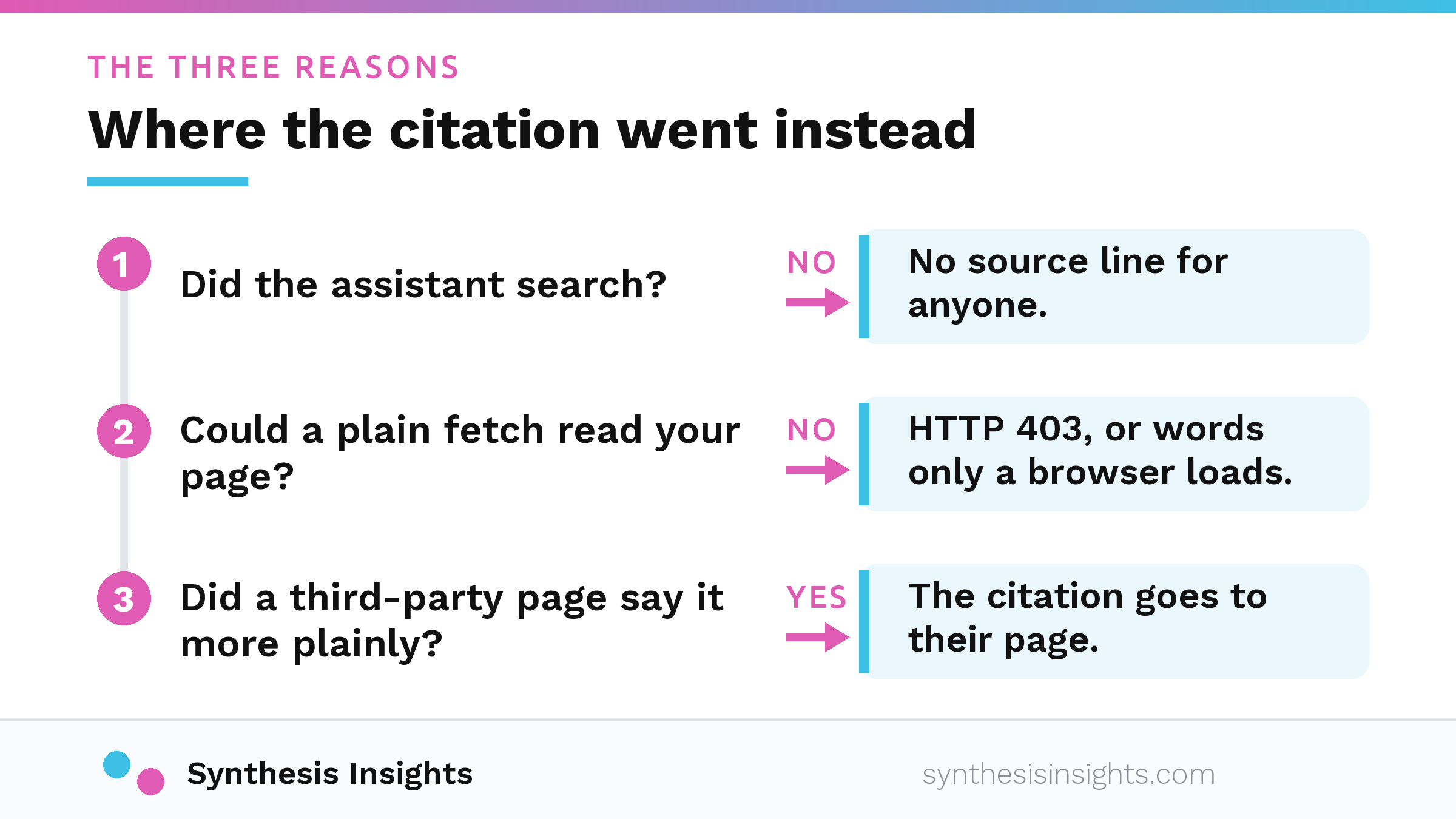
An assistant that never searched answered from what it already held. When it builds the answer that way, the result carries no source line for anyone, including your competitors. You cannot win a citation that was never available in the first place. The assistant drew on patterns it absorbed during training, and no specific page gets credited because no specific page was consulted. This is the reason you have the least direct control over. Since stored knowledge is frozen at the training cutoff, answers built from it may be out of date, and fixing a wrong description is a separate problem from winning a citation, as wrong information about your company details.
The assistant searched but could not read your page
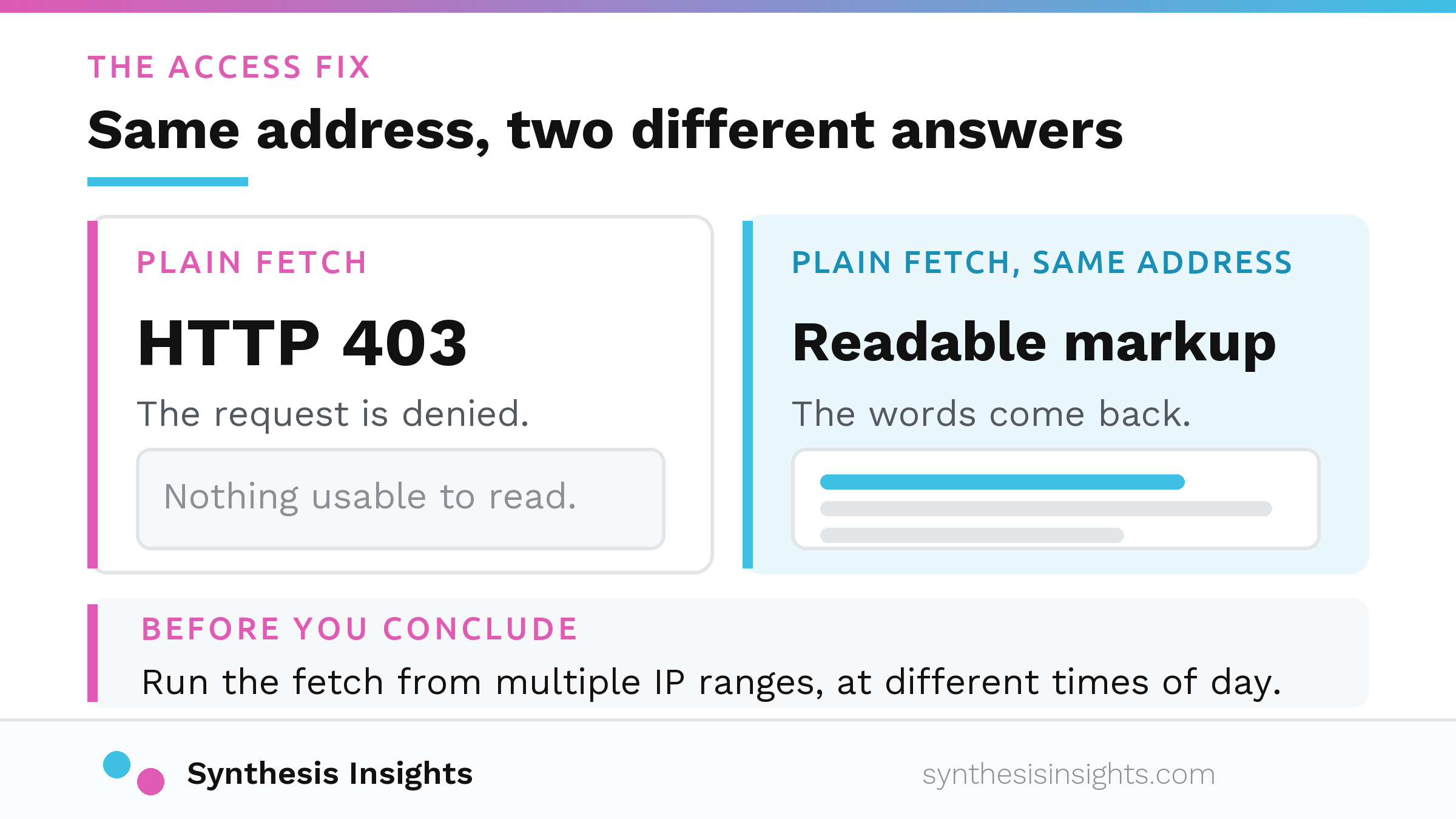
A page that is invisible to a simple fetch cannot become a citation, no matter how good it is. Run a plain fetch: request the page’s address the way a simple program does, without a browser, and read what comes back. If the server returns an HTTP 403, the request is denied. If the page’s words only appear after scripts run in a browser, the plain fetch holds nothing usable. Either way, the assistant that searched got nothing.
A third-party page answered the same question more clearly
The assistant could read your page and a third-party page said the same thing more plainly, earlier, and in fewer words. An answer that sits in the opening paragraph is available to anything that reads the page. An answer that appears only after extended context is available only if the reader stayed that long.
What to do about each reason
When a model answered from stored knowledge, you cannot change that answer. The work is forward looking: make your pages readable and plain now so your material is available when a search does run. Structure pages so the answer sits at the top, in the language the buyer uses when they ask the question.
When the assistant searched and could not read the page, the fix is access. You need to know which AI crawlers can retrieve your pages. Our guide on how to check which AI bots can access your website walks through the test. Once you know which bots can reach your pages, you can decide which ones to allow. If you find a block, use the AI crawler list to identify the correct bot names to allow.
When a third-party page won because it answered more plainly, the fix is the shape of your own page. Restructure it so the direct answer appears up front, in the reader’s own words, before the context and explanation. A product page that opens with three paragraphs of brand positioning before stating what the product does is structured differently from a review site that names the product and its function in the first sentence.
What this audit can and cannot tell you
Twenty answers is a small sample and one sitting is one snapshot; the same question asked twice can return a different result, which is why broader tracking over time matters, as covered in share of AI answers.
A number blended across several assistants is an average, and an average can hide one assistant behaving completely differently from the others. One assistant might cite you consistently while another never does, and the blended number will tell you none of that.
A plain fetch that returns an HTTP 403 once means you should re-test before concluding anything, because bot protection varies by the address a request comes from, by what the request says about itself, and by time. Run the fetch from multiple IP ranges and at different times of day before you decide the page is permanently blocked.
The audit reads the answers themselves. Your analytics record the clicks that arrive from an assistant, and how to see ChatGPT traffic in Google Analytics shows where to find them.
Where the work actually goes
Two levers move your owned share. The slow lever is editorial: how plainly your own pages state their answers, and what gets published about your company elsewhere. That is the lever that shifts your owned share from near zero to a number that reflects the weight of your own site. It moves over months because it depends on your publishing cadence and on external articles you do not control. The fast lever is technical: access and page structure, which a reader can change in a week. The slow lever is the bigger one. Your own worksheet gives you one sitting’s blended number. The AI Visibility Audit runs a fixed set of your buyers’ real questions across several assistants and returns the baseline and the written plan that one afternoon’s tally cannot produce.
FAQ
Why doesn’t ChatGPT cite my website?
An answer that comes from the model’s existing knowledge contains no source line at all. When a search does run, your page might be inaccessible to a plain fetch, either because the server denies the request or because the text only loads after scripts execute in a browser. Even when the page is readable, a third-party page that states the same answer more plainly and earlier will often win the citation.
What is the difference between being mentioned and being cited by ChatGPT?
Being mentioned means the assistant uses your company’s name in the text of an answer. Being cited means the answer includes a source line that points to a specific page the assistant used to form that statement. A mention tells you that you are part of the conversation. A citation tells you whose page earned the link and what reasoning the assistant is relying on.
What sources does ChatGPT cite instead of brand websites?
Across the three assistants it tested, AirOps found that 85% of brand mentions came from external domains and nearly 90% of those third-party mentions came from listicles, comparison pages, or reviews. The pattern is that assistants cite pages that aggregate, compare, and summarize.
How do I check which pages ChatGPT cites about my company?
Gather the last 20 AI answers that name your company. For each answer, locate the source line attached to the sentence that names you. Tag each as an owned citation (points to a page you control), a third-party citation (points to a page you do not control), or named with no citation at all. Divide owned citations by total citations to produce your owned share. That number tells you how much of your citation footprint is on your own pages.
Does blocking AI crawlers stop ChatGPT from citing me?
OpenAI documents OAI-SearchBot as the crawler used to surface websites in search results in ChatGPT’s search features, so blocking it blocks the crawler behind those results. A server that returns HTTP 403 to every plain request is a different problem from a robots.txt directive. See the fuller explanation on website blocking AI crawlers.