B2B search engine marketing is a twenty-five-year-old term describing a search engine that doesn't work the way it used to. When Danny Sullivan coined the phrase in 2001, a search engine returned a page of organic listings with a few paid ones next to them, and search engine marketing meant everything you did to show up in either, one discipline built on two levers. That's not what most people mean by the term now, and it's not what a modern B2B buyer actually sees when they go looking for a vendor. Today the same research question can get answered by a paid ad, an organic result, or an AI assistant that skips the results page entirely and just names three companies. Only some of that is worth budget. All of it gets called the same thing.
Where the term actually came from
Sullivan didn't invent search advertising or SEO. He named the category that held both. Writing about his own 2001 usage, he said flatly: "SEM = SEO + PPC". He'd wanted one term for the whole spectrum, "optimizing for crawlers, managing paid listings, submitting to directories," and his reasoning was practical, not academic: "I think it's important to have an umbrella term because a good search marketer does want to consider both things." Optimizing your site and buying placement above it were the same job wearing two hats.
Somewhere in the years after, the industry split the word from half its meaning. SEM narrowed until most people use it as a synonym for paid search alone, and organic kept "SEO" to itself as a separate specialty with its own agencies, its own tools, its own line item. That split wasn't wrong exactly. Paid and organic really do run on different mechanics, different timelines, different budgets. But it left the original umbrella term homeless, doing duty as a stand-in for just one of the two things it was built to describe.
What "search engine" means in 2026
The narrower problem is that "search engine" has moved again, and this time nobody's proposed a new word for it. Google doesn't route every query to a results page anymore. In its own words, from the July 2026 earnings call recap on the company blog, Google has "recently brought together AI Overviews and AI Mode into one seamless Search experience that combines our frontier capabilities with the best of the web," and AI Mode, its chat-style search experience, alone has "surpassed 1 billion monthly active users" since its global rollout the previous October. A billion people a month are using a search experience that, for a growing share of queries, never generates a page of blue links at all. It generates an answer, sometimes with a short list of companies attached, and moves on.
For a B2B buyer, that answer can be the entire research step. Someone on a buying committee asks an assistant "who handles industrial coatings for a company our size" the same way they used to type it into Google, and depending on the query, they get an AI-written summary that names a handful of vendors instead of ten links to evaluate themselves. The search engine Sullivan wrote about in 2001, and the one most SEM advice still assumes, was a list a human clicked through. The one a meaningful share of today's buyers use is closer to being asked a question and handed an opinion.
Three jobs wearing one name
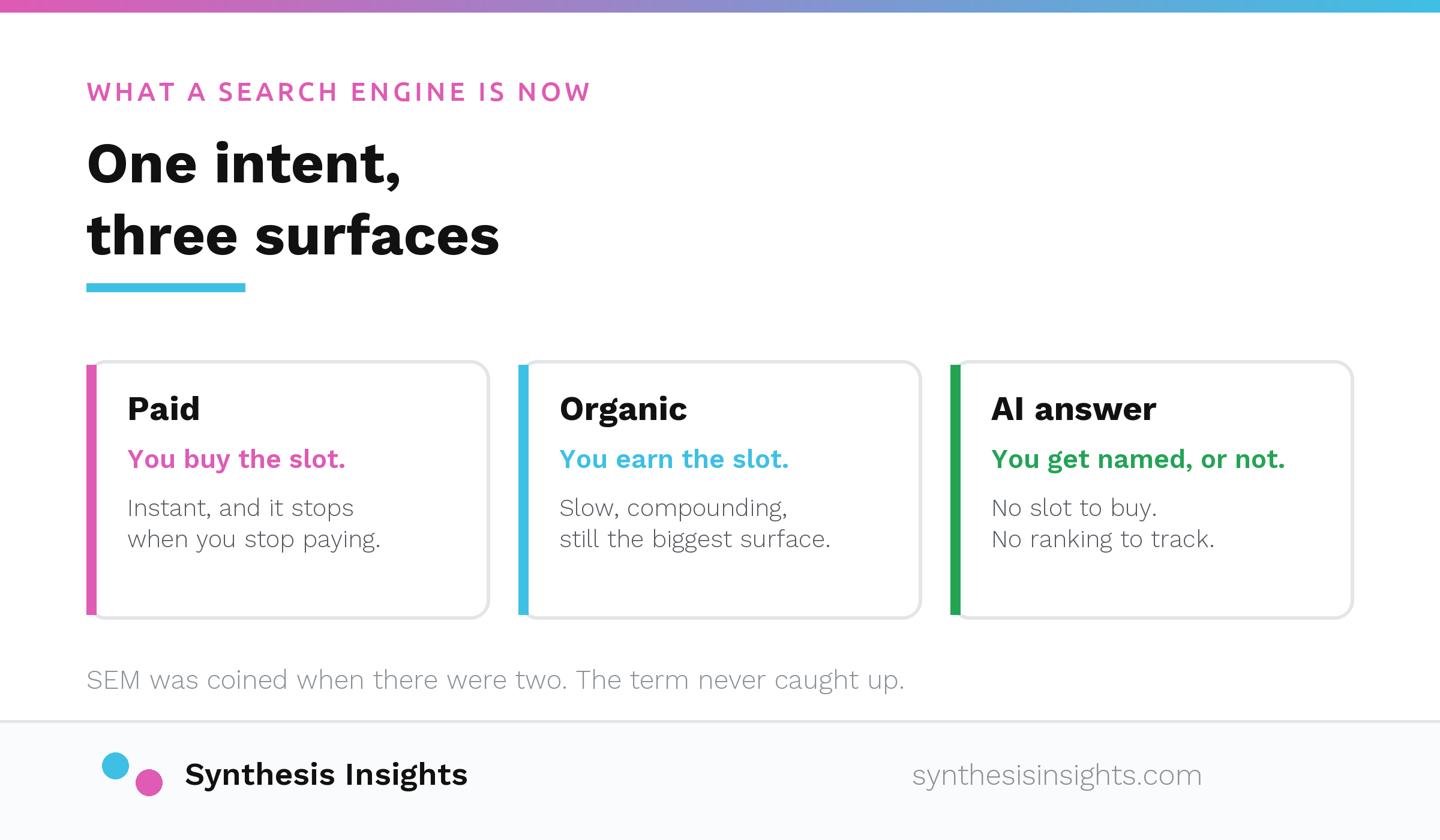
So "B2B search engine marketing" in 2026 covers three surfaces that behave nothing alike, and treating them as one motion is where most SEM advice goes wrong.
That split matters more in B2B than it does for a consumer buying one item on impulse, because a B2B purchase usually runs through more than one person. A buyer might click a paid ad on Monday, land on an organic explainer while comparing options on Wednesday, and ask an assistant which vendor a colleague hasn't heard of before looping that colleague in on Friday. One purchase produces three separate research moments, and each gets answered by a different surface. Treat "search engine marketing" as a single motion and fund the one surface you already understand, and you can starve the other two by accident, without ever deciding to.
Paid search is still the closest thing to what the term originally half-meant: you bid, you win or lose an auction, you pay per click, and the placement disappears the moment the budget does. It's the only one of the three you can turn on this afternoon and be visible for a specific, exact-match buyer intent by tomorrow. Whether it's worth turning on comes down to your funnel's economics far more than the auction's mechanics, and that's its own question with its own math I've written up separately: B2B PPC.
Organic is the compounding asset. It costs time and content instead of a daily bid, it takes months to show up, and once it's ranking it keeps showing up without a repeat charge. It also happens to be the raw material the AI surfaces below draw from, though I'd keep building it even if that link vanished tomorrow. If you want to know which organic metrics actually tell you it's working versus which ones just look like progress, that's covered here: SEO KPIs.
AI answers are the one nobody's fully priced yet, because there's no auction to bid into and no keyword to rank for in the traditional sense. An assistant either names your company when someone describes the problem you solve, or it doesn't, and right now most companies have no idea which one is true for them. If you want to find out where you actually stand, I wrote a short diagnostic for exactly that: AI Visibility Check.
What's actually worth a B2B budget
Here's the allocation, stated plainly instead of diplomatically. Paid search earns a line item when the math behind it works. It's a rented placement, and rented placements are worth exactly what they return, no more sentimental than that. Organic earns a standing investment almost regardless of your paid budget, because it's the only one of the three that gets cheaper to maintain the longer you've done it, and because it's quietly become the input to the surface everyone's newly worried about. AI answers don't currently earn a budget line of their own. There's no invoice to write for "get mentioned by an assistant." What earns you a mention there is mostly the same organic authority and clear, citable description of what you do that earns you a mention anywhere else. It's a downstream effect, not a channel you buy.
That's a less satisfying answer than "spend X on AI optimization," and it's the honest one. The buyers asking assistants for vendor names are drawing on the same signals search engines have rewarded for years: a company that says clearly what it does, backed by a site an algorithm and a language model can both parse without guessing. Chasing a fourth channel with its own budget line is premature. Getting the other two right isn't.
If you're trying to figure out where your own mix actually stands, that's a conversation worth having before you spend more anywhere: Paid Media Management, or the paid search side specifically if that is where the budget already sits.
The term "search engine marketing" hasn't caught up to any of this, and it probably won't. Words rarely get revised once they're load-bearing in enough job titles and line items. What can get revised is what you do under the label. Twenty-five years after Sullivan coined it to mean one discipline with two levers, it's grown a third, and most B2B budgets still allocate like it only has one.