"B2B marketing trends" posts share a scoring problem: they predict, and nobody ever comes back to check. Somebody writes "video will keep growing" and "AI will personalize everything," a year passes, and neither sentence gets held to account. I'm not going to do that here.
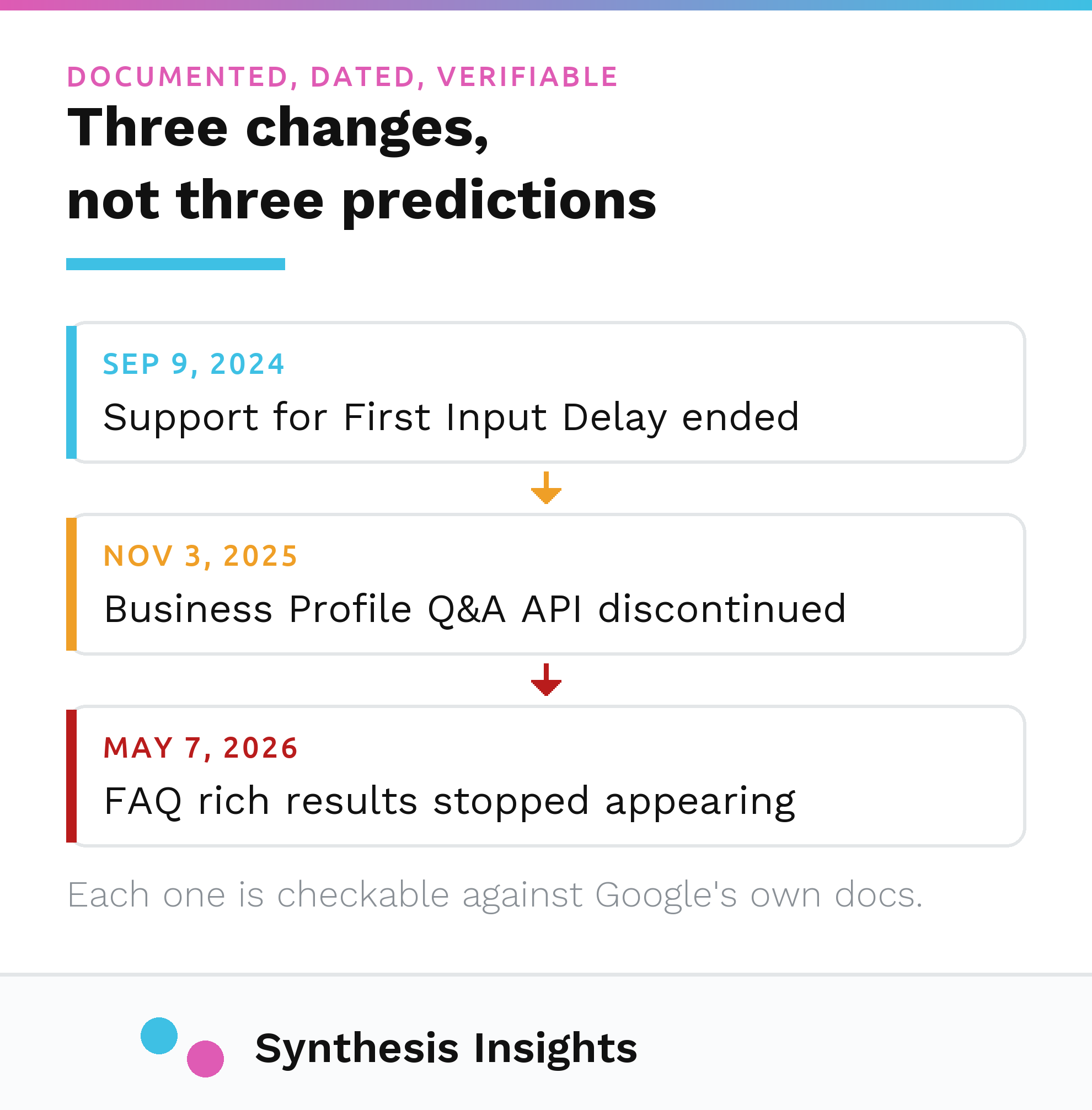
Instead, here's a narrower question: what actually changed in the last two years that breaks something a B2B marketer is currently relying on? Not a forecast. A record. Three platform changes, each with the date, the primary source, and what to do differently because of it.
Google stopped rendering FAQ rich results in May 2026
If your site publishes FAQ schema hoping for the expanded question-and-answer snippet in search results, that snippet is gone. Google's own structured data documentation states the feature "will no longer appear in Google Search starting May 7, 2026," and Google's Search Central documentation confirms the removal took effect on that date. Google will also drop the FAQ search-appearance filter and Rich Results Test support for it, and teams still pulling FAQ data through the Search Console API have until August to adjust those calls.
This isn't sudden. Google restricted FAQ rich results to authoritative government and health sites back in August 2023. May 2026 just finished the job for everyone else.
What to do differently: stop building FAQ schema for the rich result. The FAQPage markup itself isn't banned, and there's no penalty for having it, but the visual payoff that used to justify the engineering time is off the table. If your team still has "add FAQ schema" as a standing SEO deliverable, that line item needs a different justification or it needs to go.
Google discontinued the Business Profile Q&A API on November 3, 2025
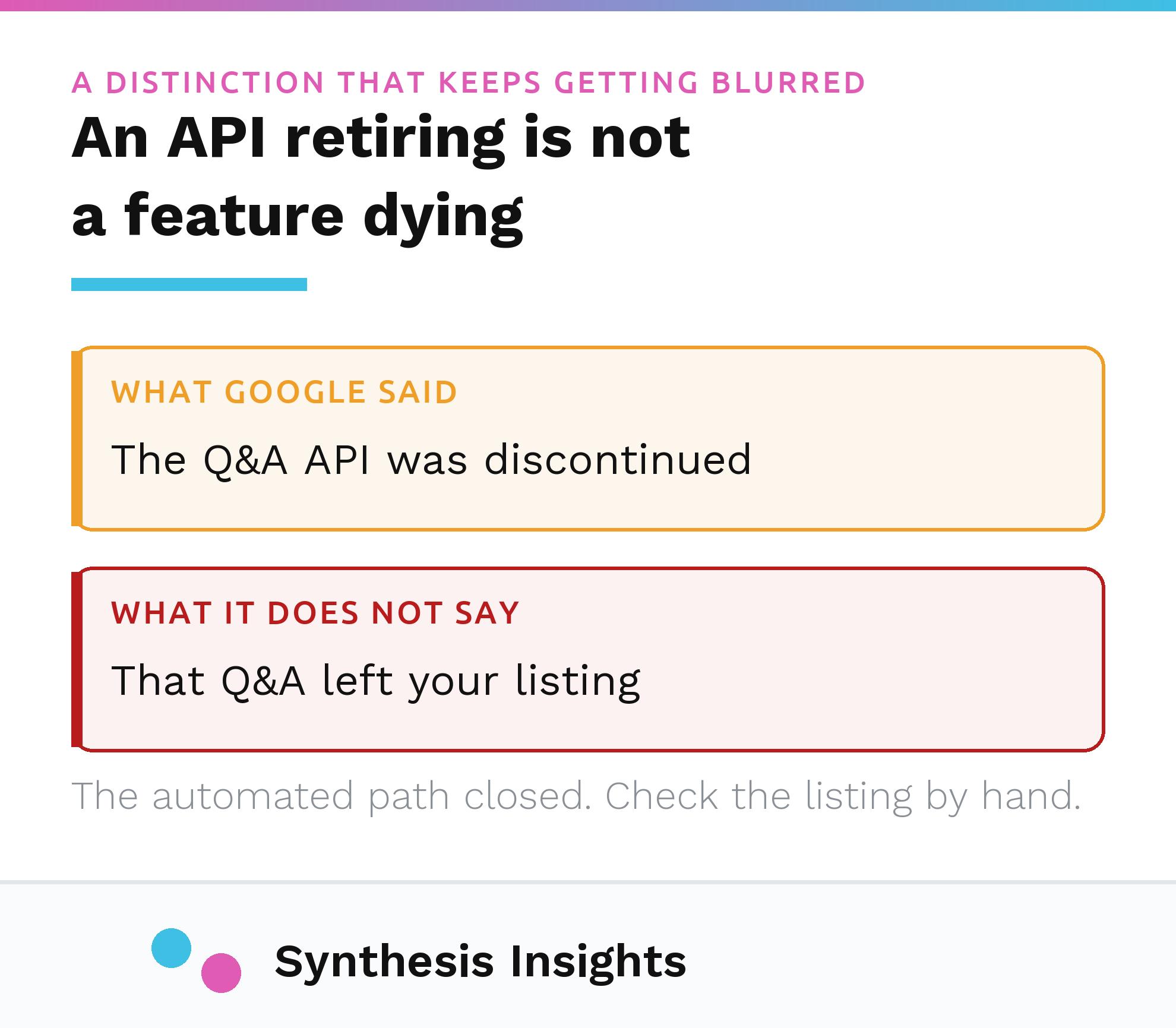
This one gets confused with the wrong claim, so I want to be precise. The API being discontinued is not the same as the Q&A feature disappearing from Google Business Profile listings. Google's own change log states it plainly: "On November 3, 2025, we will be discontinuing the My Business Q&A API as we are in the process of updating the Q&A functionality and user experience." That's an API retirement, tied to Google reworking how Q&A works, not a removal of the feature from the profile page itself.
What changed in practice: any tool or integration that read or posted questions and answers programmatically through that API stopped working on November 3, 2025. If your listing management vendor used to auto-answer common questions on your Google Business Profile through the API, check with them directly on how they're handling it now, because the automated path is closed and Google hasn't published a replacement.
What to do differently: if this affects you, don't assume the feature is dead and stop monitoring it. Check the listing manually and ask your vendor what changed on their end, specifically.
First Input Delay was replaced by Interaction to Next Paint
If you're still reading a technical SEO guide, an agency audit template, or an internal Core Web Vitals dashboard that names First Input Delay (FID) as a ranking signal, that guide predates a real change. Google's web.dev blog announced that "Interaction to Next Paint is now a stable Core Web Vital metric, replacing First Input Delay." Google's own FID documentation is blunter about what happened next: support for FID ended on September 9, 2024, and it tells you to focus on INP instead.
The practical difference matters for anyone who actually reads these reports. FID measured only the delay before the browser could start responding to a user's first interaction with the page. INP measures the full responsiveness of every interaction across the page's lifetime, not just the first one and not just the start of the response. A page can pass FID cleanly and still feel sluggish on the third click, because FID was never watching for that.
What to do differently: if a vendor hands you a Core Web Vitals report and FID is one of the three headline metrics, ask why. That's either a stale template or a stale understanding of what Google measures, and either way it's worth a direct question before you trust the rest of the report.
The harder trend: AI assistants answer questions without a results page at all
I'm not going to attach a made-up adoption percentage to this one, because I haven't found a number I trust enough to publish, and a trends post that invents statistics to sound current is worse than one that says less. What I can say plainly: when someone asks ChatGPT, Perplexity, or Gemini which vendor to shortlist for an industrial part, a coating process, or a technical service, there often isn't a search results page in that exchange at all. No blue links, no meta description, no FAQ rich result to click through.
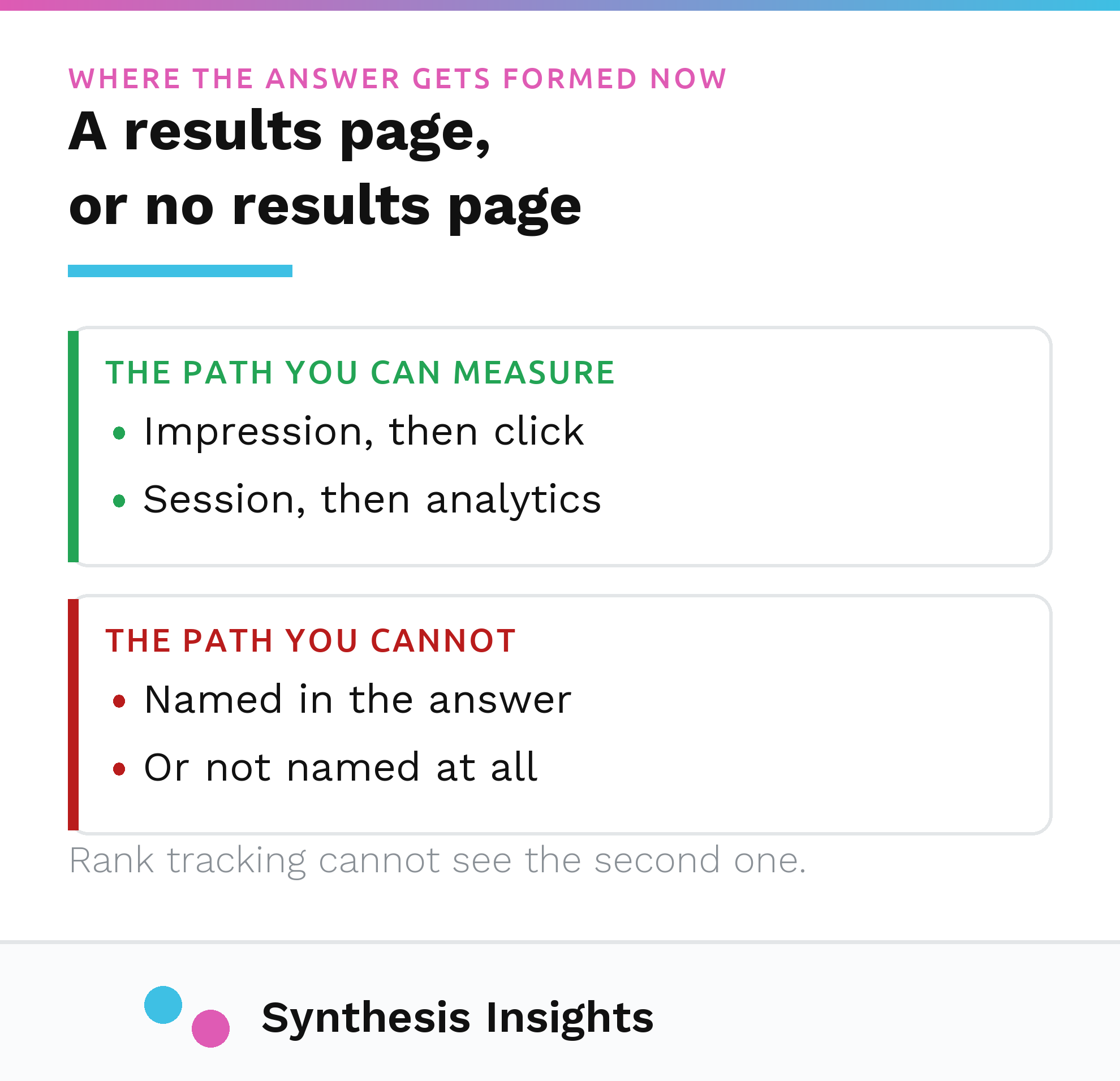
That doesn't make the three changes above less relevant. It changes what they're for. Structured data, page speed, and listing accuracy are still inputs into how a platform (search or AI) forms and cites an answer. But the traditional way of checking "are we visible" (rank tracking, a results-page screenshot) doesn't capture whether an assistant is naming your company at all. That's a different measurement problem, and it's the one we walk through in our AI visibility audit. For a plainer breakdown of how that overlaps and doesn't overlap with traditional SEO, I wrote about it separately in AEO vs GEO vs SEO.
Why I didn't write the version with ten predictions
A prediction-heavy trends post is entertainment. Nobody comes back in twelve months to check whether "hyper-personalization at scale" happened, because it's not falsifiable enough to check. A documented change is falsifiable by design: it has a date and a source, and you can verify it yourself in five minutes using the links above. That's the only kind of trends content I think is worth publishing, and it's the only kind I'm going to keep writing.
If your team's SEO or content process still runs on FID benchmarks, FAQ schema for the rich result, or an untouched Google Business Profile integration, those are the three places to check first, not the eight-trend list.