B2B conversion rate optimization (CRO) is the practice of identifying and fixing barriers that keep industrial buyers from becoming qualified leads, then measuring the result against CRM-attributed pipeline and revenue rather than raw form fills. Unlike B2C conversion work, where a visitor might check out in a single session, industrial buying cycles involve extended research, multiple stakeholders, and a request for a quote or a call long before a form submission. (In British English it's spelled "conversion rate optimisation"; the discipline is the same.)
Most B2B conversion rate optimization advice assumes you can run a real experiment: split the traffic, wait for a winner, ship it. In B2B lead generation, that assumption is usually wrong. Most B2B accounts do not get enough traffic to make an A/B test mean anything, and a test that never reaches statistical significance is not a test. It is a coin flip you paid for.
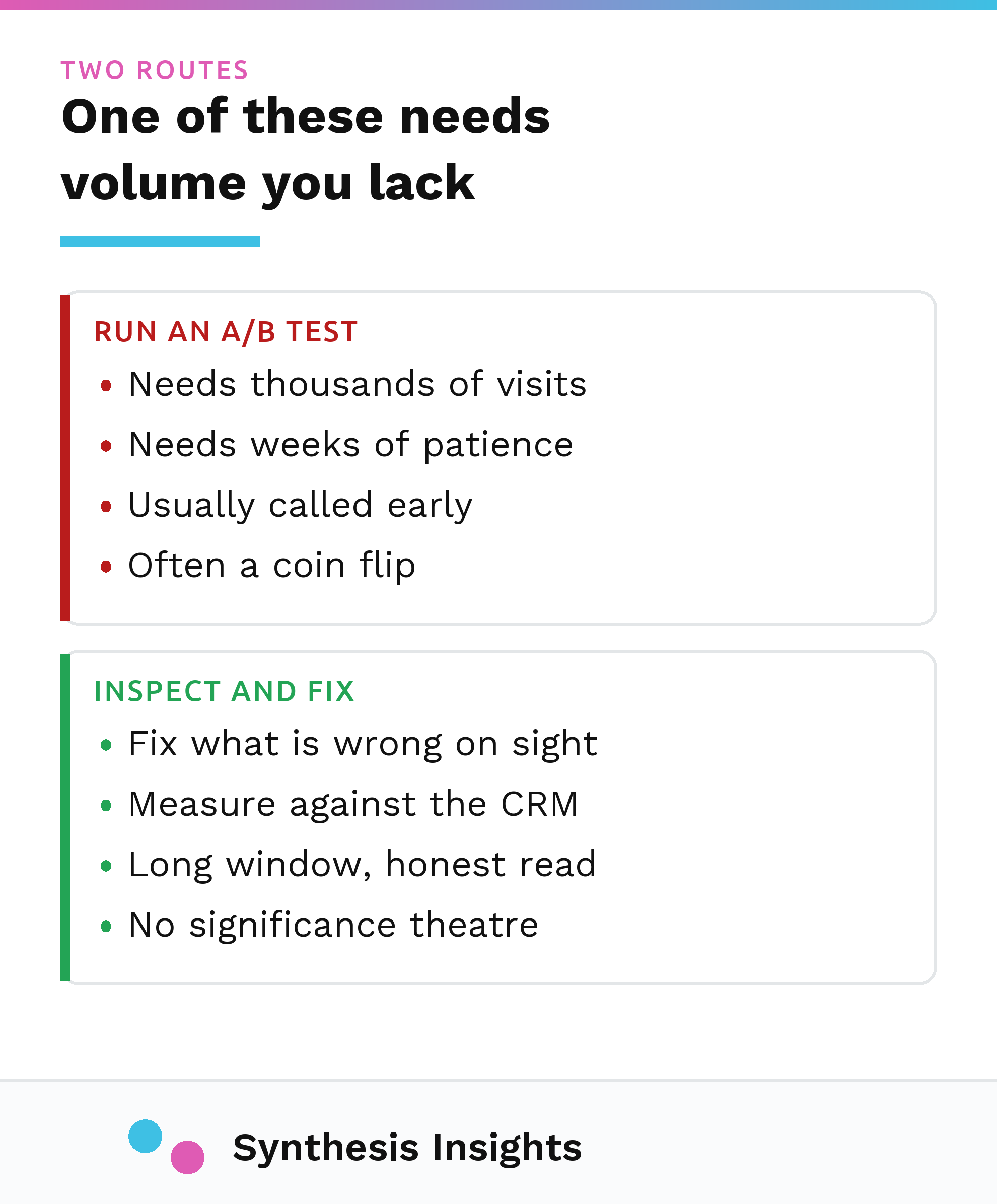
That is not a reason to skip conversion work. It is a reason to do it differently. Instead of testing your way to a better landing page, you inspect your way there: fix what is visibly wrong, measure against what your CRM actually closes rather than what your form counts, and give judgment a longer window than a "test" ever gets.
I want to be specific about why the math does not work, because "not enough traffic" gets thrown around as an excuse for skipping conversion work entirely, and that is a different, lazier claim. The problem is not that testing is hard. It is that most B2B accounts do not clear the volume a valid test requires, and running one anyway produces a result that looks scientific and is not.
What is a good B2B conversion rate for industrial and manufacturing sites?
Before benchmarking conversion rates, it helps to clarify which conversions we're measuring. For a manufacturer, a qualified lead that enters the CRM from a phone call can be worth more than a stack of raw form submissions that never turn into pipeline.
I see teams chase a single blended benchmark and decide their site is broken because it falls short. The number they find is a B2B average that hides a spread so wide it cannot tell any individual company whether it is doing well. The real picture is messier and more useful.
First Page Sage publishes conversion rates by industry from their client data, and the spread tells the real story.
- Manufacturing: 2.2%
- Industrial IoT: 2.6%
- Heavy Equipment: 1.7%
- Engineering: 1.2%
- Construction: 1.9%
- B2B SaaS: 1.1%
- Legal Services: 7.4%
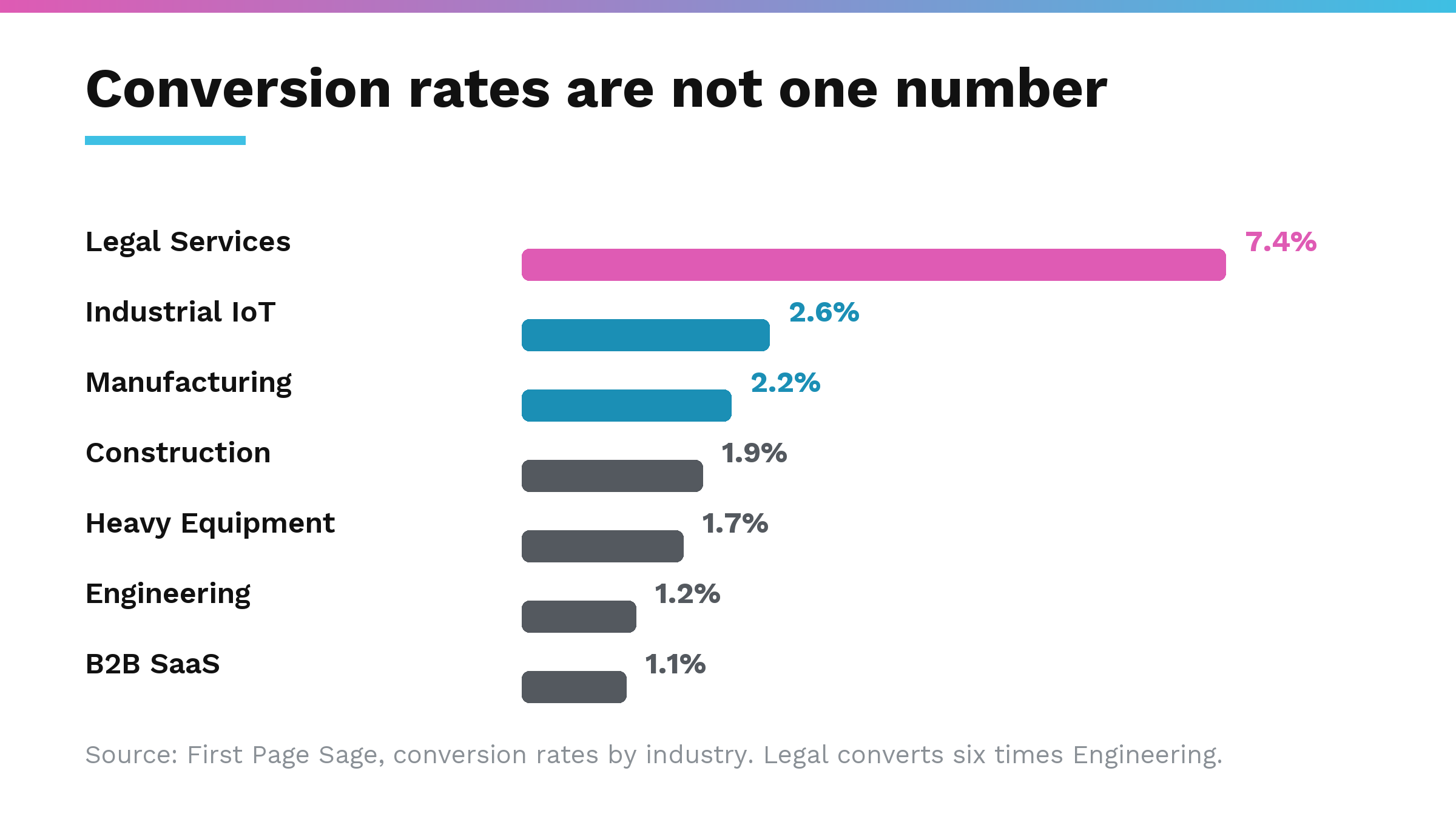
Those numbers come from a dataset collected between early 2022 and mid 2025, and the gap between the top and bottom is larger than the optimization gains most teams will ever generate. Legal Services, at 7.4%, converts more than six times as often as Engineering at 1.2%. No amount of form redesign closes a gap that wide. The difference is not the quality of the landing page. It is the nature of the buying process, the urgency of the need, and how long someone shops before they fill out a form.
An industrial or engineering site converting somewhere between roughly one and two and a half percent is operating inside the normal range for its category. That is not a failure. It is the reality of selling complex equipment and engineering services to a small, deliberative audience. And a conversion rate in that band has a direct, inconvenient consequence: a standard A/B test needs traffic volumes that most B2B accounts do not have.
What conversion optimization for industrial buyers means when the phone rings before the form
Industrial buyers rarely convert on a first visit. They research over weeks, comparing spec sheets and case studies, and when a project takes shape, they loop in an engineer to verify technical fit or procurement to issue an RFQ. A website form is often the last thing they fill out, if they fill one out at all. Phone calls, quote requests, and direct emails happen much earlier.
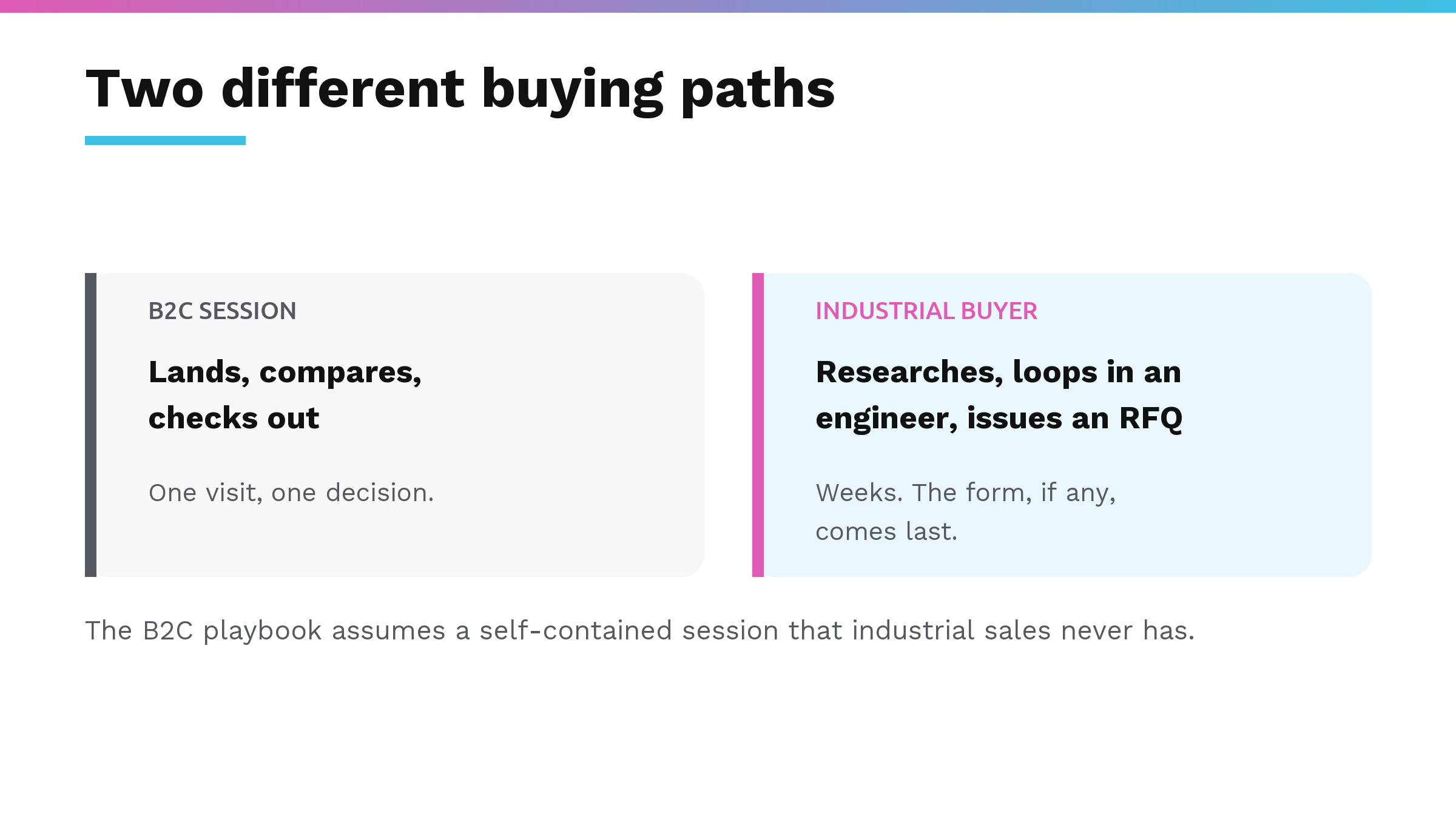
That sequence breaks the B2C conversion playbook, which assumes a self-contained digital session ending in a transaction or signup. A SaaS trial signup flow, for example, doesn't account for the offline handoffs and committee decisions that define an industrial sale.
Why B2B conversion rate optimization rarely clears the traffic bar for a valid A/B test
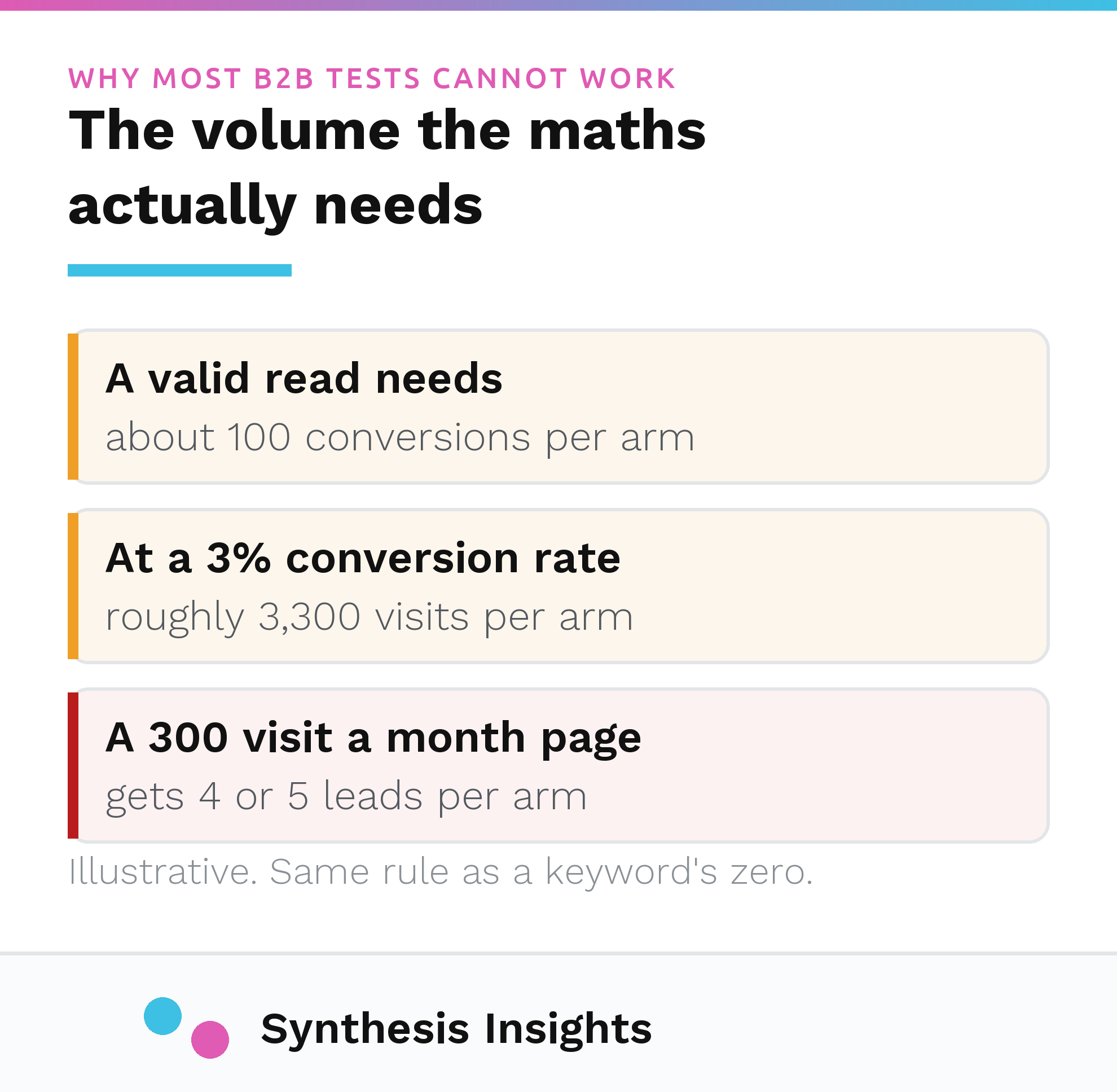
Statistical significance is not a formality. It answers a real question: how do you know the difference you are looking at is a real effect and not noise? The rule of three answers a version of that question for zero-conversion data: with zero conversions in n clicks, you can be roughly 95% confident the true conversion rate is below about 3/n. Turn that around and it tells you how many clicks you need before a result means anything at all: roughly 30 clicks at a 10% baseline conversion rate, 60 at 5%, 100 at 3%, 150 at 2%. I've written through that table in more detail in the context of cutting search keywords, where the same math tells you when a zero-conversion search term is actually dead rather than just quiet.
An A/B test asks a harder question than a single negate decision. You are not asking whether one number sits below a threshold. You are asking whether two numbers, each estimated from limited data, are different from each other. That needs more volume than either arm needs on its own, because the noise in both arms has to shrink enough for a real gap between them to become visible above it.
What that looks like on an actual B2B landing page
Take a page getting 300 visits a month, converting at 3%. That is a reasonably active page for a lead-gen account. Apply the baseline math above and you need roughly 100 conversions worth of signal, at minimum, before a single-arm read is trustworthy. Split that traffic 50/50 between a control and a variant and each arm is down to 150 visits a month, roughly 4 or 5 leads. You are not reaching the volume either arm needs in a month. You are reaching it, optimistically, sometime in the second year, and only if nothing else about the account, the offer, or the season changes in the meantime, which it does.
Run the same arithmetic on a page converting at 1%, which is common for a considered B2B purchase with a long sales cycle, and the timeline moves from unrealistic to absurd. This is why "just A/B test it" is close to meaningless advice for most B2B accounts. It is correct in the way "eat less, exercise more" is correct: technically true and useless at the volumes involved.
The coin flip you paid for
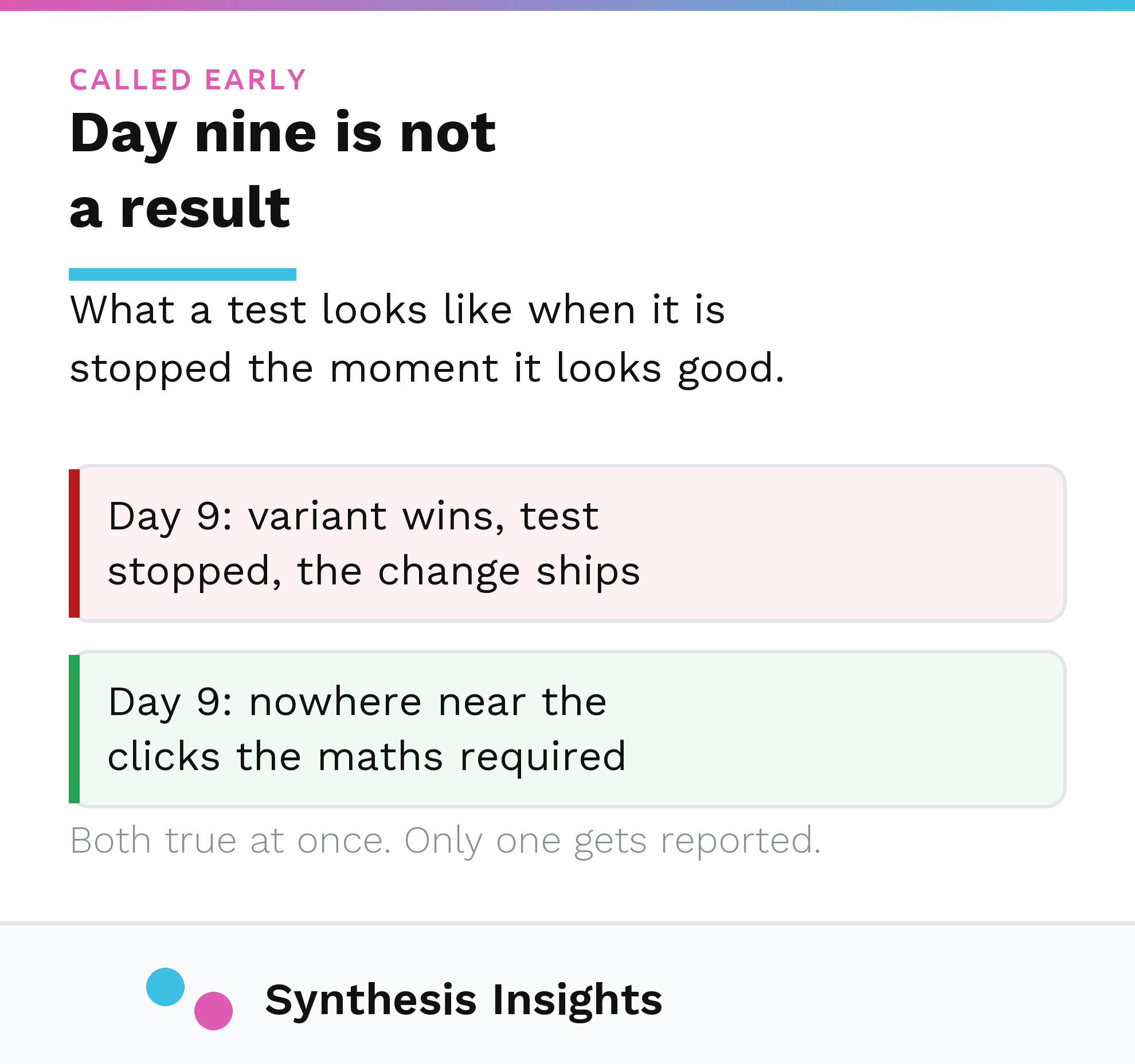
Here is what actually happens on most of these "tests." Nobody waits for the math to clear. Someone opens the dashboard on day nine, sees the variant up 22%, and calls it. That looks like discipline. It is actually close to the exact failure mode Evan Miller described in his widely cited essay on running A/B tests: stop checking the moment you see a significant looking result, and your real false positive rate runs far higher than the 5% the dashboard is quietly assuming. Miller's own example: peek at a test ten times without a pre-committed sample size, and what you think is 1% significance is actually running closer to 5%.
The tools were never built for B2B's volume
The tooling did not help. Google Optimize, the free A/B testing tool a lot of small and mid-size B2B teams reached for by default, was shut down entirely on September 30, 2023, with Google pointing remaining users to paid third-party platforms built and priced for consumer-scale traffic. The tools were never designed around B2B's volume problem. They were built for traffic levels B2B mostly does not have, and B2B accounts inherited them anyway.
None of this means the person running the test is being dishonest. They are doing what the interface told them was normal: watch the dashboard, wait for green, ship it. The dashboard just never told them how many visits "significant" was supposed to require.
How to improve B2B website conversion without A/B testing
If you cannot earn a valid test, you are not stuck. Most B2B landing pages have real, visible problems that do not need a controlled experiment to diagnose. They need someone to look. The question I use is the same one I would use meeting the buyer in person: would this help me sell if I were standing in front of them? A page that takes six seconds to load on mobile, buries the actual offer under three paragraphs of throat clearing, or asks for a job title and company size before it asks for an email address, does not need a split test to tell you it is losing people. I've written elsewhere about the landing page best practices I follow, but the short version is: look at the page the way a skeptical buyer would, and fix what is obviously wrong before you go looking for what is subtly wrong.
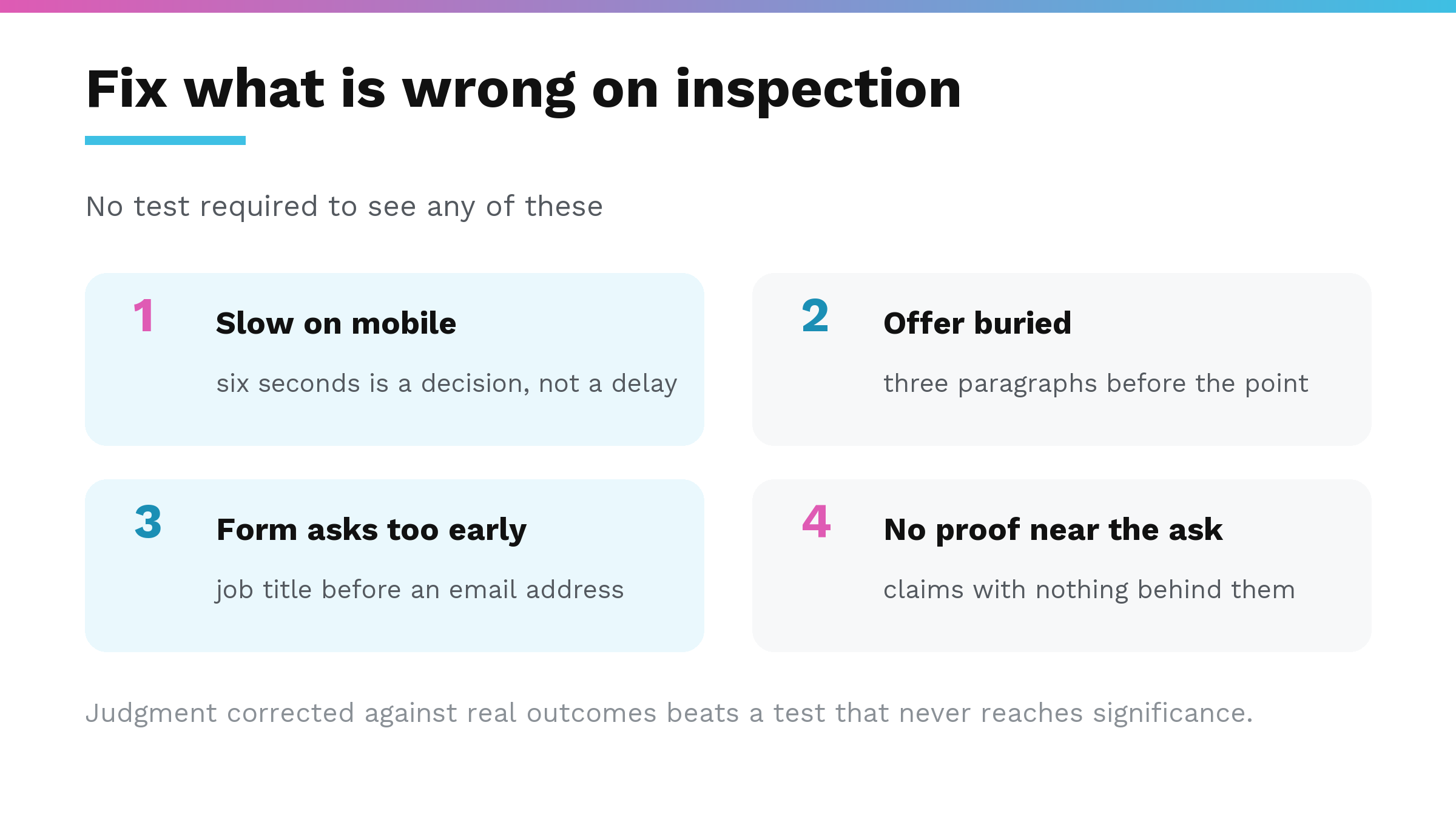
This is judgment, not experimentation, and I want to be honest about the tradeoff. Judgment can be wrong. It does not carry a confidence interval. But an untested call, corrected against a long enough window of real outcomes, beats a "significant" result built on 40 clicks per arm. One is honest about being a guess. The other is dishonest about not being one.
Measure against the CRM, not the form fill
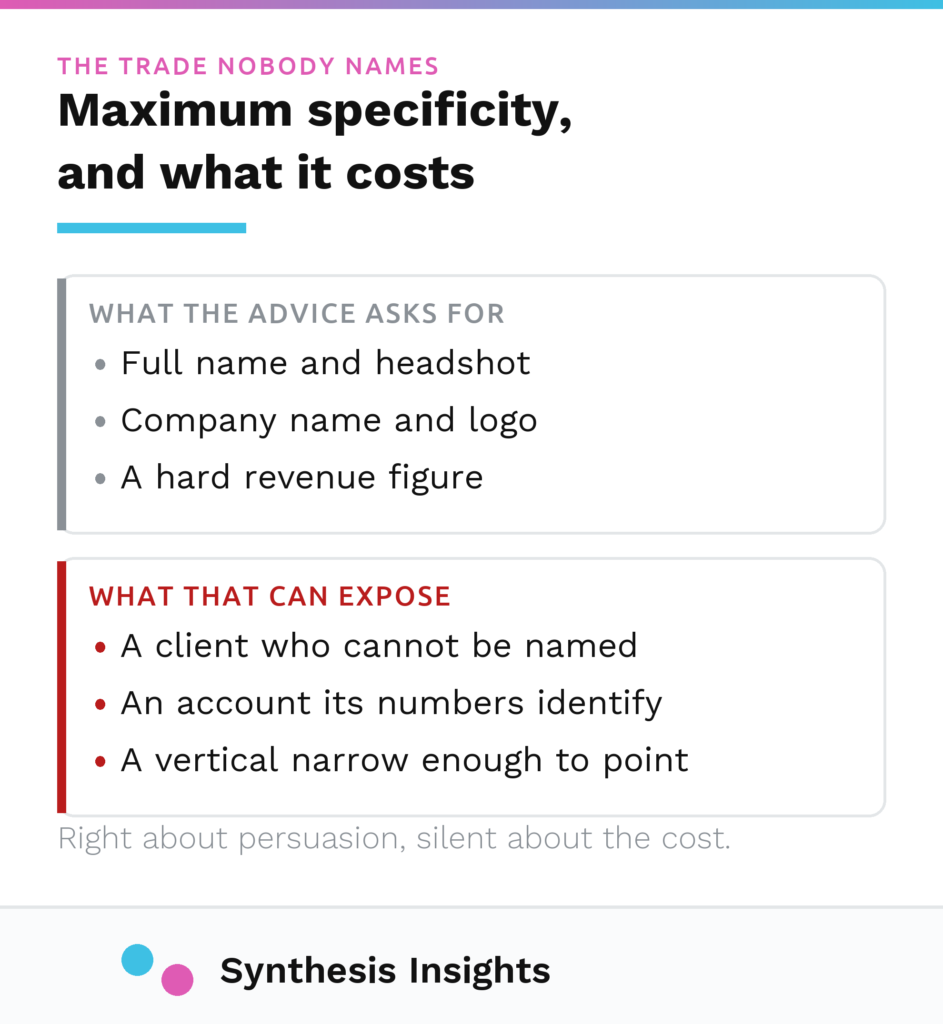
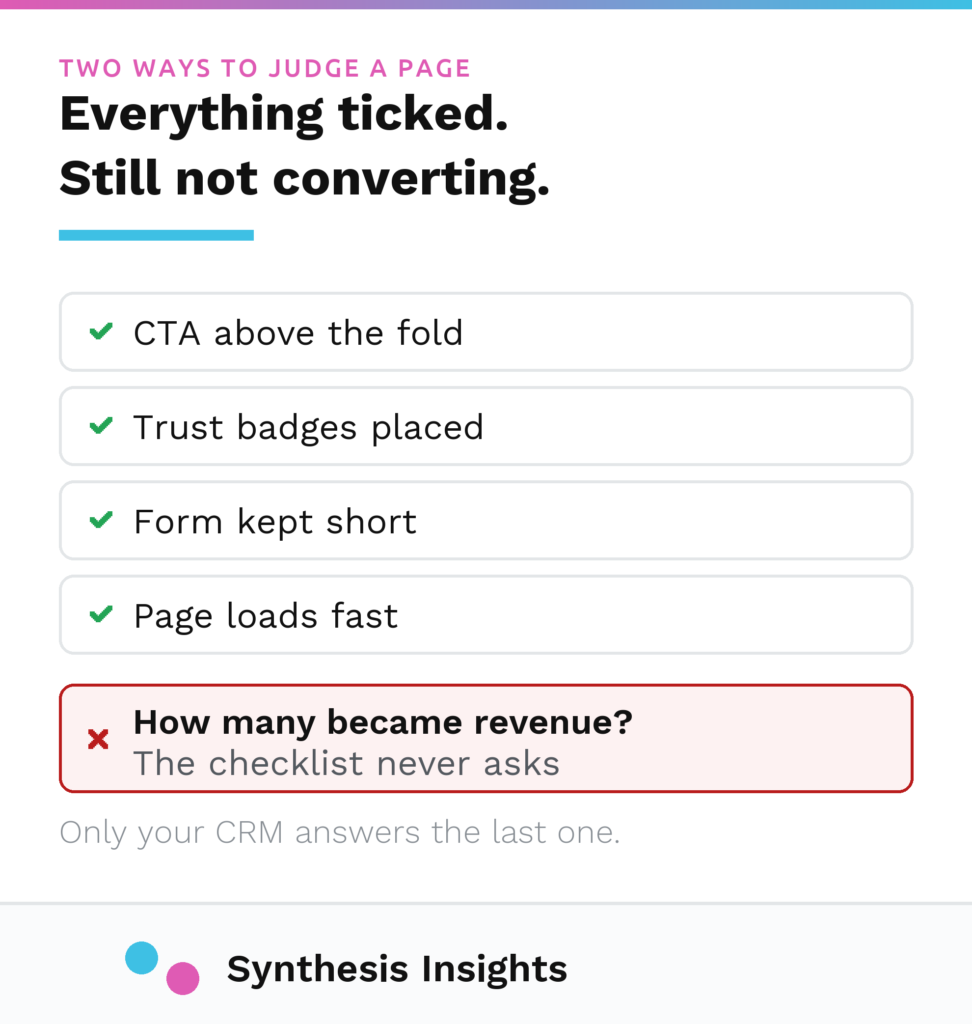
Even the fix-what's-wrong approach fails if you are grading it against the wrong number. Most CRO tooling reports the metric closest to the click: form submits, session recordings, heatmap clicks. Those are useful diagnostics. They are not the answer to whether the page is working, because a page can lift form fills and still send you worse leads, and a page that looks flat on form fills can quietly be sending you the leads that actually close. The difference between a metric that diagnoses a problem and one that tells you whether you won is something I've covered in depth in my writing on SEO KPIs, and the same idea applies here.
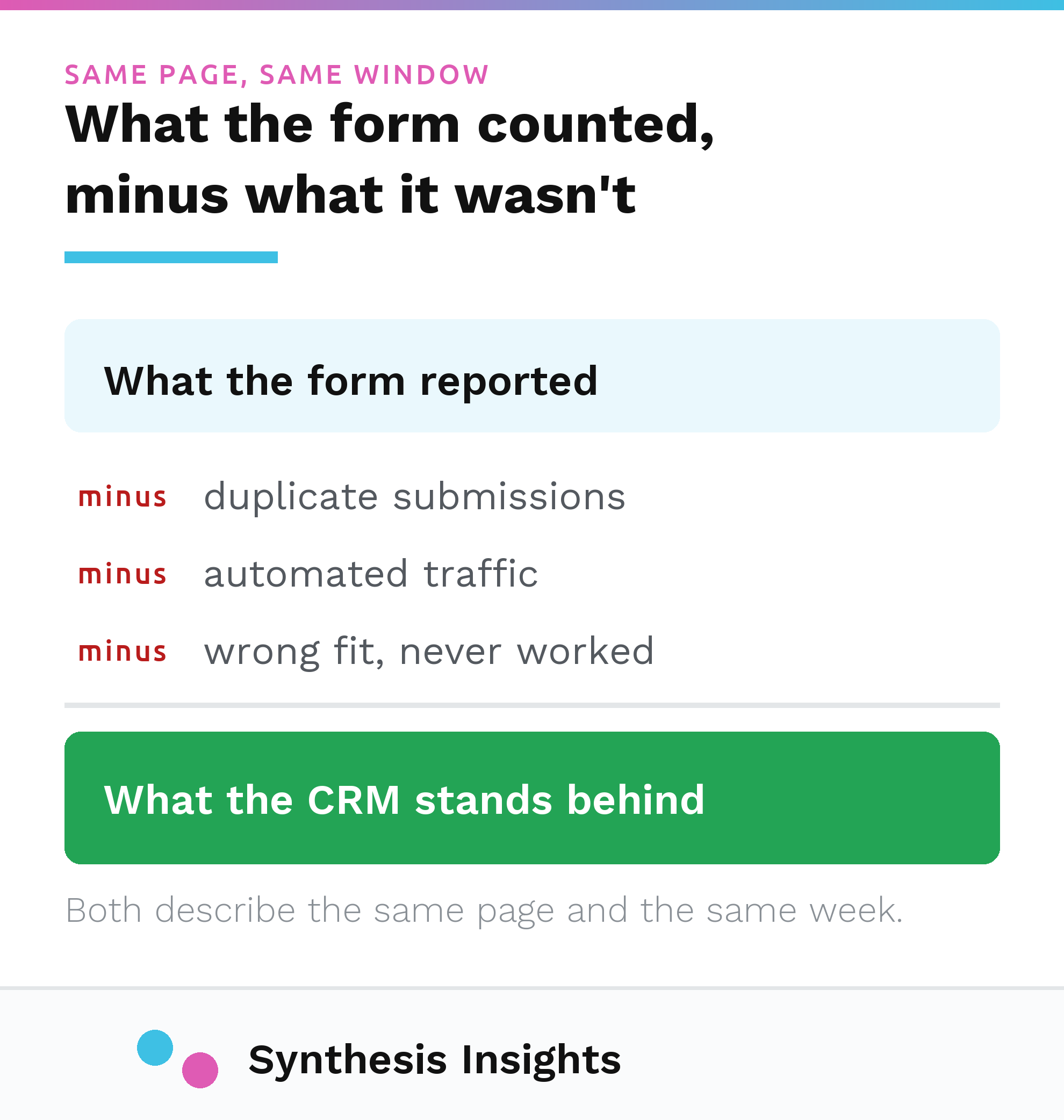
The same reasoning applies to B2B keyword strategy: the CRM is the source of truth, and the platform's conversion count is a secondary signal at best.
What the form-fill count misses
The fix is to track the page against what your CRM eventually records: qualified leads, sales-accepted opportunities, closed revenue, rather than the raw submit count your analytics tool reports at the moment of the click. That also means accounting for the channels a form-fill count misses entirely. A call that converts because of a well-tracked phone number never shows up in a standard form conversion count, and a page redesign that looks like a loss on forms can be a win once the calls it drove get counted too.
This is slower to read than a test result. A CRM outcome takes weeks to resolve where a form submit resolves in a second. That is the actual cost of doing this correctly, and it is also the reason the fast, form-fill-only test always felt easier: it answered quickly because it had quietly redefined the question into something that resolves quickly.
What this actually looks like in practice
In practice, this means running B2B CRO on a longer clock than the testing-tool interface wants you to use. Change one thing at a time, the one you're most confident is wrong, so you can still tell what moved the number. Give it a real window: a full sales cycle where you have one, rather than the two weeks a testing tool would ask for. Watch the CRM outcome instead of the form count, and hold the account's other variables as steady as you can while you watch. Accept that you will not get a p-value at the end of it. You will get a judgment call, made with more information than you started with, which is what conversion work in a low-volume environment actually is.
That is a less satisfying story than "we ran an A/B test and the variant won by 18%." It is also the honest one for most B2B accounts, and honest beats satisfying when getting it wrong costs someone a quarter of pipeline. If your ad spend and your CRM already tell two different stories, that reconciliation is where a B2B PPC agency starts.
What B2B CRO looks like when you cannot run a valid test
The real failure in B2B CRO is not skipping tests. It is running one anyway, dressing a coin flip up in a dashboard, and making decisions as though the coin flip meant something. If your traffic can feed a valid test, run it. The math above tells you exactly how much you need. If it can't, say so, and go fix what is visibly broken instead. Both are defensible. Pretending you ran an experiment when you never had the volume for one is not.
B2B conversion rate optimization FAQ
What does B2B CRO stand for?
CRO stands for conversion rate optimization. In a B2B or industrial setting, the work targets qualified pipeline recorded in the CRM rather than the raw count of form submissions.
Can you do B2B conversion rate optimization without enough traffic to A/B test?
Yes, and most industrial accounts have to. You inspect the page for visible problems, fix them one at a time, and grade the change against qualified pipeline. The same discipline of grading against the CRM applies to B2B PPC as well.
How is B2B conversion optimization different from B2C?
B2B buyers research for weeks, comparing spec sheets and looping in an engineer or procurement stakeholder. A phone call or RFQ often arrives before any form submission.
How long should a B2B conversion test run?
Give the change a full sales cycle where you have one, and change only one thing at a time. The number to read at the end is the CRM outcome, which takes weeks to resolve. The form count resolves immediately. The final result is a judgment call, with no p-value.