When a buyer asks an AI assistant which company to use, the assistant returns a shortlist, and your company is on it or it is not. Most of the published advice on how to get recommended by ChatGPT cites no source at all. Three specific fixes were measured in a peer-reviewed study: citing sources on your pages, adding direct quotations, and including statistics that carry their origin.
The advice on this question disagrees with itself
Run the search yourself. Here is how the first five results read in September 2026. One page leads with setting up a Google Business Profile as its first tactic. That tactic appears in none of the other four lists. Reddit and community presence is a named tactic on two of the five pages and does not appear in the other three lists at all. One page orders its six tactics by impact, cites a study for one of the six, and offers nothing measuring the order it puts them in. Another lists nine tactics with no ordering claim at all. Two of the five cite no source for any tactic. None of the five cites a peer-reviewed study properly, although one page points at the same paper this post cites directly without naming it or linking it.
The practical question for a marketing leader is how to tell which of that advice can carry budget and which cannot.
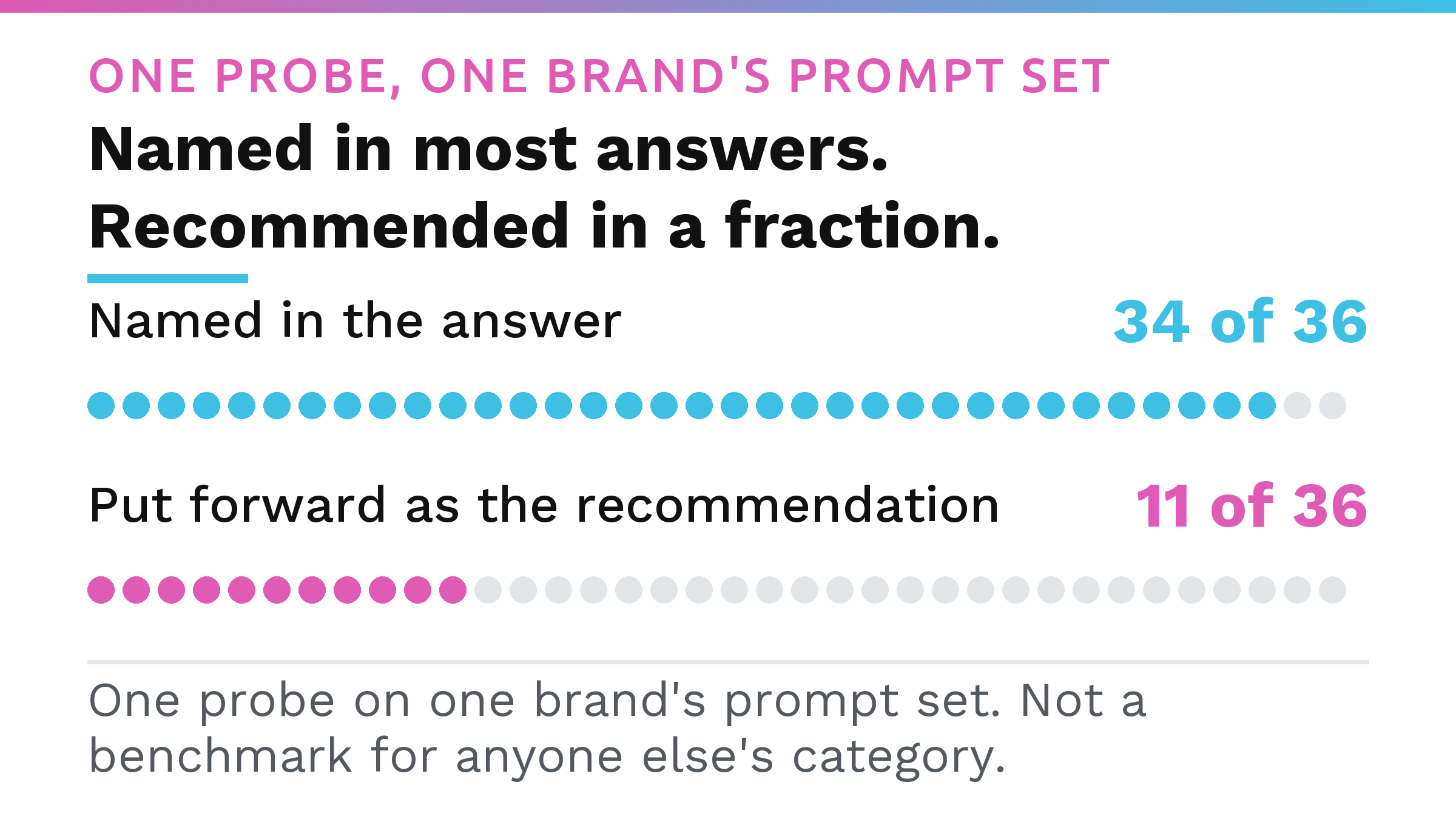
The commercial reason the question matters is that being mentioned and being recommended are not the same thing. In one recent probe across a set of buying-intent prompts, a single brand was named in 34 of 36 answers but put forward as the recommended choice in only 11 of those 36. That is one probe on one brand’s prompt set. The gap is the finding. The ratio is not a benchmark for anyone else’s category. For the fuller treatment of that distinction, see share of AI answers.
Your buyers are already building shortlists this way
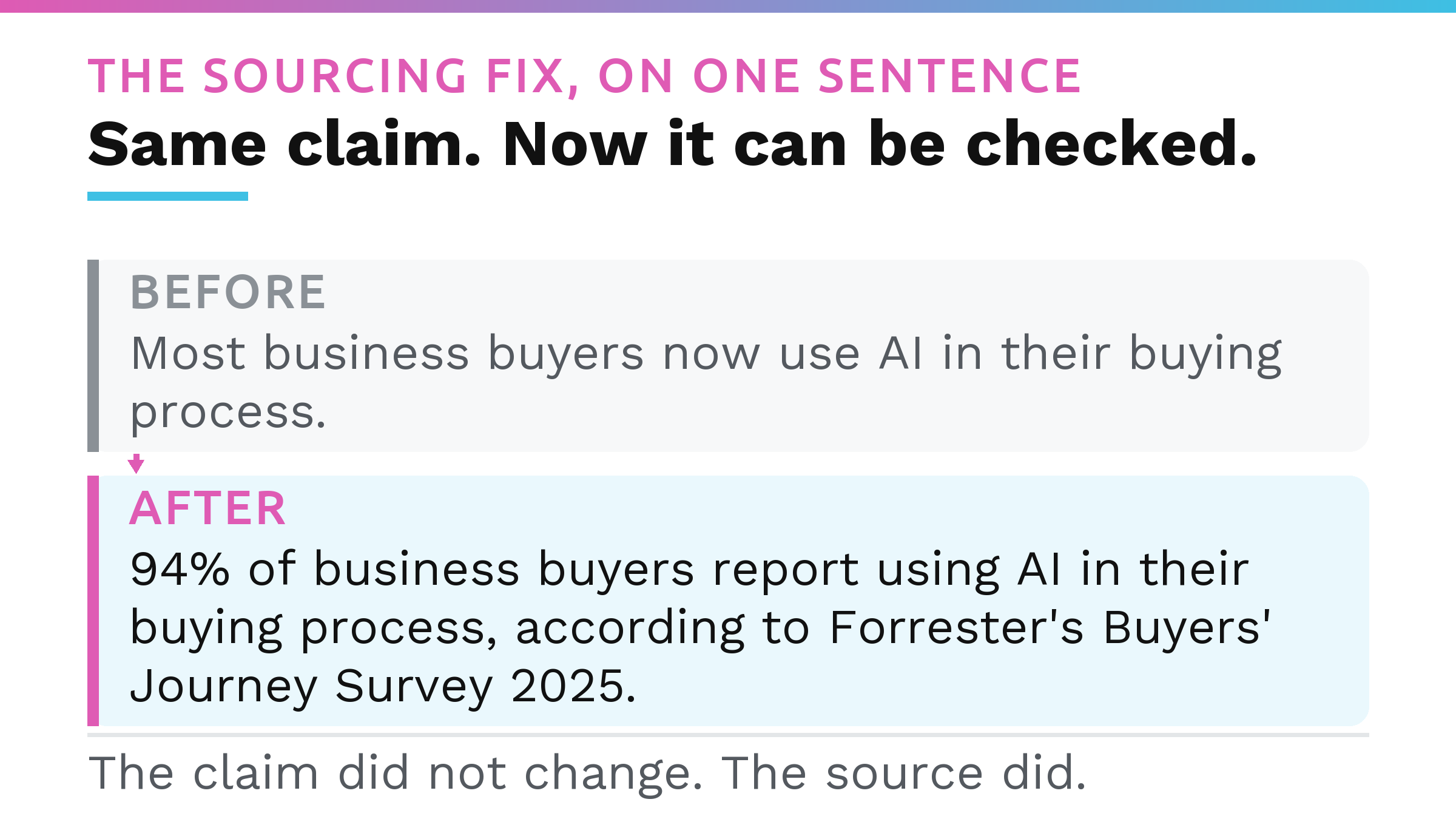
Forrester’s Buyers’ Journey Survey 2025, detailed in B2B Buyers Make Zero Click Buying Number One, found that 94% of business buyers report using AI in their buying process, up from 89% the prior year, and 61% report using private AI tools provided by their organisation.
How an assistant decides who to put forward
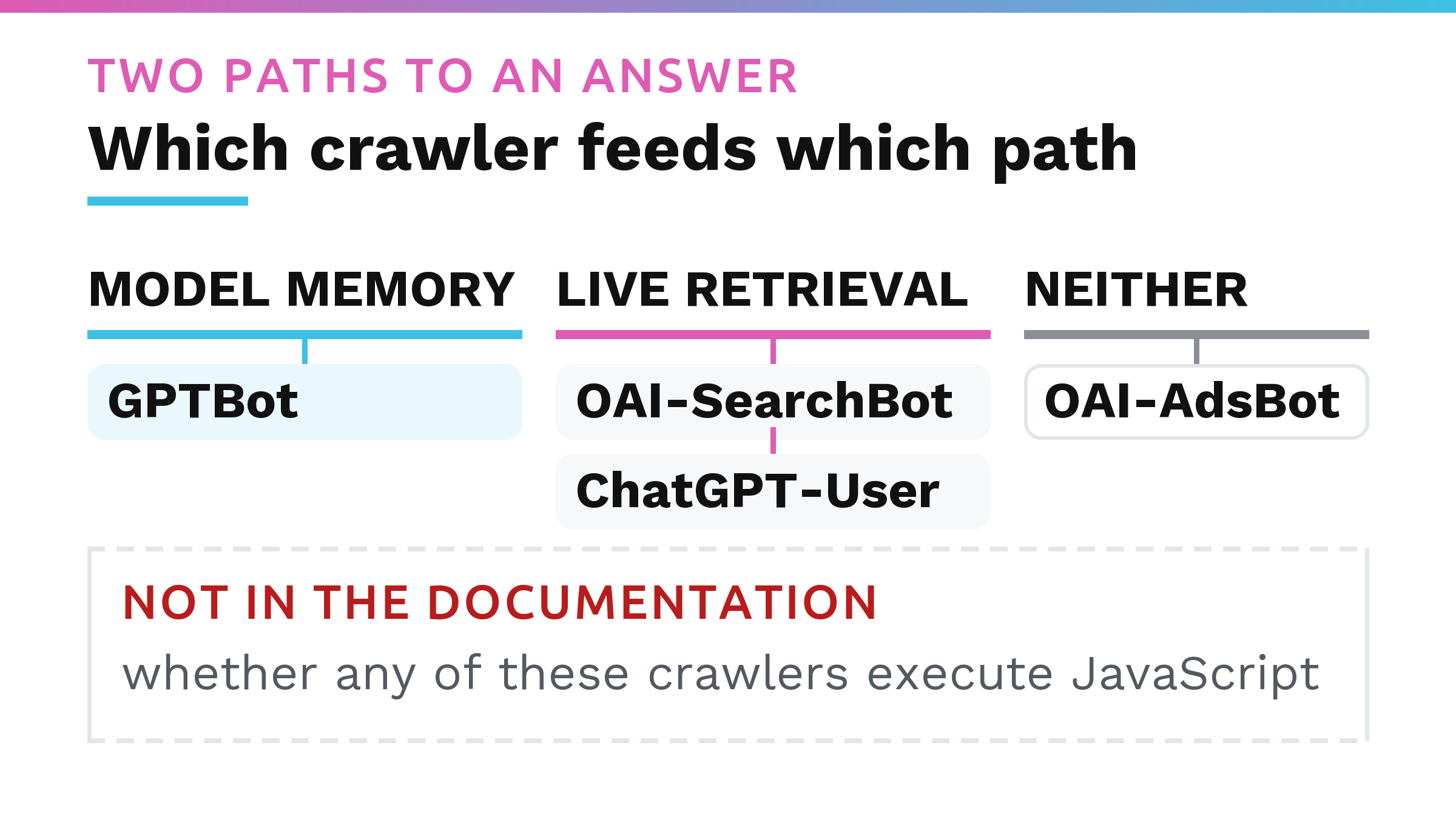
An AI assistant can answer a question through two paths: model memory, what the model already carries from its training data, and live retrieval, what it retrieves from the live web when the question triggers a fetch. The second path is the one OpenAI documents controls for.
OpenAI operates separate crawlers for separate jobs. OAI-SearchBot surfaces websites in ChatGPT’s search features. GPTBot crawls pages for training the foundation models. ChatGPT-User visits a page in response to certain user actions inside ChatGPT and Custom GPTs and is not used for automatic web crawling. OAI-AdsBot validates pages submitted as ads.
robots.txt, a file setting crawler permissions, is controlled per bot. Each setting is independent of the others. A site can allow the crawler that gets it surfaced in ChatGPT’s search features while blocking the one that gathers training data. The practical consequence is that a company that blocked AI bots broadly may have switched off the crawler that could have got it cited while intending only to opt out of training. That is a mechanism worth checking. Two places to do that: check which AI bots can access your website and the AI crawler list.
OpenAI’s documentation states that for search results it can take about 24 hours from a site’s robots.txt update for its systems to adjust. That timeline is specific to robots.txt changes reaching OpenAI’s systems. It is not a timeline for when a content change appears in an answer.
The documentation also reaches a clear stopping point. It says nothing about whether any of these crawlers execute JavaScript. This post makes no claim in either direction on that point.
Three tiers of evidence, and how to tell them apart
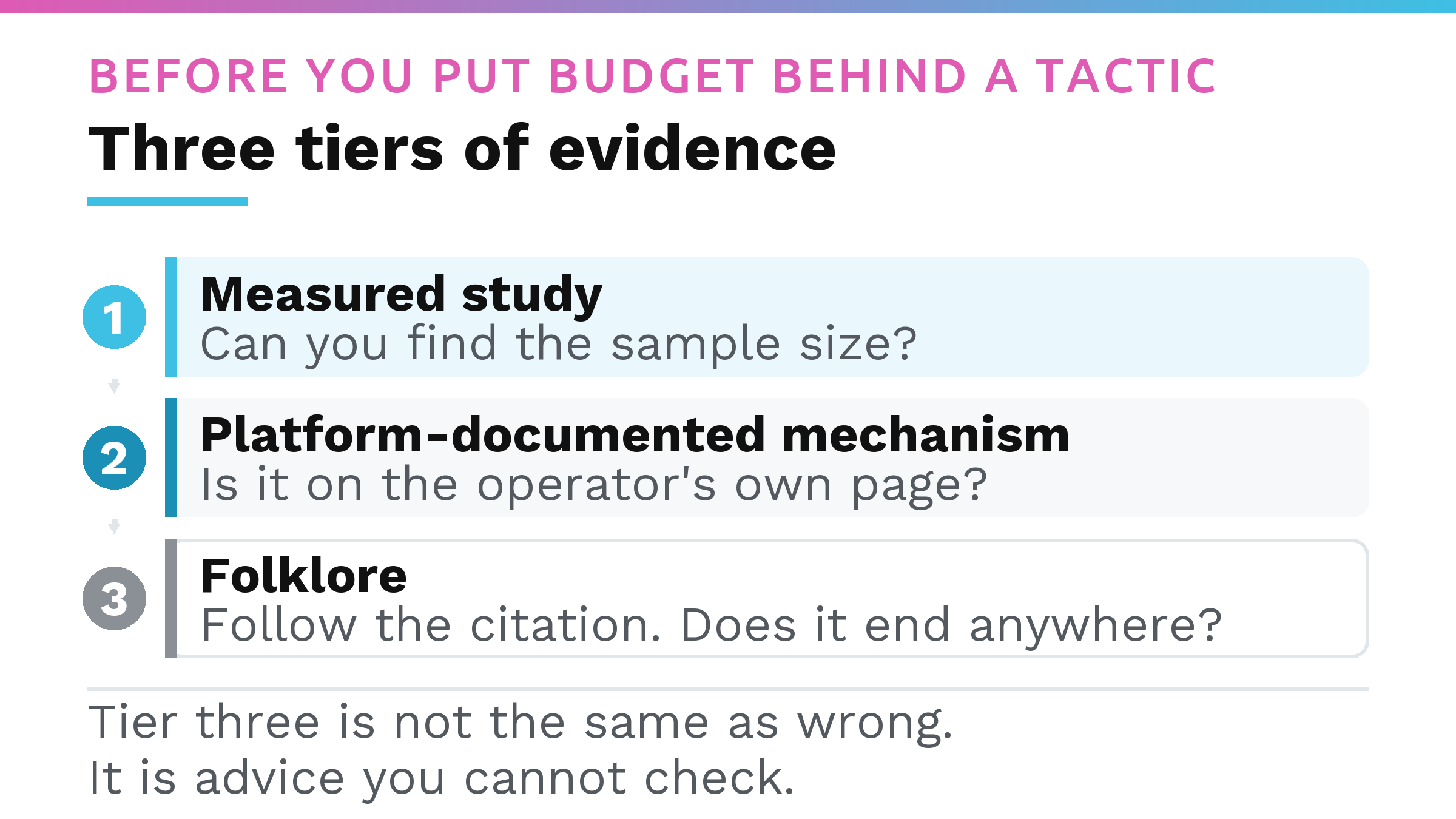
Sorting advice by its evidence is a step the five pages examined earlier do not take. A tier here labels the kind of backing a claim rests on. Distinguishing the tiers lets a reader decide how much budget a claim deserves before it is proved right.
Tier one is a measured study. Somebody ran an experiment and published the method, the sample size, and the metric, and said what the metric does and does not capture. The worked example is the peer-reviewed paper in the next section, a 10,000-query benchmark with two named metrics. The test: can you find the sample size in under a minute? If not, it is not a measured study.
Tier two is a platform-documented mechanism. The company that operates the system states in its own documentation how the system behaves. This kind of source tells you how the system works and stays silent on how well any tactic performs. The worked example is the crawler documentation in the section above. The test: is the claim on the operator’s own documentation page, and does that page actually say it, or does it say something adjacent to it?
Tier three is folklore. The advice is plausible, widely repeated, and traceable to nothing. The worked examples are the week-count timelines for when a change shows up in an answer, which a later section covers. The test: follow the citation. If it ends at another blog, or at nothing, it is folklore, however sensible it sounds.
Tier three is not the same as wrong. Some of it will turn out to be right. It is advice you cannot check, which is a different problem, and it should change how much budget it gets rather than whether you think less of the person who wrote it.
How to get recommended by ChatGPT: the three fixes a peer-reviewed study measured
The paper is GEO: Generative Engine Optimization, published at KDD 2024.
The authors built a 10,000-query benchmark drawn from real anonymised search-engine queries plus synthetic queries across multiple domains. For each query they simulated a generative engine that fetched top sources and had a language model write an answer citing them. They tested nine content-optimisation methods, applied one at a time, and re-ran the same methods against a live commercial engine as a generalisability check.
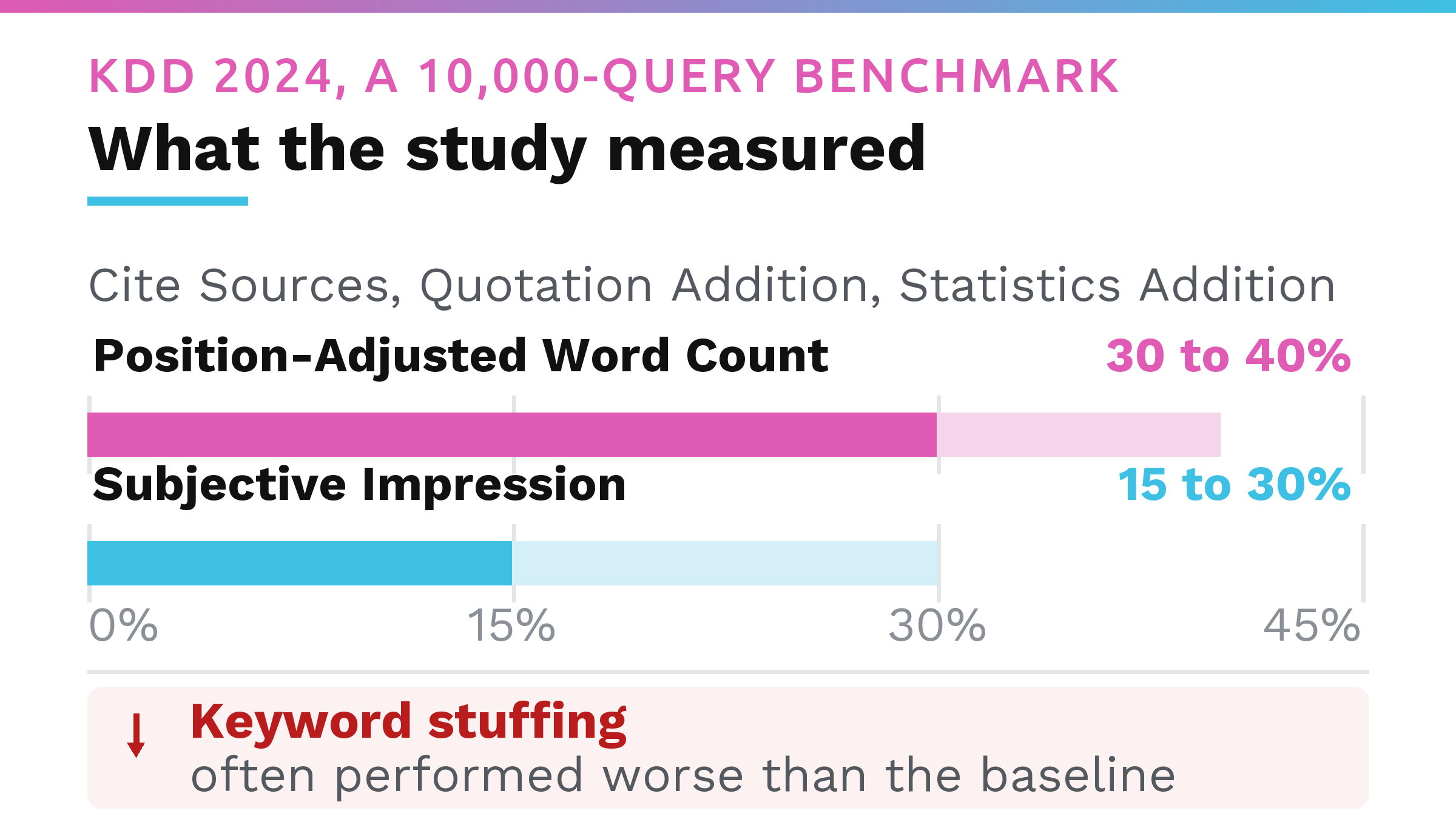
The result, in their own words: "our top-performing methods, Cite Sources, Quotation Addition, and Statistics Addition, achieved a relative improvement of 30-40% on the Position-Adjusted Word Count metric and 15-30% on the Subjective Impression metric."
Position-Adjusted Word Count measures how much of a generated answer’s text draws on a given source, weighted so content used earlier in the answer counts for more. Subjective Impression is a separate machine-judged score of how favourably a source’s contribution reads.
Neither metric is a head-to-head test of whether one brand got recommended over another. They measure how much visibility and favourable weight a source earns inside an answer.
The same study found that keyword stuffing, the traditional SEO tactic, often performed worse than the baseline, the unmodified page.
Translated into work on your own pages, the three fixes are straightforward. Attribute the claims on a page to the specific source they came from, rather than floating them as unattested facts. Quote named sources directly instead of paraphrasing them into the house style. Carry the relevant figures with their source rather than replacing them with adjectives. A number with its source does work that an adjective cannot.
What these three fixes do and do not buy you
Each of the three techniques plausibly worked because it gives the assistant something concrete to carry into the answer: a name, a verbatim phrase, a number with its origin attached. The study’s own metrics reward concrete, attributable content.
Two boundaries matter. First, efficacy varied by domain in the study, so 30 to 40 percent is not a number any single reader should expect in their own category. Second, Position-Adjusted Word Count and Subjective Impression measure how much of an answer draws on a source and how favourably that contribution reads. That sits upstream of being recommended. Improving those metrics changes the input to a recommendation decision, not the decision itself. Whether your page earns the source line is a separate measurement with its own causes, examined in why ChatGPT won’t cite your website.
What has nothing behind it
Several widely repeated pieces of advice fail the test from the earlier section. Each item may well be right. The problem is that a reader has no way to check.
Week-count timelines for when a content change shows up in an answer appear on multiple pages. The pages that give those timelines cite nothing for them. The honest mechanical statement is simpler and more useful: live retrieval can reflect a changed page as soon as it fetches it, and model memory updates on no published schedule.
The tactic of hiding text on a page for the model’s benefit is widely repeated. It arrives without any reference to a test or measurement.
Review volume plays and mass directory submission appear as tactics on some lists. The advice arrives with no citation that resolves to a measurement.
How do you know whether any of it worked
One prompt run proves nothing. The unreviewed preprint "Don’t Measure Once: Measuring Visibility in AI Search (GEO)" by Schulte, Bleeker and Kaufmann found that AI-search answers vary across runs and prompts. A single observation is unreliable, and visibility is better described as a distribution than as one number. For a fuller treatment of what you can actually count, see share of AI answers.
The study in the earlier section measured a simulated engine plus a re-test on one live commercial engine in 2024. The mechanism it found still holds.
Where to start
Start with the sourcing fix because citing sources was one of the three top-performing methods in the study, and most companies can do it on material they already have. The study measured the methods one at a time, so each stands on its own and the other two are not optional extras. For each page that carries a claim or a number, ask whether the source of that claim is named on the page, whether any quoted expert is quoted directly, and whether each statistic carries its origin. If a statistic appears without an attribution, add the attribution. If a quoted expert is paraphrased, add the direct quote.
If you want a clearer view of where you stand today, an AI Visibility Audit is the done-for-you version of this work.
FAQ
How does a company get recommended in ChatGPT’s answers?
A recommendation can come from what the model carries in its training data or from what it retrieves from the live web when a question triggers a fetch. For the retrieval path, the page must be reachable and usable by the crawler that feeds ChatGPT’s search features. Model memory updates on no published schedule, so live retrieval is the one OpenAI documents controls for.
Which measures demonstrably work to increase ChatGPT recommendations?
The three content techniques that showed measurable improvement in a peer-reviewed study are citing sources on the page, adding direct quotations from named sources, and including statistics that carry their origin. The study measured improvements on Position-Adjusted Word Count and Subjective Impression, which capture how much visibility and favourable weight a source earns inside an answer. Neither metric is a head-to-head recommendation test.
How can I find out if ChatGPT already recommends my company?
Run a set of buying-intent prompts relevant to your category and record whether your company appears and in what role. A single prompt proves nothing, so use a range and treat the result as a rough distribution rather than one number. A structured starting point is available in the 10-minute AI visibility check.
What is the difference between ChatGPT naming a brand and recommending it?
Naming a brand means the brand appears somewhere in the answer: as an example, in a list, or as part of an explanation. Recommending it means the answer puts the brand forward as the choice the user should consider. A brand can be named in most answers and still picked as the recommendation in only a fraction of them. The gap is where the commercial opportunity sits.
Does blocking AI crawlers stop me from being recommended?
robots.txt control is per bot and each setting is independent. A site can block the crawler that gathers training data while allowing the crawler that surfaces pages in ChatGPT’s search features. If a site blocked all AI bots, it may have inadvertently switched off the crawler that could have got it cited. OpenAI’s documentation states that after a robots.txt update, it can take about 24 hours for its systems to adjust for search results.