If your company shows up in AI answers today, part of that visibility rests on a single platform that a model update can switch off. The August 2026 drop in Reddit citations inside ChatGPT showed how quickly that can happen.
What is AI citation volatility?
AI citation volatility is the tendency of an AI assistant to change which sources it cites when its model or retrieval system changes, even though the websites themselves did not change.
Buyers now form shortlists inside AI answers; when the platform carrying your mentions goes dark, you are not in the room when that happens, and nothing on your own site changed to warn you.
If most of your third-party mentions come from a single forum or video platform, you don’t control that visibility. A model update controls it. The question is whether your AI visibility is concentrated enough to break when the source mix moves.
What happened in August
OpenAI announced GPT-5.6 as ChatGPT’s new default model on August 6, 2026, with the free-tier rollout following within days, according to OpenAI’s deployment update. PromptWatch and Qwairy both observed ChatGPT’s citation behavior shifting starting around August 8, within days of the rollout.
The most visible change was a sharp drop in Reddit’s share of ChatGPT citations. PromptWatch measured Reddit falling from 3.83% of citations to 0.52% between August 14 and 17, as reported by Search Engine Land. Qwairy measured a drop from 2.05% to 0.07% across August 1 to 18, in its own tracker data. That is a decline of roughly 86 to 97 percent depending on the tracker. The window mismatch is part of why the numbers differ.
These trackers disagree on the exact magnitude, measured different windows, and cannot rule out measurement artifacts. The timing is correlation, not proof that GPT-5.6 alone caused the change, and OpenAI has not published a mechanical explanation for the shift.
The direction of the swing also reverses. In May 2026, after the earlier GPT-5.5 transition, SISTRIX data reported by Search Engine Journal showed Reddit citations rising 59%. A source type that gained after one model transition lost much of that gain after the next. That pattern, not any single platform, is the reason to run the check.
Why does the source mix keep moving?
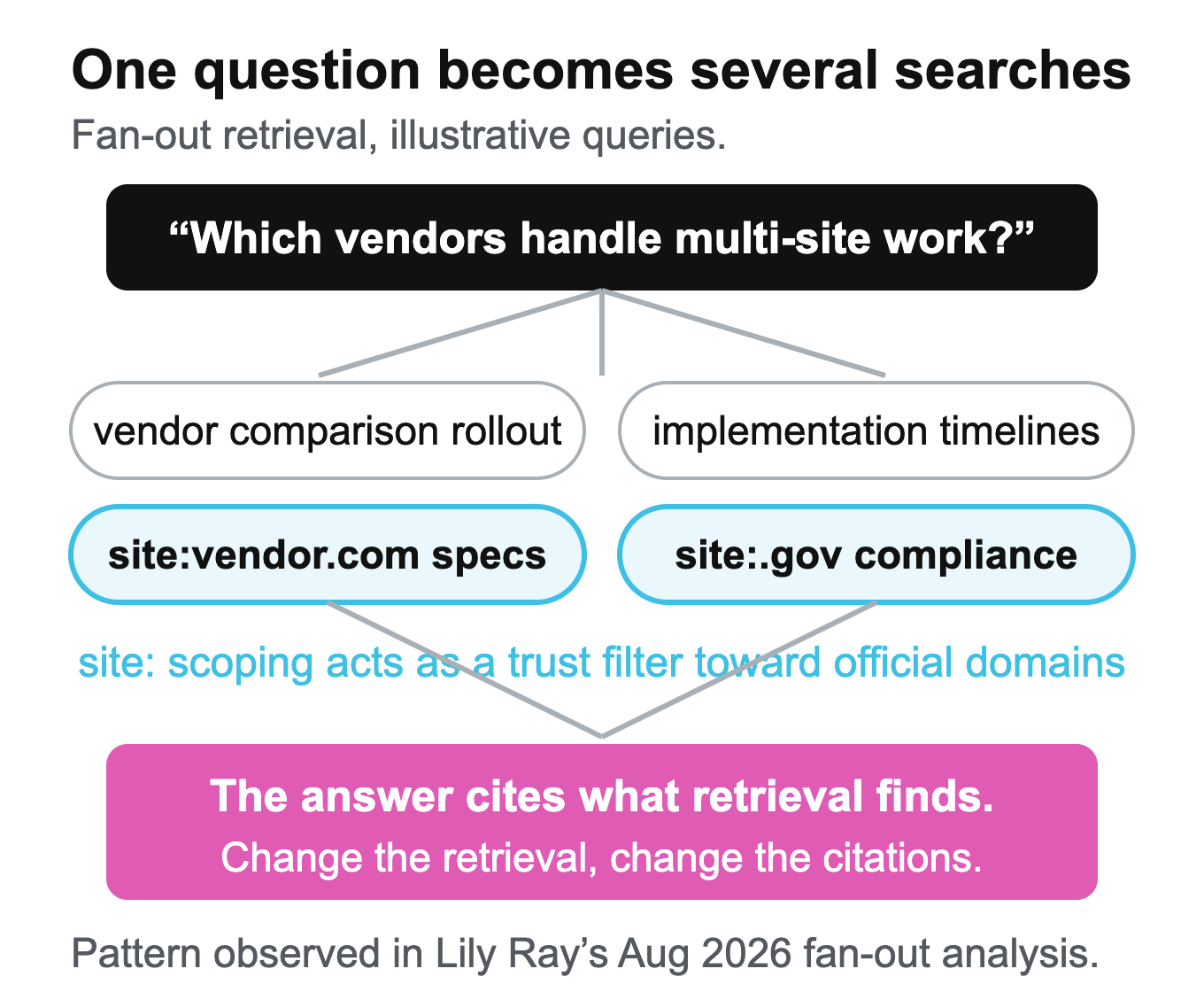
When someone asks a question, the assistant runs retrieval searches, pulls candidate pages, and decides which of those pages to cite. When the model or its retrieval logic changes, the source mix changes. Retrieval logic is the set of rules and search patterns the assistant uses to select candidate sources. The underlying websites, their content, and their authority signals may not have changed at all.
Nothing in observed behavior suggests a fixed list of preferred sources.
Lily Ray’s August 17 analysis of ChatGPT’s evolving fan-out queries gives a useful view of how ChatGPT chooses sources. Fan-out queries are the retrieval searches ChatGPT runs after a user asks a question, to gather candidate sources for the answer. According to her analysis, ChatGPT increasingly scopes those fan-out queries with the site: operator, a search command that restricts results to a specific domain or type of domain. That operator functions as a de facto trust filter, routing queries toward official brand sites, government sources, and established platforms.
For B2B companies, the retrieval shift is straightforward: official and institutional domains are gaining weight. A manufacturer’s own technical content, the trade press around its category, and the directories that structure its industry become the places to invest.
Run a concentration check this week
Not ready for the full check? The 10-minute AI visibility check is the lighter starting point; the check below extends it by measuring concentration. The full version takes a couple of hours.
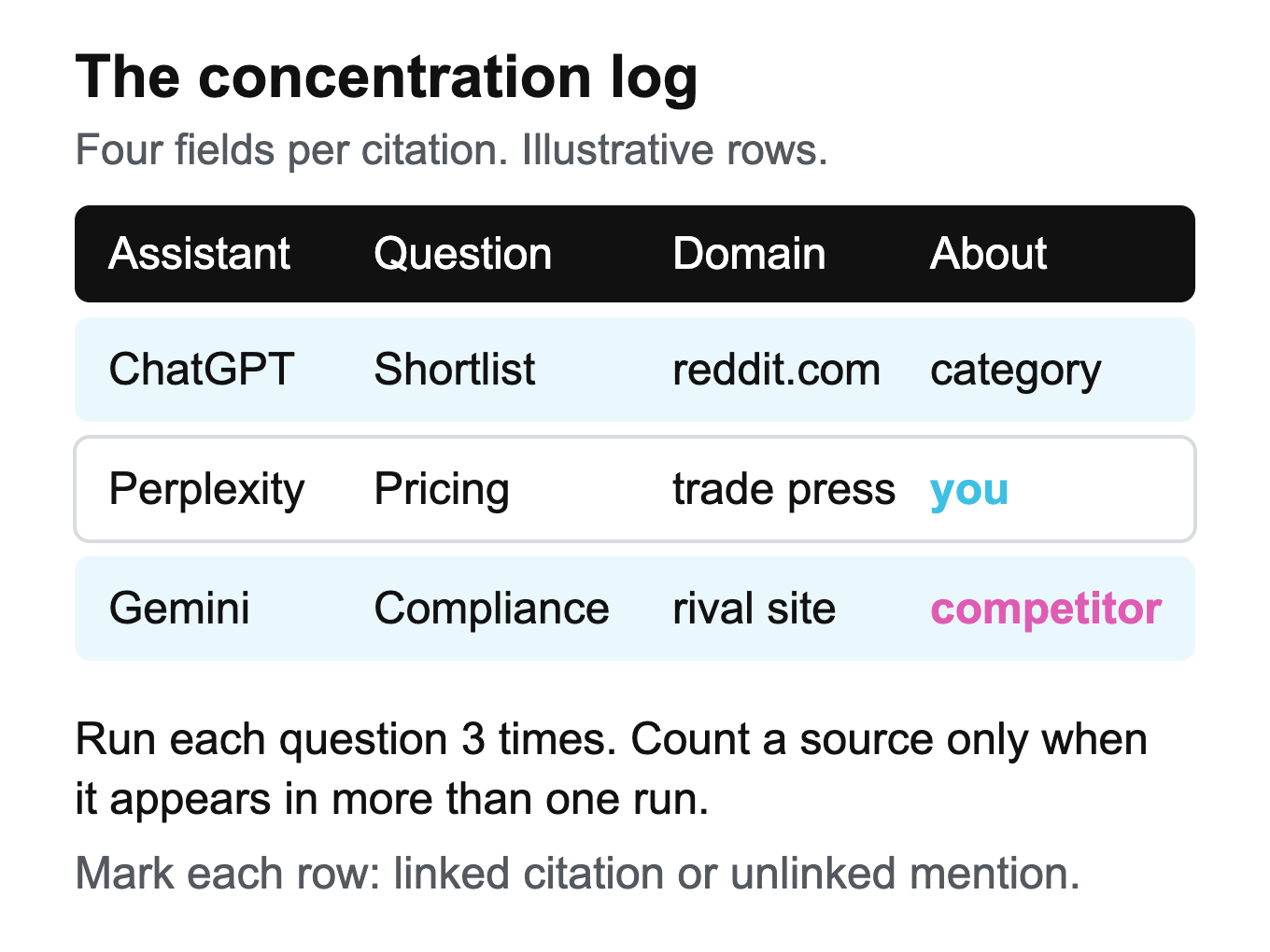
- Ask the questions. Ask 10 real buyer questions in ChatGPT, Perplexity, and Gemini with web search on. Use the questions a buyer would ask before building a shortlist: pricing structures, implementation timelines, vendor comparison criteria, support requirements, compliance standards. Run each question three times. Answers and citations vary run to run, so count a source only when it appears in more than one run. A smaller version still produces signal, three questions in one assistant will show you today whether one platform dominates.
- Log what gets cited. A citation is a linked source in the answer’s source list or footnotes. When an assistant names a brand in prose without linking, log it separately as a mention. Record the domain, which assistant, which question, and whether the mention was about your company, your category, or a competitor. A spreadsheet is enough. Copy the headers: assistant | question | domain | about | linked or mention.
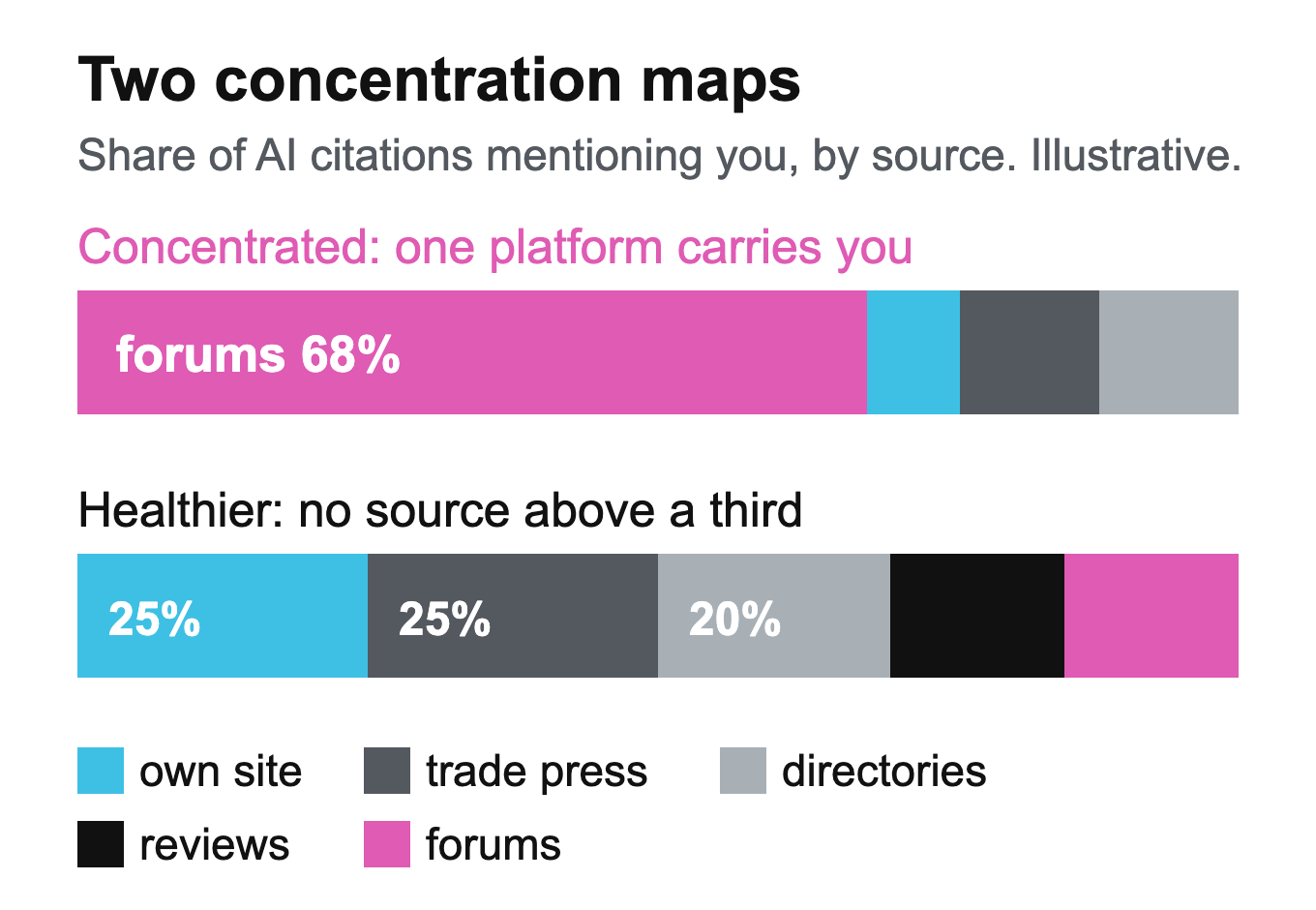
- Read the concentration. As a practical line, if one platform carries roughly a third or more of the third-party citations that mention you, treat that as concentration risk. If your own domain rarely appears while third parties carry your visibility, that is a different exposure. A healthy result shows mentions spread across several source types, no single third-party platform above roughly a third, and your own domain appearing regularly for questions where your content genuinely answers. Read per assistant, not just in aggregate. The competitor column often delivers the sharpest finding: a question where a competitor is named and you are not. What you end up with is a concentration map: a breakdown of which domains and source types carry your AI mentions.
- Re-run on a schedule. That is a snapshot. Re-run the check after any major model release, and quarterly at minimum. The data go stale quickly, which is exactly why you need a repeatable check.
Other data worth pulling. Pull the free Bing Webmaster Tools AI Performance report. It covers citations in Copilot and Bing answers, not the assistants above. Google Search Console now has its own free generative AI performance report, available to all websites worldwide since August 31, 2026. That report counts impressions, meaning how many times links to your site were shown to a user in AI Overviews and AI Mode, so the two reports measure different things. What each report counts is set out in can you see when ChatGPT cites your website. If the Bing report disagrees with your manual check, that usually means the two systems retrieve differently, which is more evidence of volatility. Services like PromptWatch and Qwairy track industry-wide citation shifts; they show the weather, not whether you are cited for your buyers’ questions.
Diversifying away from single-platform risk
Diversify AI search visibility toward source types with lower single-platform risk. Strengthen your own site’s crawlability, content, and evidence pages; a good starting point is understanding how AI crawlers access your site, covered in our AI crawler activity post. Build coverage in the trade publications your buyers actually read, maintain accurate entries in the industry directories that structure your category, and pursue the kind of third-party citations described in our off-page SEO strategy. Where review platforms have editorial standards and real customer verification, those references can carry more weight than anonymous forum threads.
Aleyda Solis’s framework for prioritizing third-party citation opportunities scores source types across six dimensions: citation influence, brand association potential, marketing alignment, business value, strategic durability, and expected effort. Strategic durability is the likelihood that a source type will remain relevant to AI assistants across model updates. The August event illustrates why that dimension exists. A source type that can lose 86 to 97 percent of its citation share in days has low strategic durability.
If your own domain is rarely cited, the issue often lives earlier in the pipeline. As the AI search readiness framework breaks down, visibility requires an assistant to Reach, Parse, and then Recommend your content; when your pages are barely cited, you likely have a Reach or Parse problem. Fixing that starts before the Recommend gate.
Do the check yourself, or have it measured
The manual check is the do-it-today option. Its limits: three runs is a thin sample, competitor benchmarking is hard by hand, and nobody remembers to re-run after the next model release.
The paid AI Visibility Audit answers those three limits in order. It samples at volume to smooth run-to-run variance, benchmarks you against named competitors on the same question set, and tracks movement across model releases, probing ChatGPT, Perplexity, Gemini, Claude and Google’s AI Overviews with your buyer questions, and reading Copilot citations from Bing Webmaster Tools as first-party data. You receive a written game plan. The metric that sampling produces is your share of AI answers, the percentage of buyer questions where assistants name your company.