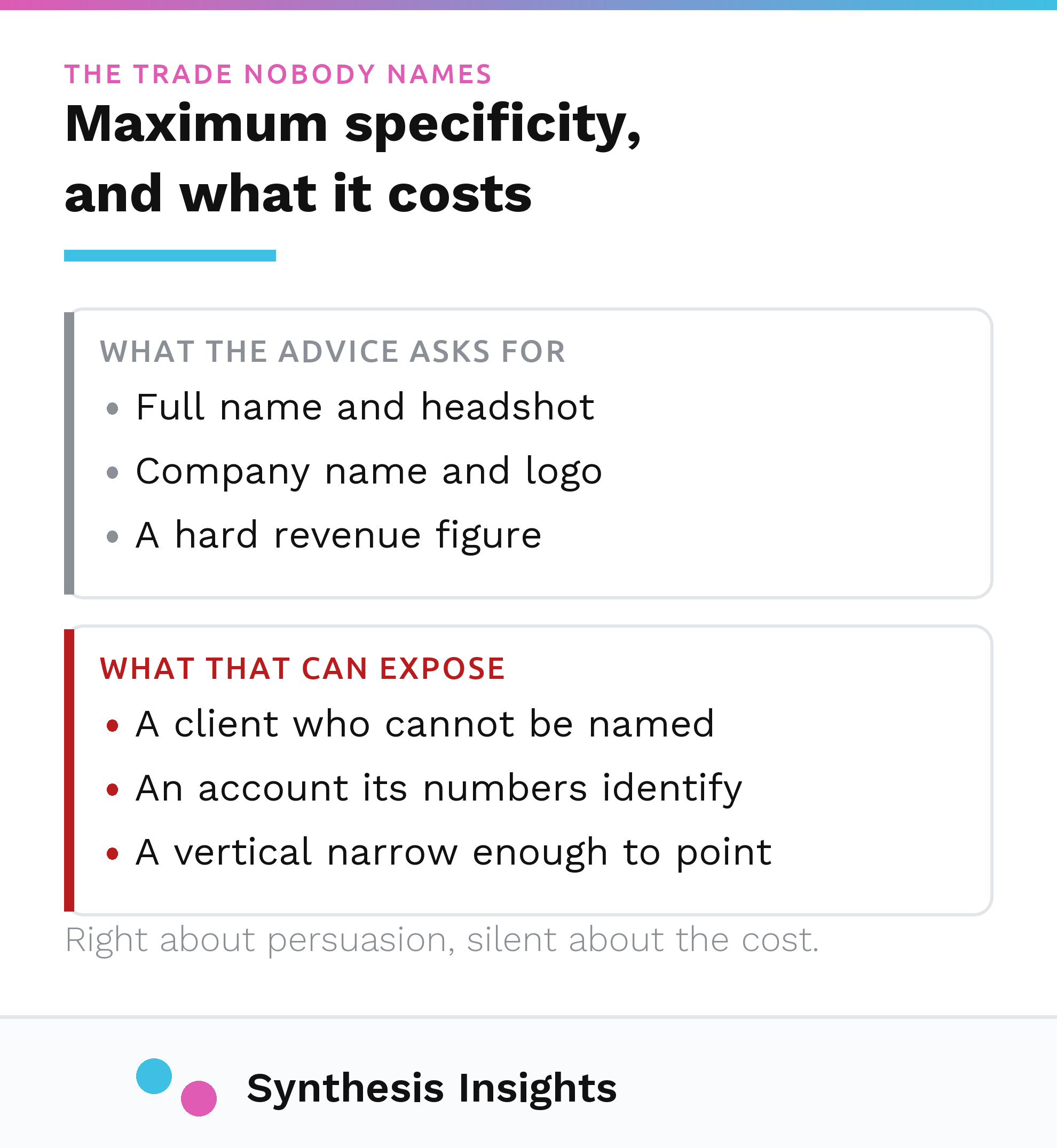
Most advice on B2B testimonials pushes for maximum specificity: full name, headshot, job title, company logo, a hard number in the first sentence. That advice is right about persuasion. A testimonial with a name and a face converts better than one without, and 74% of buyers use reviews to inform their purchase decisions, according to TrustRadius's 2026 B2B Buying Disconnect Report. People check.
What that advice doesn't say is that specificity has a cost, and the client is the one who pays it. Some clients cannot be named at all. Some numbers, put next to each other, let a reader solve backwards to a spend figure or a deal size that was never meant to be public. A testimonial that exposes a client is a bad trade even when it converts, because the damage lands somewhere your dashboard will never record it, in the form of a client who trusted you with a quote and then found their name where they didn't expect it.
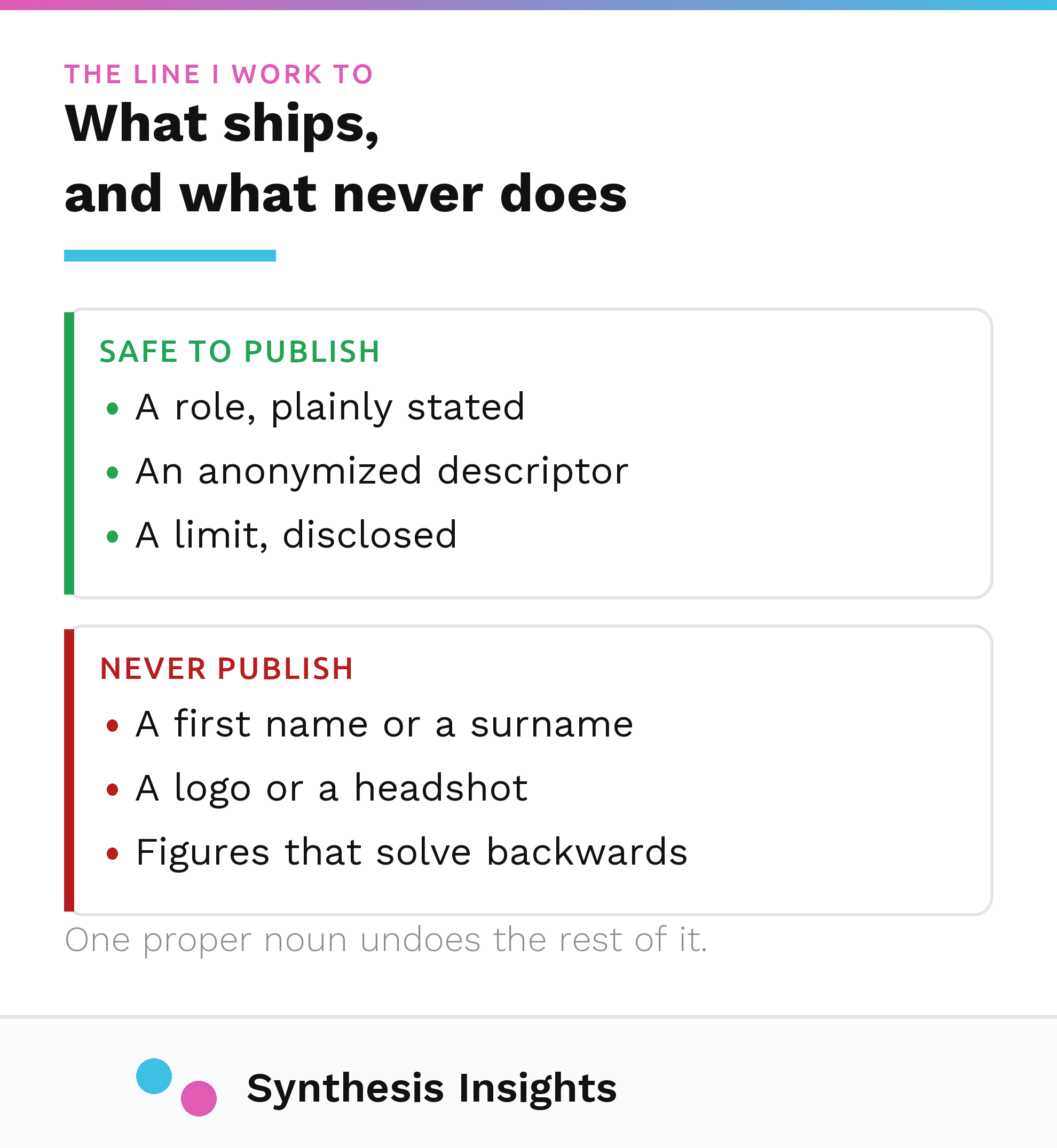
I run a strict rule on my own work: I never publish a client's real name, and I never publish a testimonial's first name either. Attribution is role plus an anonymized descriptor and nothing more: "Marketing lead, an industrial manufacturer," where most advice would have me run "Sarah, VP of Marketing at [Company]." I learned to hold that line the hard way.
The near miss
A testimonial I'd cleared for publication used a first name and a job title, no company name, no logo. It looked anonymized on the page, right up until you put it beside the client's public reviews. That first name, paired with the role, matched a public Google review left under the same first name for the client's business, and the review said enough about the account to close the loop. One proper noun was the whole gap. Anyone who ran the two side by side could work out exactly whose testimonial it was, and the client hadn't agreed to be identifiable, only to be quoted.
Nothing came of it beyond a hard conversation with myself before it went live, but the lesson was blunt: anonymization isn't a spectrum where dropping the last name gets you most of the way there. It's binary. Either a determined reader can reconstruct the identity from what's on the page, or they can't, and a first name is frequently enough on its own to let them.
Since then the rule has three parts, and all three exist because a real gap in the first one showed up in that near miss.
No real names, first or last. Role and an anonymized descriptor only: "Operations director, a mid-size manufacturer." Never a first name, because a first name is a searchable string, and searchable strings connect to public records the way a company name does.
Blur the vertical when it's narrow. A generic descriptor like "an industrial manufacturer" protects a client in a crowded field. It does nothing for a client in a field with a handful of players. If the real vertical would narrow the field to a short list, I widen the description to the next level up, or I swap in a comparably-sized vertical I don't actually serve, so the illustrative example can't be worked back to a real account.
No figure set that solves backwards. One number setting a floor, a percentage improvement, a ratio, is fine on its own. A set of numbers together, spend plus result plus timeframe, can let a reader reconstruct a deal size that was never meant to be public. I'll publish the shape of the result. I won't publish the inputs that let someone rebuild the account.
What still makes it credible
Strip out the name, the logo, and the identifying numbers, and you might assume there's nothing left to persuade with. There is, and it's the part most testimonial advice skips past on the way to "get a photo": the actual content of what the client said.
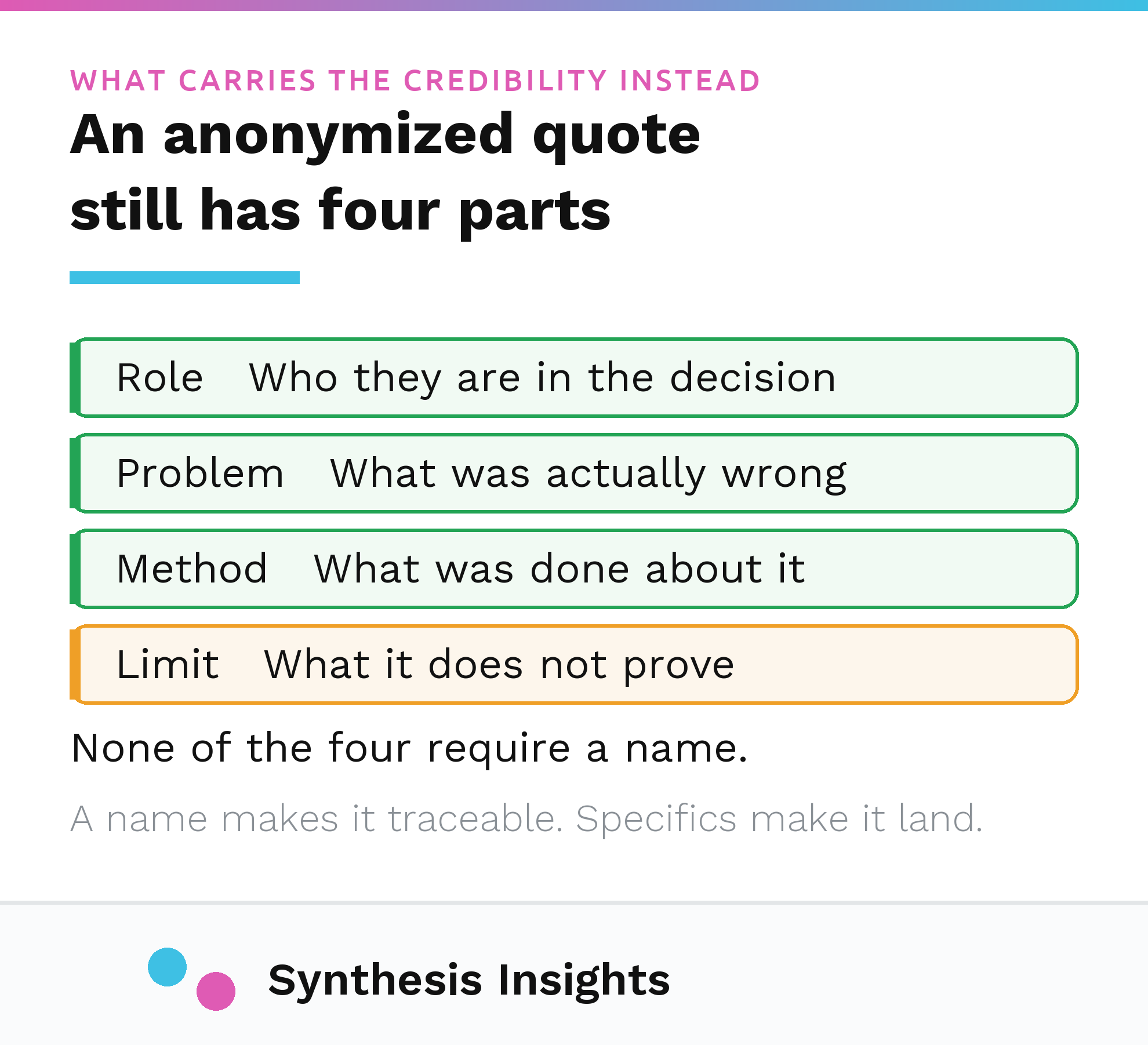
A credible anonymized testimonial keeps four things:
Role and buying context. What the person's job actually involved, and why they were the one evaluating the work, with no name attached to any of it. "The marketing lead who owned the ad budget" tells a reader more about relevance than a job title alone.
The specific problem. Vague praise reads as filler. A described problem, the kind of problem a reader recognizes from their own account, reads as real regardless of whose account it happened on.
The method behind the outcome. What changed, and in what order. A testimonial that says "you fixed our tracking before touching bids" is more convincing than one that just says "great results," because it describes a decision a reader can evaluate on its own logic.
Disclosed limits. A testimonial that admits what didn't move, or how long the fix actually took, reads as more honest than one that claims everything got better immediately. Disclosed limitations are a credibility signal.
None of that requires a name. What it requires is that the quote be specific about the situation, which is a different kind of specificity from being specific about the identity, and most testimonial checklists collapse the two into one.
The rule everyone quotes gets the emphasis wrong
The FTC's endorsement rule requires that a testimonial reflect the honest opinions, findings, beliefs, or experience of the person giving it. That's the actual legal bar, and what it asks about is honesty, with no requirement anywhere in it for photographic proof of who said the words. A named testimonial with a headshot is more traceable than an anonymized one, which is a different quality altogether from being more honest. Most advice conflates the two, treating a name and a logo as the thing that makes a quote trustworthy, when the thing that makes it trustworthy is whether it's true and whether it's specific about what actually happened.
That distinction is also where this piece is different from the question of whether a customer story is true in the first place. I've written separately about verifying the behavior behind a B2B user story, which is about confirming a quote reflects something a buyer actually did. This is the next problem: once you know a testimonial is true, deciding what you're allowed to publish about who said it.
I'd rather ship a testimonial that's anonymized and undeniably specific about the work than one with a name attached and a spend figure a competitor could triangulate. The first one still converts. Check the results page and you'll see the same principle applied to case studies: real numbers, no identity attached to the ones that would expose an account. If you want to see how that plays out on your own account, book a call and I'll walk through what I'd publish and what I wouldn't.