
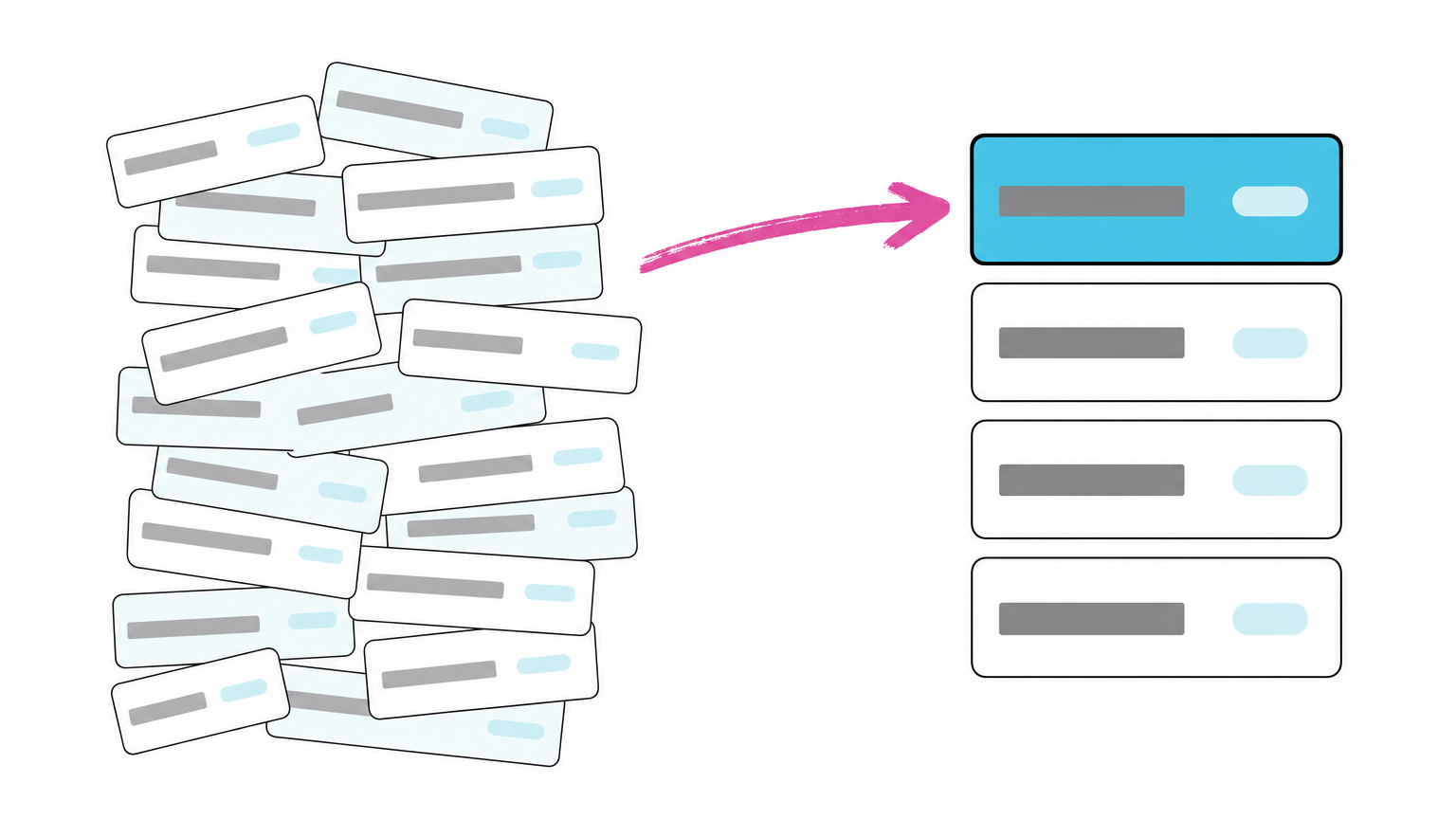
A question set you invent yourself measures your imagination. Real buyer questions already sit in your support inbox and sales notes, written in the words buyers actually use. A set pulled from those real questions shows how visible you are in what buyers are asking ChatGPT about your industry. The list has to be frozen before the first measurement, because once you start tracking, any change breaks the comparison.
What it costs to guess the questions
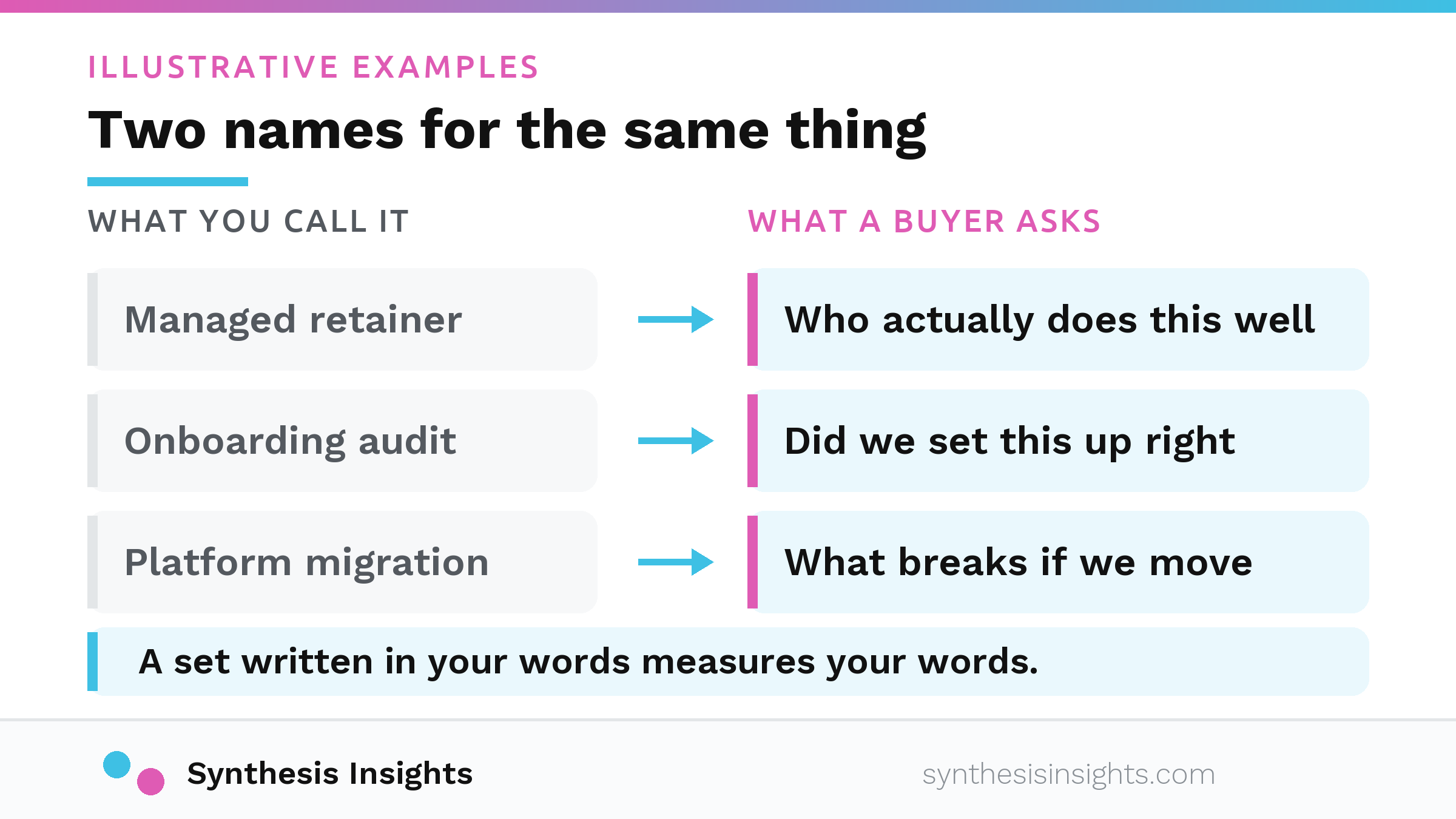
A company names what it sells using the internal label it uses every day. A buyer describes the problem they have. The gap is buyer language: the words a prospect actually types or says. Those words are different from the company’s own term for the same capability. When a visibility score, a measure of how often assistants name you, is generated from questions that came out of a marketing meeting, it tells you whether you rank for phrases written inside your own company, detached from the questions buyers actually ask. If the score moves next quarter, you cannot say whether the assistant changed, your website changed, or the question was never the right question to begin with. The measurement is dead on arrival.
The urgency is not theoretical. Forrester’s Buyers’ Journey Survey, 2025 found that 94% of business buyers used AI in the buying process, up from 89% the year before. The more telling figure is 61%: the share who use private AI tools provided by their organisation. When a buyer does their research inside a tool their own employer runs, no analytics you own will ever record that conversation. A shortlist is being assembled inside a tool you cannot see, and a supplier is either named on it or absent from it, before you have any record that the evaluation happened at all. You have no observational access to it. The only record of that interaction that can exist is the one you make by going and asking the questions yourself. That turns the list of questions you choose into the measuring instrument, not a preliminary step before measuring starts.
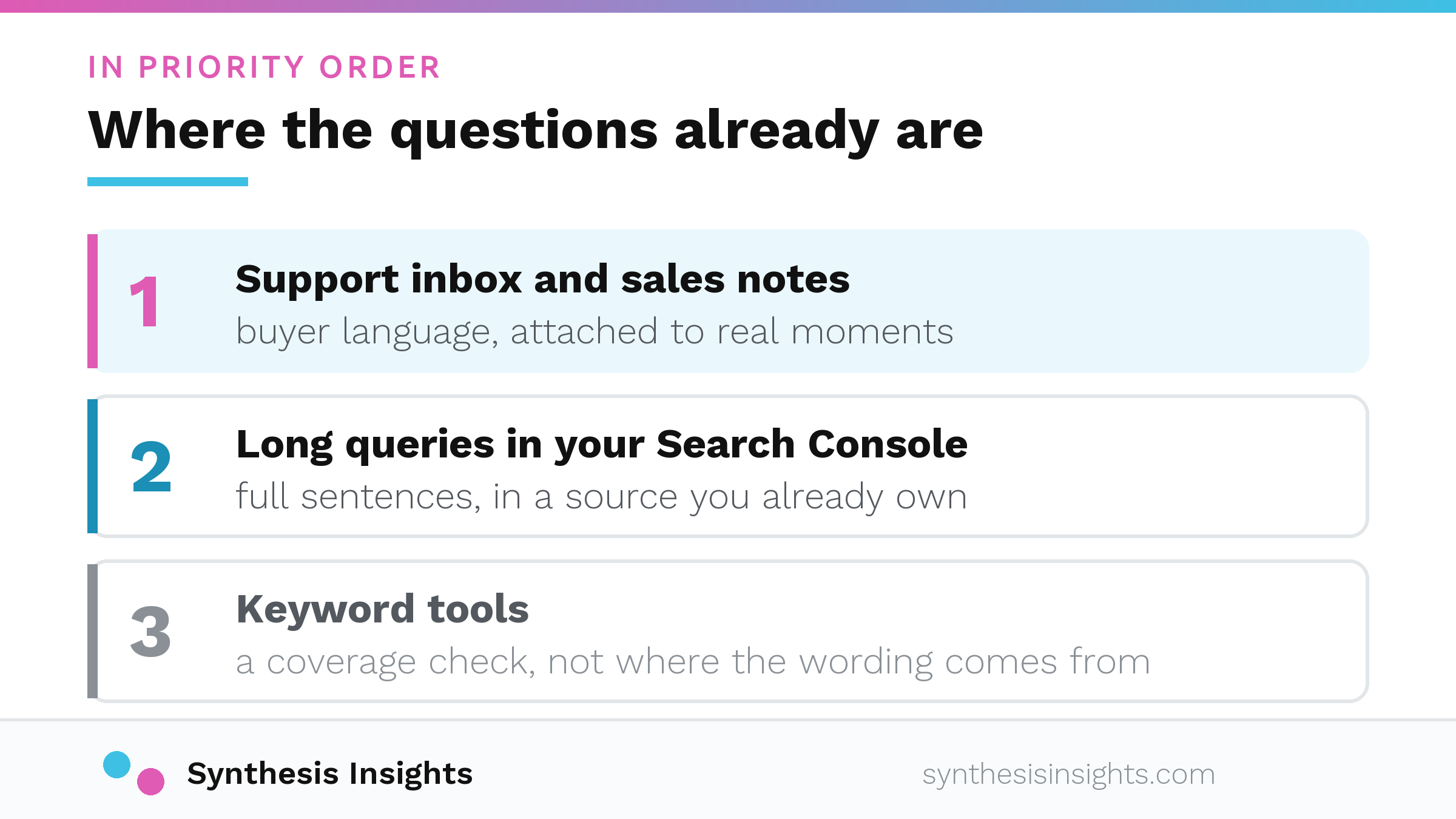
Where the real questions already are, in priority order
1. Your support inbox and sales notes, first. These are in buyer language, about your category, and attached to real moments: a deal that stalled, a customer who was confused, a question a rep answers from memory on every call. Frontline notes sit at the top of the priority list because they carry the exact phrasing a person used at a moment when they had money on the line. Pull from a window long enough to cover a full sales cycle, and use the same window every time you rebuild the set. Keep only the tickets and notes shaped like a question, plus the ones a rep answers from memory on every call. Rewrite each in the buyer’s own words as a question you would type to an assistant, and tag it with its buying stage.
2. The long conversational queries in your own Search Console, second. Search Console offers no filter that isolates conversational queries. Take the query list for a fixed date range and look at the long rows, the ones that are full sentences rather than two or three words. Over a recent 90-day window, our own Search Console surfaced queries like these:
- "how do i find the exact questions buyers are asking chatgpt in my category?"
- "how do i know if ai assistants are mentioning my company when people ask questions in my category"
- "our best new client this month found us through a chatgpt recommendation. that was luck, and we want to turn it into a predictable channel. which agencies specialize in increasing a brand’s recommendation probability in ai assistants? look up current providers online."
These are full sentences with context and an instruction to the assistant, and they appear in a source you already own.
3. Keyword tools, last. The short typed phrases these tools return are a different shape from the sentences a buyer speaks to an assistant. Use them to check whether you are missing a topic area entirely. Write the questions you will actually ask using the buyer language from your own sources.
What makes a question set usable: buyer language and a spread of buying stages
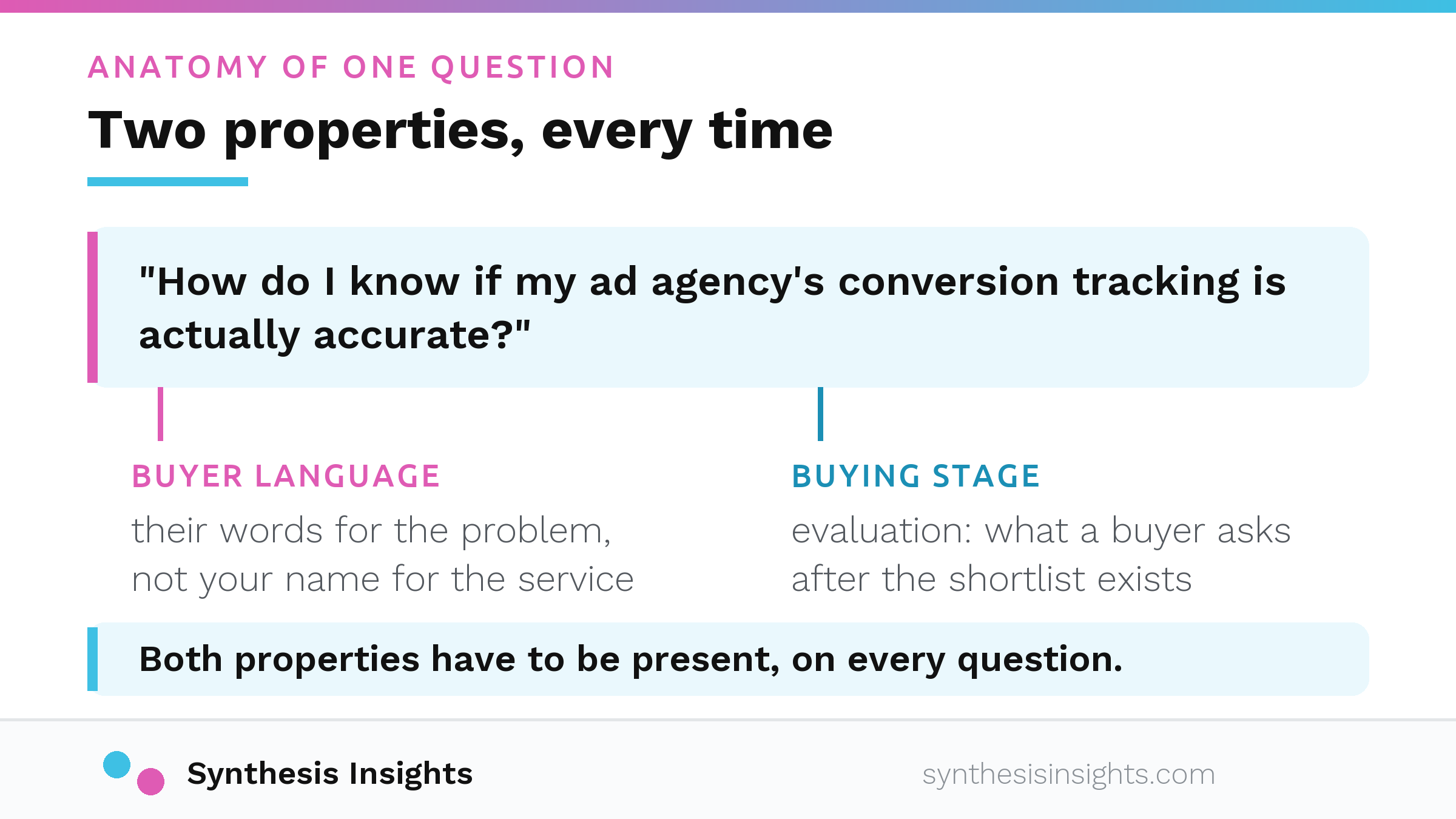
A usable question set has two properties. First, every question is in buyer language. Second, the set spreads across buying stages.
A buying stage is where in the purchase process the question sits. A buyer asking "Who does this well?" is at vendor selection. A buyer asking "How do I check if the work was done right?" is at evaluation. The answers a good supplier needs to show at each stage are different.
A set made entirely of "who is the best supplier of X" questions tells you whether you get named on a shortlist. It tells you nothing about whether you survive the questions a buyer asks after you are on it. A company can win one and lose the other. If you measure only the first, the number you report to leadership is incomplete. Both properties have to be present for the measurement to mean anything.
Freeze the set before the first run
The freeze rule is this: lock the list of questions, with a date and the name of the person who owns it, before you run the first measurement, and then leave it alone. Do not add a question. Do not reword one. Do not remove the one that now looks embarrassing.
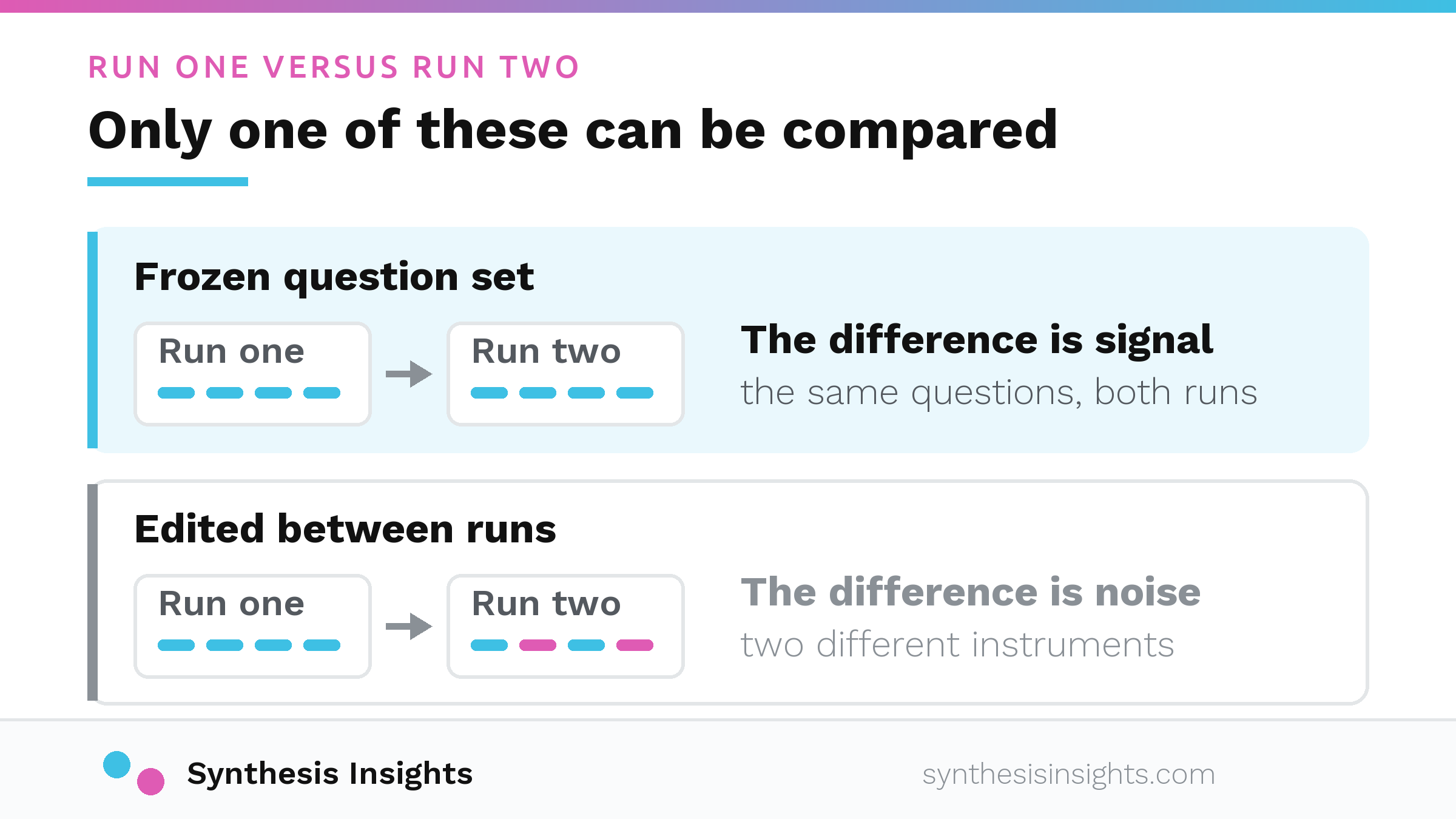
Schulte, Bleeker and Kaufmann, in their 2026 paper "Don’t Measure Once: Measuring Visibility in AI Search (GEO)," write that the probabilistic nature of AI search makes one-off observations unreliable, and that their findings underscore the need for repeated measurements and for describing visibility as a distribution built from them. If the only way to get a reliable signal is to measure repeatedly, the instrument doing the measuring has to hold still between runs. Edit the questions between run one and run two, and the second run measures something different. The difference between the scores is noise. You end up with two numbers that cannot be compared and no way to know it. More detail is in our piece on AI citation volatility.
A worked example: the question set we froze for ourselves
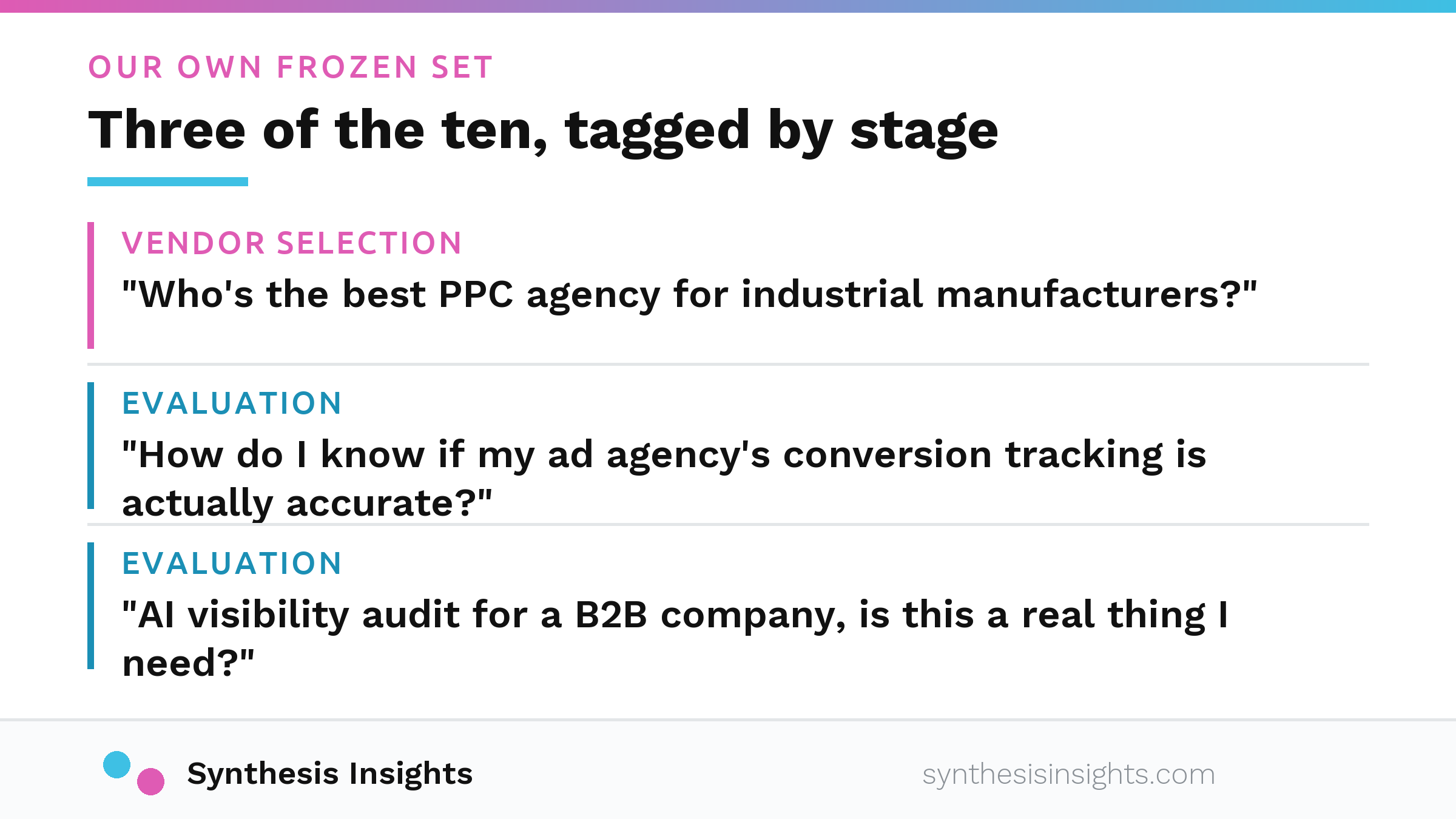
The file we use internally at Synthesis Insights holds ten questions across two categories: eight under a B2B and industrial paid media agency category, and two under an AI visibility audit category. Every question is tagged with a buying stage, either vendor selection or evaluation. Four sit at vendor selection and six at evaluation. The file is marked frozen, with the name Andre Rosdahl and the date 22 August 2026. Here are three of them:
- "Who’s the best PPC agency for industrial manufacturers?" (vendor selection)
- "How do I know if my ad agency’s conversion tracking is actually accurate?" (evaluation)
- "AI visibility audit for a B2B company, is this a real thing I need?" (evaluation)
The first question determines whether you appear on a list at all. A buyer early in the process is asking who does the work. The second and third are what a buyer asks when they are already comparing two suppliers and want to know what goes wrong, or whether a category of service is legitimate. A set that lacks the evaluation questions would report that a brand is visible, without revealing whether it earns trust after the shortlist.
The structure is what to copy. The set uses two categories because the company sells two distinct things, and every question carries a stage tag so the set can be read by stage later. The lock record names a person and a date, which removes any argument later about what the set contained at run one.
What a frozen question set cannot tell you
First, a frozen set measures the exact questions you chose. It cannot tell you which questions buyers ask most often. Freezing buys comparability across measurements. It costs you coverage. If a new question becomes common in your market, a frozen set will miss it until you make a new version. That trade is real and should be made deliberately.
Second, a set goes stale. The fix is to version it. Start a second question set and keep running the first one alongside it. The series you already have does not break, and you can observe when the original set stops being representative.
Third, the same question can produce different answers on different days. That variability is why the freeze rule matters. A frozen set lets you separate real shifts from background noise.
Fourth, identifying the questions buyers ask is a separate job from appearing in the answers. Understanding what buyers are asking ChatGPT about your industry tells you what to look for. It does not tell you whether you showed up. That second measurement is its own discipline, covered in our piece on share of AI answers.
What to do once you have the set
A probe is a scripted prompt run against an assistant the same way every time, as opposed to typing something in once and screenshotting it. With a frozen question set, run two is comparable to run one. The movement between the two is a signal about your brand, because the list stayed the same. That is what the discipline buys. Moving the number is a different job from measuring it, and the evidence behind that work is in how to get recommended by ChatGPT.
Building the set is work you can do. Running it across several assistants and reading what comes back takes a system; a 10-minute AI visibility check gives a quick sense of what a single run looks like. The AI Visibility Audit is where this work gets done for a company that would rather not run it itself.
FAQ
How do I find the exact questions buyers ask ChatGPT in my category?
Start with your own support inbox and sales notes. Then check the long conversational queries in Search Console. These sources contain the actual words buyers use. Extract the questions, sort them by buying stage, and freeze the list before measuring.
Can I build this question set using a keyword tool?
The short phrases keyword tools return are not shaped like the full sentences people type to assistants. They are useful for checking whether you are missing a topic area entirely, but the final questions need to be written from the buyer language found in your own support notes and sales calls.
How many questions do I need to get a useful read?
The right number is enough to cover both buying stages for each category you sell into, and then exactly that same number every subsequent run. Changing the count between measurements breaks the comparison. The spread across vendor selection and evaluation matters more than the total.
Should my question list change every time I run the check?
No. The list must stay frozen between runs to make the measurements comparable. If you discover a new question that matters, start a second question set and run it alongside the first. Leave the original untouched.
What is a frozen question set and why does it matter?
A frozen question set is a list of prompts locked with a date and an owner before the first measurement run and left unchanged afterwards. It matters because AI search results vary. Without a stable set, you cannot tell whether a change in your score came from a real shift in visibility or from a different question being asked.