
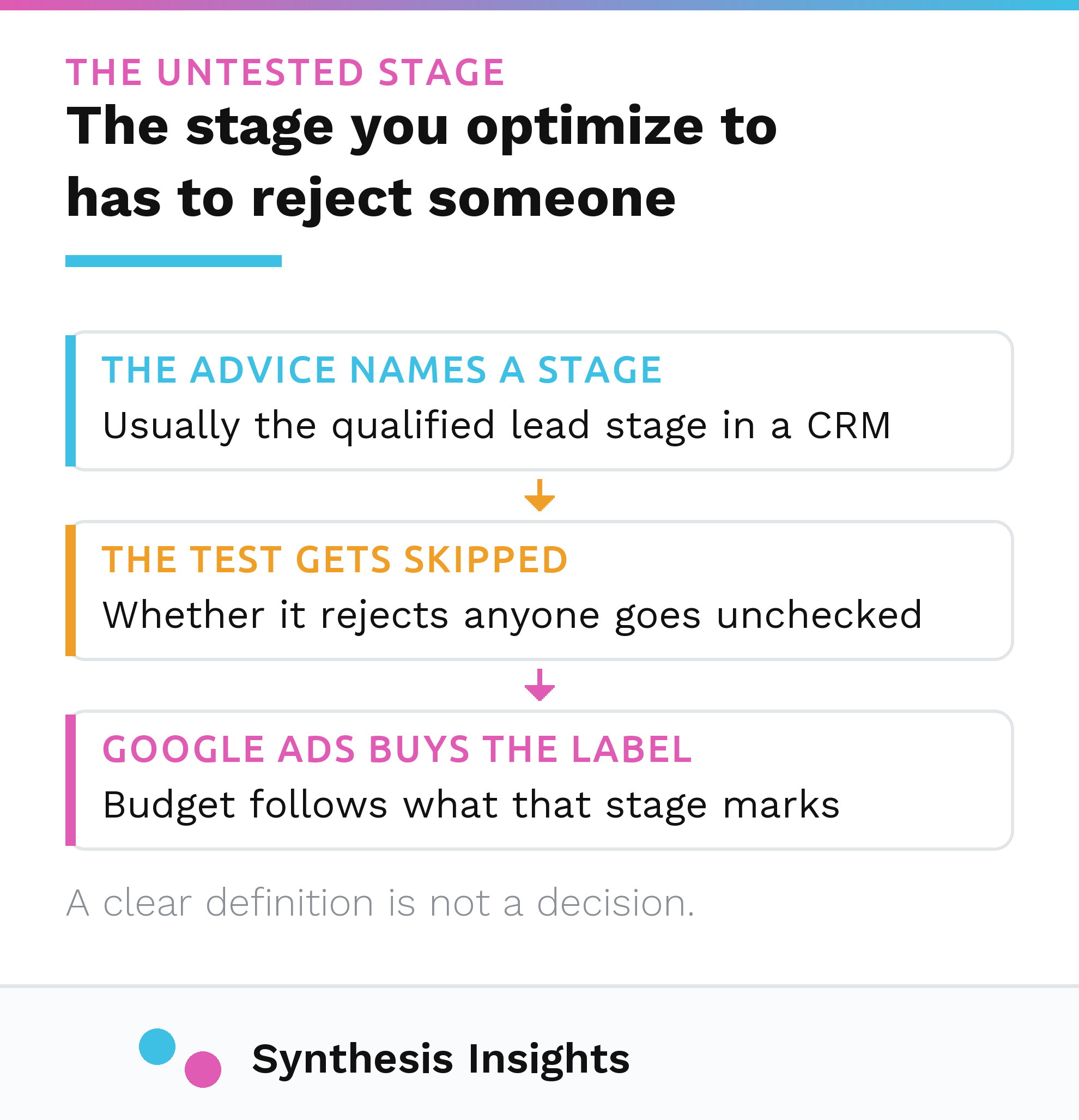
The standard advice is reasonable
The usual recommendation is to pick the deepest conversion event that still produces enough reliable monthly volume for the bid strategy to learn from. For B2B and industrial lead generation, that typically means the lead stage where someone on the sales side has looked at the record and decided it is worth a conversation. Google calls this a qualified lead conversion goal, and its documentation describes it as a lead “further qualified offline (outside of Google Ads) in your customer relations management (CRM) system or internal lead generation system.” Across the pages I read, the qualified-lead stage is repeatedly named as the right landing point, and the reasoning holds up. A form fill tells you someone downloaded a piece of content or asked for a quote. A qualified lead tells you a human being reviewed the submission and decided it warranted follow-up. That is more signal, and more signal should produce better bidding.
Google also states plainly that “choosing the appropriate conversion goal is critical to making the most of Google AI.” The platform is built to take the conversion actions you mark as primary and go find more of them. If you send back a stage that genuinely separates promising leads from dead ends, the bid strategy has something real to work with. If you send back a stage that rubber-stamps nearly everything, the bid strategy is optimizing toward arrival, no matter what the stage is called.
The question the standard advice does not ask
What none of the pages I checked proposed was testing whether the chosen stage actually separates leads that close from leads that get rejected. The nearest any of them get is a data-hygiene argument: get sales and marketing to agree on what each stage means and apply it consistently. That is necessary work, and it is not the same thing as finding out whether the stage, as it is applied today, rejects anybody.
Agreeing on a definition and applying it consistently solves a labeling problem. It makes sure that when a salesperson marks a lead qualified, they mean roughly the same thing the marketing team thinks they mean. But a stage can be defined clearly, applied uniformly, and still mark nearly every lead that arrives, which means the label carries little information. The bid strategy cannot tell the difference between a genuine opportunity and a waste of time if the CRM never tells it there was a difference.
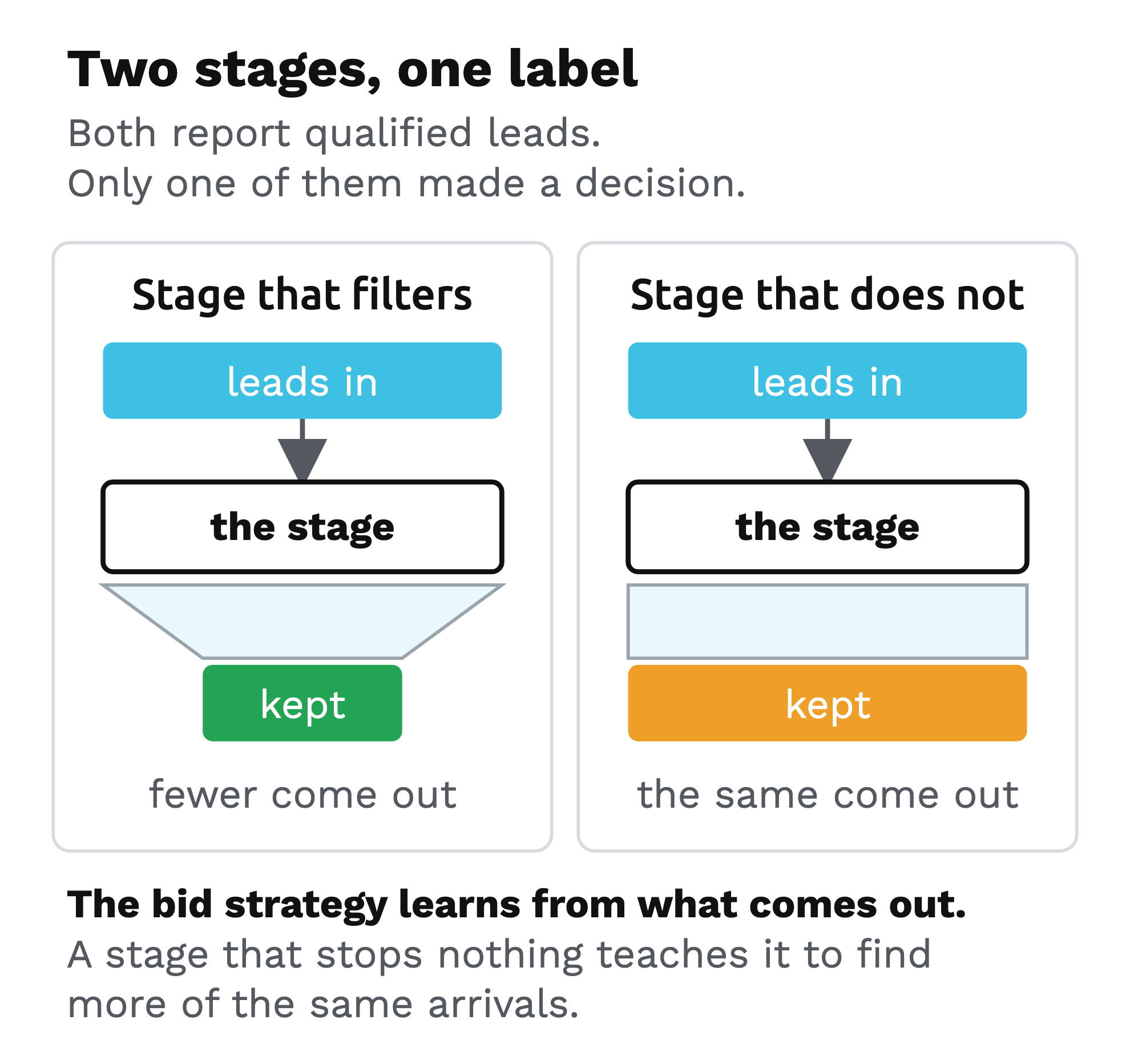
This is why measuring against the CRM instead of the form fill matters. The form fill tells you someone raised their hand. The CRM tells you whether anyone on your team wanted to talk to them after they did. That second judgment is the one you are grading against when you optimize toward a qualified-lead stage. The question is whether the judgment is actually being made.
One account, one year, one audit
In one account Synthesis audited, paid search brought 867 leads over a twelve-month period. The sales qualified lead stage marked 804 of those 867 leads, 93 percent, as sales qualified. Sales later threw out 184 of those 804.
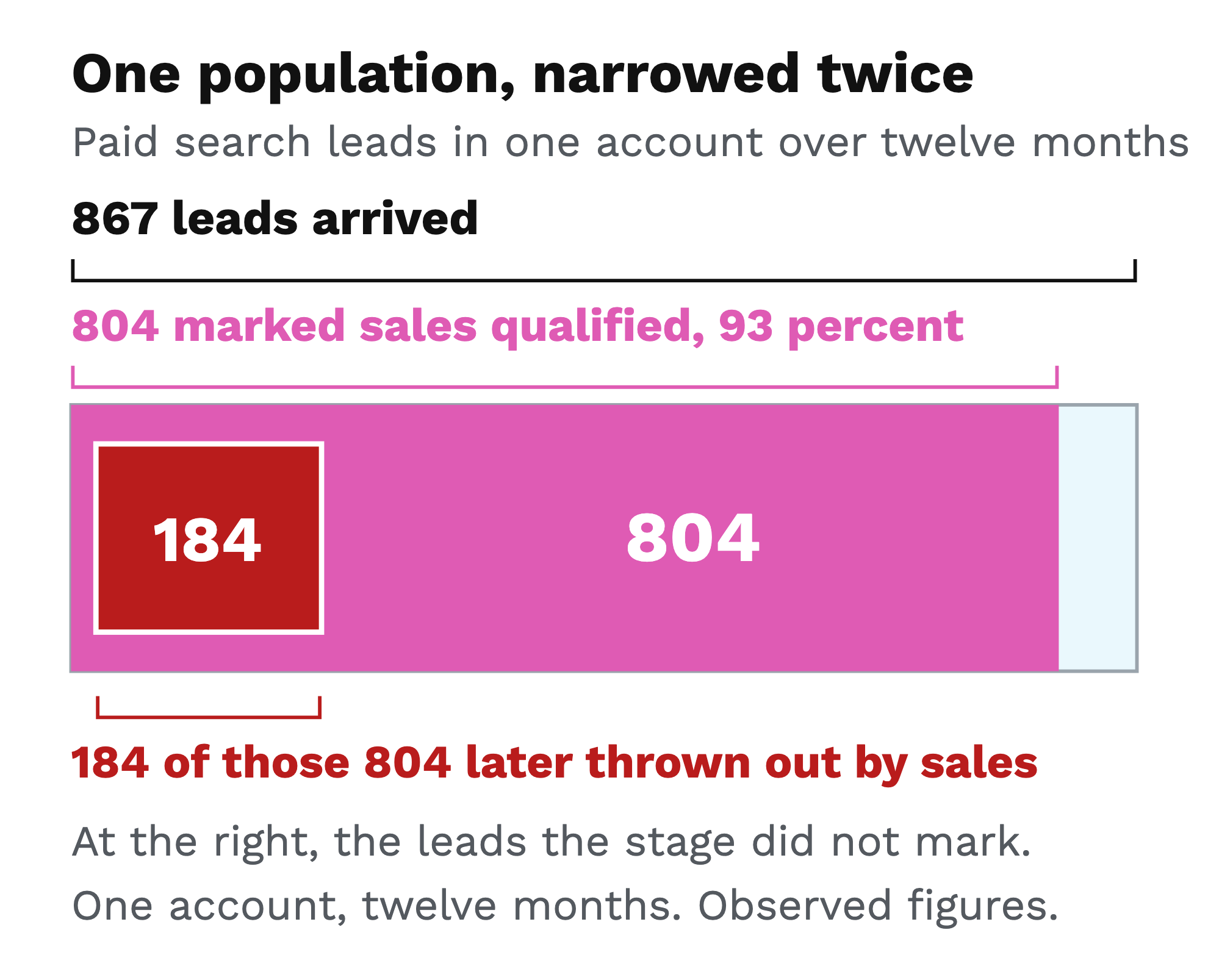
The bid strategy was told to optimize toward the sales qualified lead stage. It saw a signal that said yes to nearly every lead. For the 184 leads the sales team later threw out, that stage had already marked them qualified, so it did not act as a filter for them.
The platform did its job. It found more of what it was told to find. What it was told came from a label that had already been applied to 184 leads the sales team went on to throw out.
One count tells whether your qualified lead stage ever rejects leads
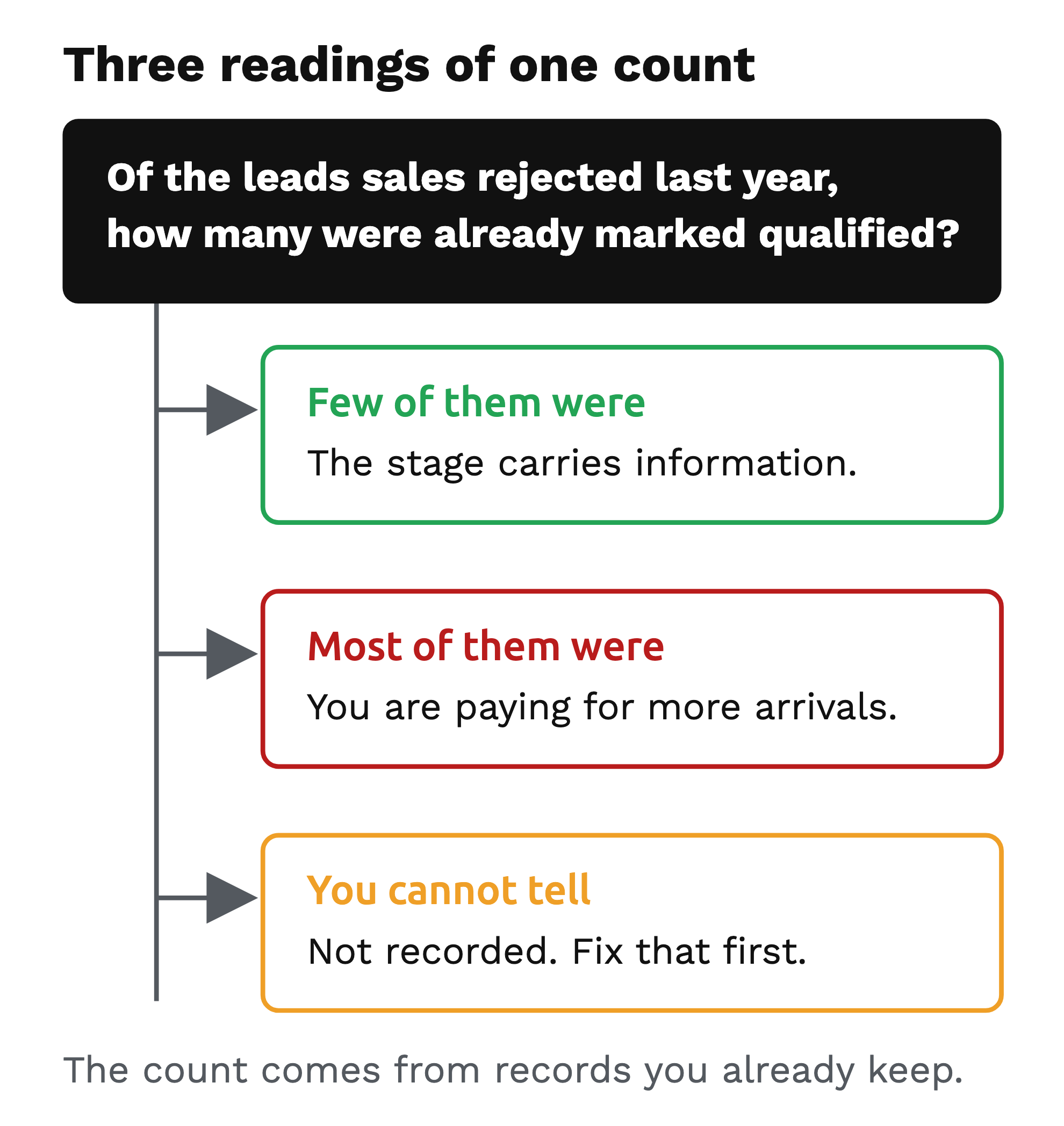
The question to answer is a single count, and it comes entirely from records the business already has. Of the leads your sales team rejected last year, how many had already been marked qualified by the stage you optimize toward?
Answering the question needs no new tracking and no change to the ad account. The work is establishing whether the rejections and the stage history line up in the records that already exist.
What comes back is a judgment about whether the sales qualified lead stage stopped the leads the sales team later rejected. Carry that judgment into your decision about which action to optimize toward.
What each answer means for Google Ads spend
The conversion actions you designate as primary are the ones used for bidding. Secondary conversion actions are for observation and reporting only. That distinction is the mechanism that makes this diagnostic matter. Whatever you mark as primary is what the bid strategy optimizes toward, and Google’s own documentation makes clear that the qualification judgment for a qualified lead happens in your CRM. The platform does not make that judgment. The platform will faithfully go looking for more of whatever your CRM called qualified.
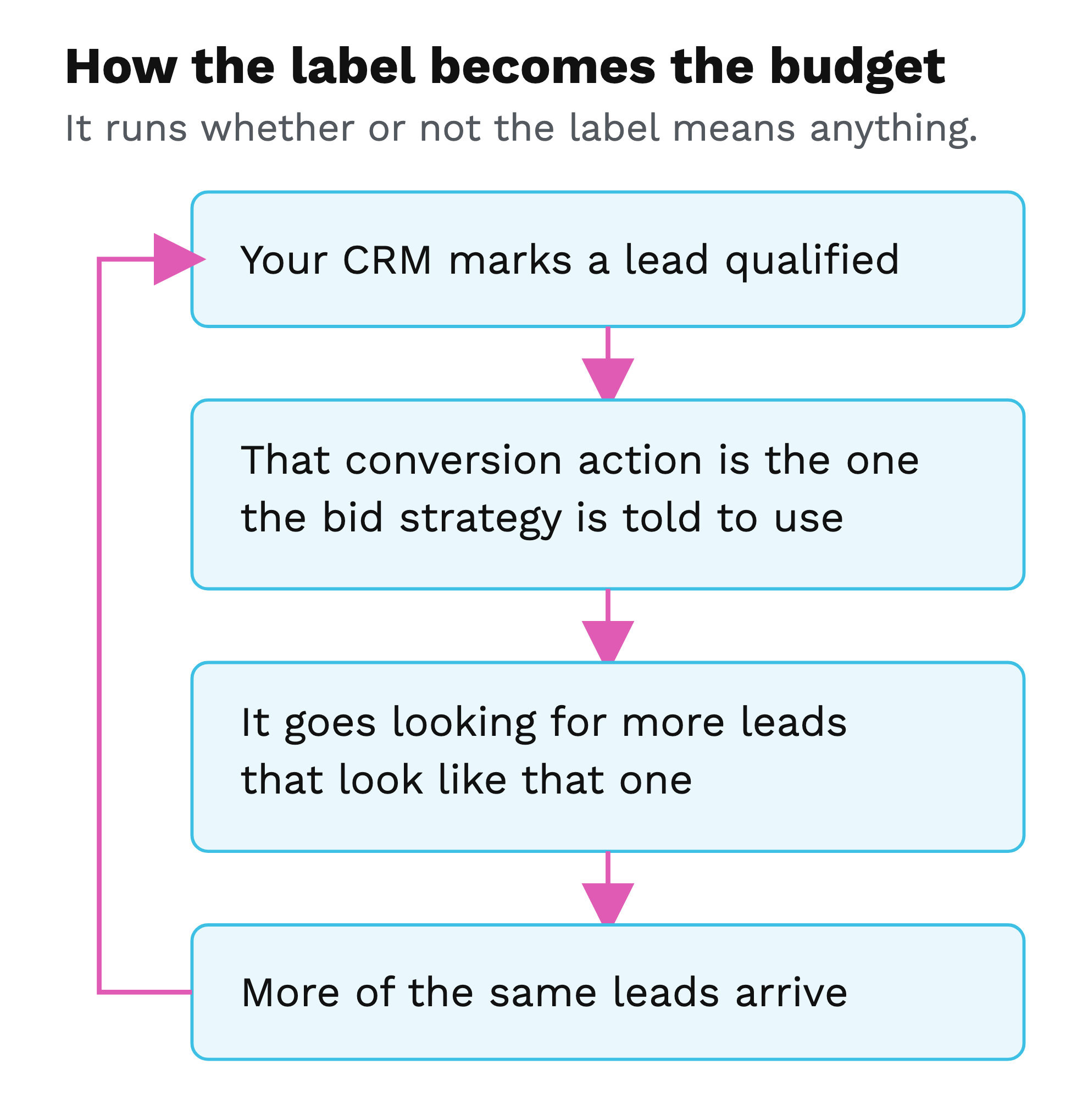
If the diagnostic shows that the sales qualified lead stage rejects a meaningful share of leads, the label carries information. The bid strategy has a signal it can use, and the argument between sales and marketing becomes a disagreement about thresholds rather than a disagreement about whether the whole system is broken. That is a manageable problem.
When the diagnostic shows that the stage marks nearly everything that arrives, you are optimizing toward arrival. The bid strategy is being told to find more leads that look like the ones you already get, with no guidance about which of those leads anyone wanted. Sales will keep throwing leads out and the dashboard will keep reporting them as qualified. The argument will repeat because the stage provided no separation.
A third outcome is possible, and it is worse. If rejection is not recorded at all, you cannot run the diagnostic. You have a year of leads, a qualified stage that may or may not mean anything, and no way to check. That is a CRM process problem before it is an ads problem, and it has to be solved first.
Picture a conveyor systems manufacturer whose sales qualified lead stage fires whenever a submission includes a company name. Every form fill that is not blank in the company field gets marked qualified. The bid strategy optimizes toward that signal, and the sales team spends the week calling sole proprietors with no budget and no project. The stage is applied consistently and the definition is clear, so the bid strategy is doing exactly what it was told. A conversion action can be named one thing and count another. A conversion action that counts a tap on a phone number as a call shows the same pattern elsewhere.
Limits on what these numbers say
This is one account, one twelve-month window, and one CRM’s stage definitions. The figures are observations, and they are not a benchmark. One audit is not a track record. The 867 leads, the 804 marked qualified, and the 184 thrown out describe what happened in a specific business with a specific sales process. They do not describe your business.
The numbers here also do not prove that the sales qualified lead stage fails to separate good leads from bad ones. That comparison requires the rejection rate among leads the stage did not mark qualified, and that figure is not published here. Without it, you cannot say whether the stage is discriminating or not. You can only say that it marked nearly everything, and that when nearly everything is marked, the signal is weak by construction.
The diagnostic is narrow. It answers one question: does the stage you optimize toward actually reject leads? It does not answer whether the rejection decisions were correct, whether the sales team is good at its job, or whether the breakeven cost per lead math works out. It tells you whether the signal you are paying the bid strategy to use contains information. That is a limited question, and it is the one that matters first.
Optimizing the conversion action takes real work
If the diagnostic shows the stage is not rejecting anything, the fix is not a settings change. Someone has to decide what the sales qualified lead stage should mean for this business. The sales team then has to apply that meaning to every lead before the stage is marked. The signal the bid strategy runs on has to be rebuilt on top of that decision.
That is judgment work. It takes someone inside the business deciding what a real opportunity looks like and enforcing that decision in the CRM every day. No tooling will decide it for them.
If you are not sure whether this problem is live in your account, the diagnostic can answer that. If it is live, fixing it is the kind of work that falls under paid media management when the person doing it understands that the signal originates in the CRM.
Common questions
What is a Google Ads conversion action?
A conversion action is a specific customer behavior you tell Google Ads to count as valuable, such as a form submission, a phone call, or a CRM stage change. The platform records each instance and uses that data to measure performance. When you set one as a primary action, it can also guide automated bidding.
Which conversion action should you optimize to?
The common advice is to choose the deepest stage that still receives enough monthly volume, often the point where a lead gets marked sales qualified. Whether that stage is right depends on whether it actually filters leads. If it passes nearly everything, the bid strategy learns from arrival patterns rather than genuine sales potential.
Should qualified leads be the primary conversion action?
The standard recommendation says yes, because qualified leads sit closer to revenue than raw form fills. In one account we audited, though, the sales qualified stage marked 93 percent of all leads over twelve months, and sales later discarded 184 of those. When a stage marks almost every lead, it reports arrival, not a meaningful judgment.
What is the difference between a primary and a secondary conversion action?
Primary conversion actions are the ones included in your bidding strategy. Google Ads uses them to set bids and evaluate campaign performance. Secondary actions are for observation only. They appear in reports so you can see the data, but automated bidding does not act on them.
How many conversions does a bid strategy need before this diagnostic is reliable?
Google recommends roughly fifteen conversions in thirty days as a practical floor for automated bidding to function well, though that is guidance rather than a strict rule. The diagnostic in this article does not depend on live bidding volume at all. It is a backward looking count of rejected leads that were already marked qualified, so you can run it regardless of monthly conversion totals.