Most B2B growth marketing advice is a list of things to add: a new channel, a new automation sequence, an account-based marketing motion, a content calendar. Add enough of them and growth is supposed to follow.
The highest-return work I've found doing this is almost never on that list. It's finding a constraint inside a channel you already run and already pay for, one that's been quietly capping performance long enough that nobody thought to check.
Here's what that looked like on one account. An industrial equipment manufacturer was running a Shopping campaign that had settled into spending about 4% of the account's total budget, month after month, and nobody was alarmed by it. Small campaigns spend small amounts. That's what they're supposed to do.
The reason wasn't strategy, and it wasn't bidding. Of 136 products in the catalogue, only 34 were eligible to serve. The campaign had an inventory filter, essentially a whitelist of item IDs, that had been set up at some point and never revisited. As the catalogue changed, the whitelist didn't. Three-quarters of the products this campaign was supposed to be selling had simply aged out of eligibility, and Google Ads only shows what's in the group you defined; it doesn't warn you that the group has gone stale. Google's own documentation on inventory filters describes exactly this mechanism: an optional filter that restricts a Shopping campaign to a defined product grouping, with everything else invisible to the auction by design.
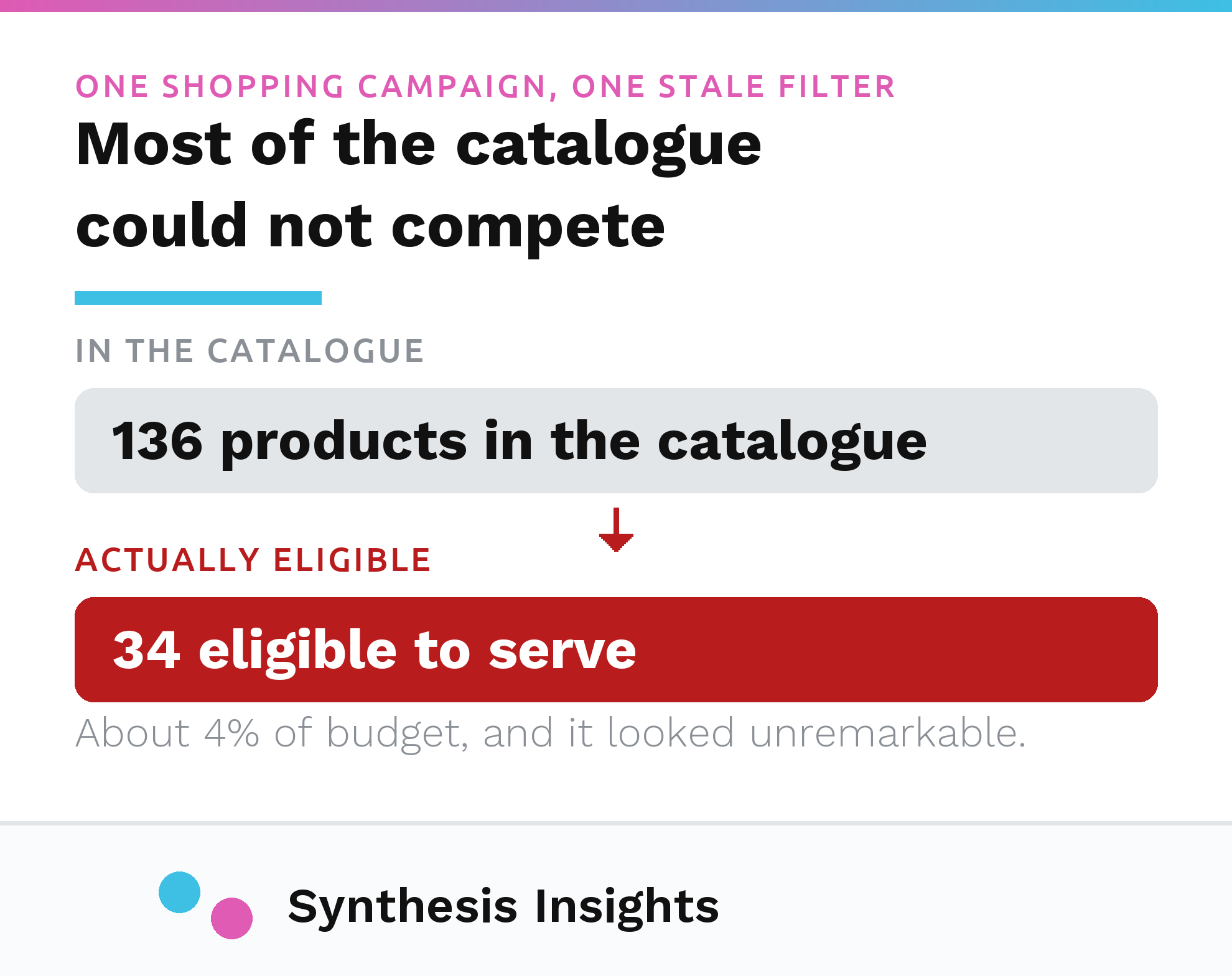
Nothing in the performance report told you this. Impressions, clicks, and cost per click all looked like normal numbers for a small campaign. That's the trap: a mechanical constraint and a genuinely small opportunity produce the same dashboard. You only find the difference by going and checking the mechanism, not the metrics.
Why this matters more than another channel
Growth marketing, as a category, sells itself on addition. More channels, more tests, more automation, a bigger stack. I am not going to hand you a budget statistic here, because the industry surveys I checked were either behind a wall I could not read or too old to quote honestly. The reasoning stands without one: if a channel you already pay for is running at a quarter of its available inventory, the return on fixing that is immediate and costs nothing but attention, while a new channel costs money, time, and a learning period before it tells you anything.
Products can also go quiet for reasons that have nothing to do with your campaign settings. Google's own Merchant Center documentation describes a "Needs Update" indicator that products enter 30 days after their last update, alongside approval statuses that Google, not you, controls. So there are at least two independent ways for a product to stop competing while your reports keep showing a small campaign behaving normally.
Nobody finds a stale whitelist by launching a new channel. You find it by asking a boring question about a channel you already have: is this line item small because the market is small, or because something upstream is stopping it from competing at all?
What a "small" line item is actually telling you
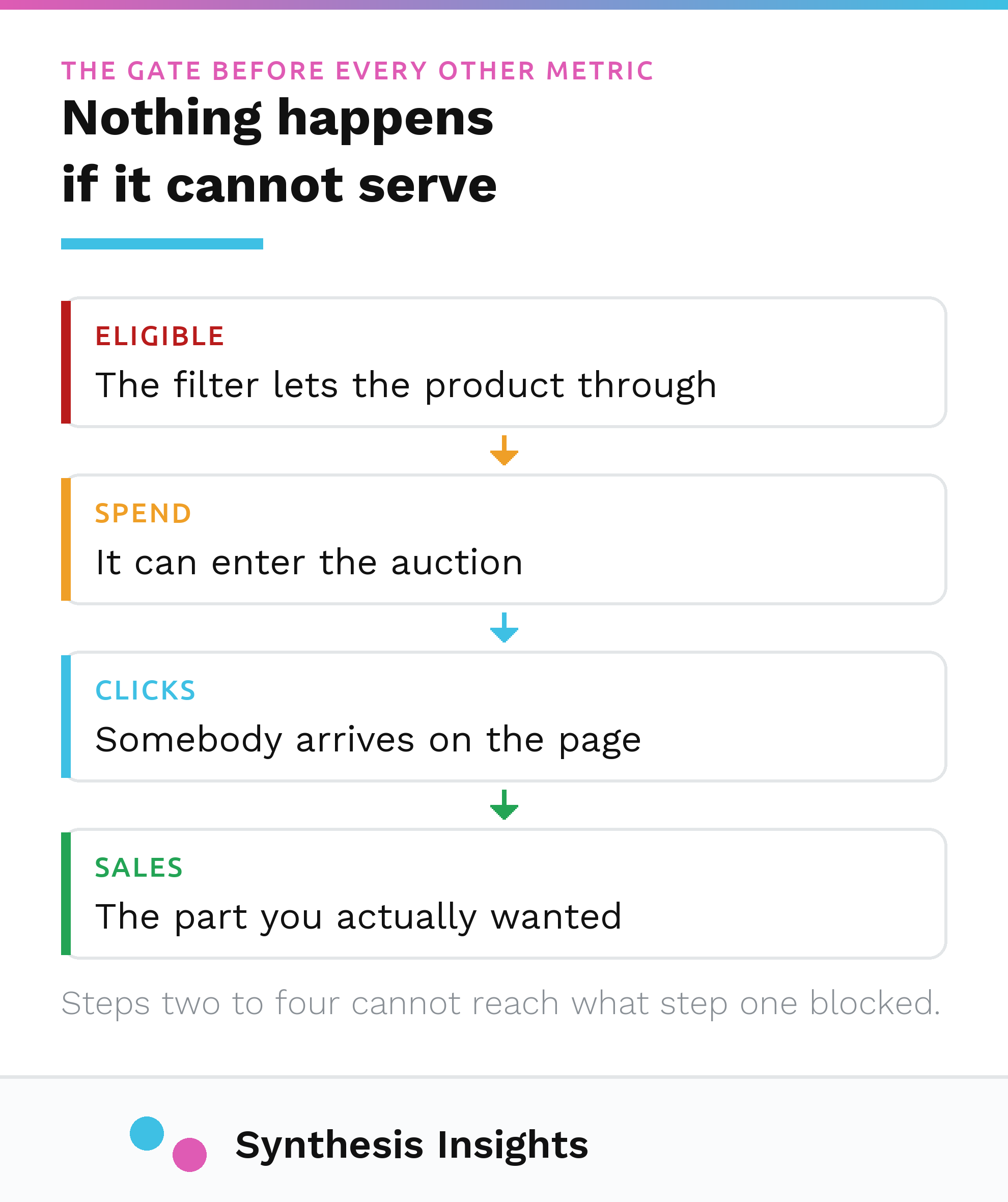
The instinct with an underperforming campaign is to treat the numbers as the ground truth and optimize on top of them: raise the bid, rewrite the ad, test a new audience. All of that is legitimate work, and none of it would have found 102 missing products, because none of it touches eligibility. You can run a flawless experiment programme on top of a broken mechanism and it will produce confident, wrong conclusions, because the experiment is only ever testing the fraction of the catalogue the mechanism allowed through.
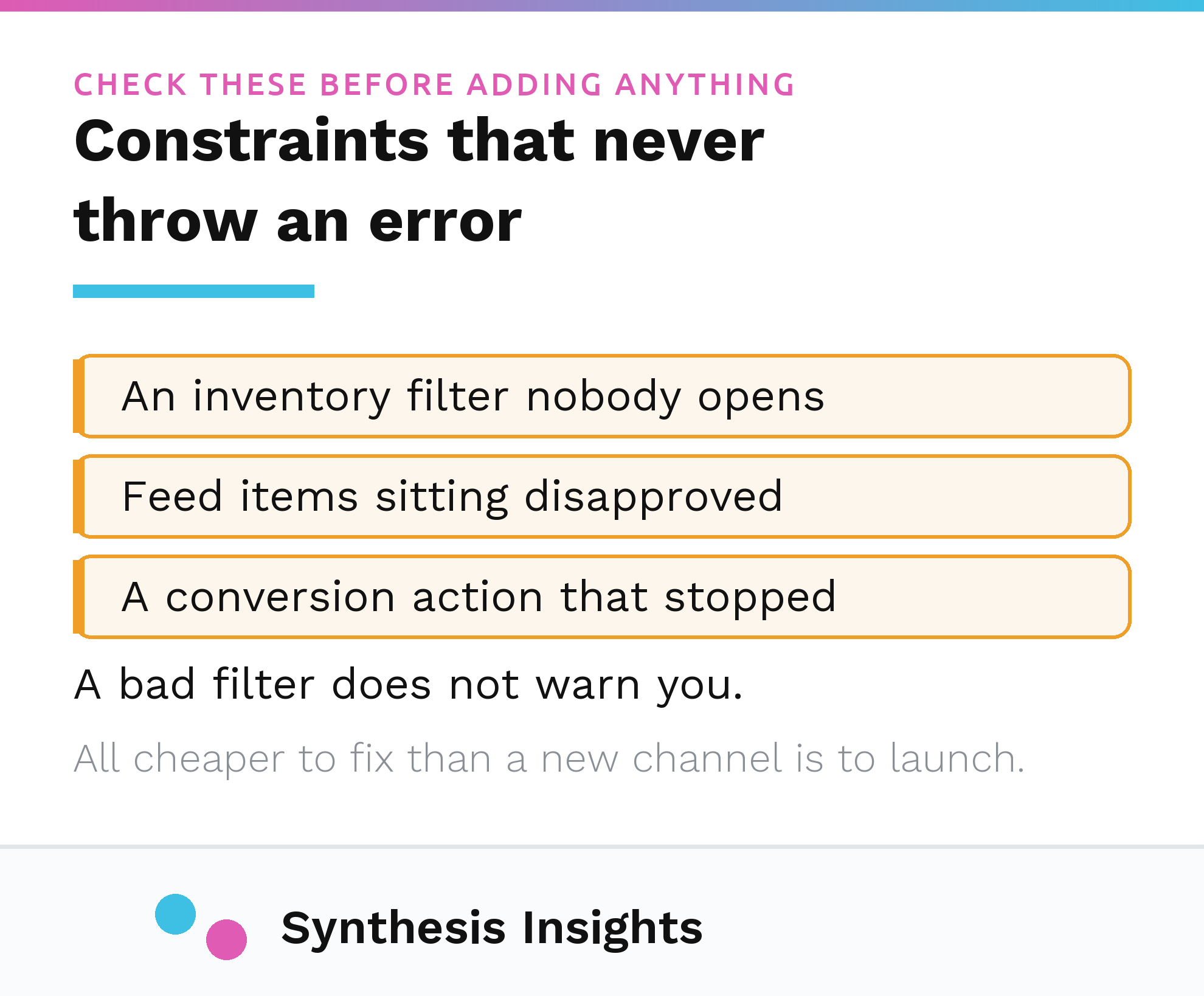
Before adding a test, an audience, or a channel, the cheaper question is whether the account is already losing eligible demand somewhere quiet: an inventory filter nobody has opened in a year, a conversion action that stopped firing, a product feed with disapproved items nobody triaged. These aren't glamorous checks. They also don't show up as errors. A bad filter doesn't throw a warning; it just makes a campaign that could be three times the size look, permanently, like it's already doing fine.
Where growth marketing actually earns the name
None of this is an argument against the standard growth marketing toolkit: content, email, paid search, account-based marketing, marketing automation. Those are real levers, and most B2B companies should be using more than one of them well. The argument is about sequencing. Fixing a mechanical constraint on a channel you already fund is usually cheaper and faster than any new initiative, because the audience, the budget, and the product catalogue are already in place. What's missing is eligibility, not opportunity.
That's the discipline worth building into a growth marketing process: before anyone proposes what to add, someone checks what's already broken. On this account, unwinding one stale whitelist did more for that Shopping campaign's ceiling than any new campaign would have, because it let the other 102 products compete for the first time in however long the whitelist had been sitting there.
If you're running paid search or Shopping and a campaign has quietly been "small" for a while, that's worth a diagnostic look before it's worth a bigger budget. I write more about what that diagnostic work looks like in practice on how we approach paid media, and about the difference between reported metrics and what a CRM says actually closed on our results page.